
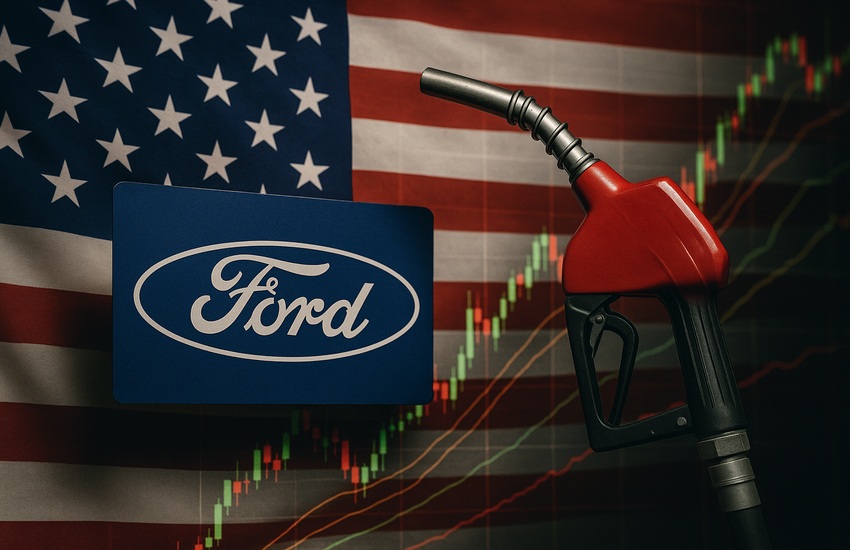
Ford shares climbed this week as a policy change out of Washington set the tone for the automaker’s next chapter. The stock moved higher after former President Donald Trump announced a rollback of Corporate Average Fuel Economy (CAFE) standards—rules that have long pushed carmakers toward electric vehicles and higher compliance costs. Ford, which builds more vehicles in the U.S. than any other major automaker, stands to gain significantly.
The company has also been vocal about the challenges of selling EVs in the U.S. market, where adoption has plateaued and tax credits have evaporated. Now, with the weight of federal mandates easing and tariffs being rebalanced, Ford is looking to refocus on what it does best: gasoline and hybrid trucks. Add in CEO Jim Farley’s front-row presence at the White House, and you have a clear reason why Ford benefits from Trump policy is becoming a high-ranking investor keyword. Let’s break down why this all matters.
Policy Tailwinds: Trump’s Rollback Of CAFE Standards Reshapes Ford’s Cost Outlook
The most direct way Ford benefits from Trump policy is through a reduced regulatory burden. Under the old CAFE rules, automakers had to improve fuel economy by nearly 5% annually. That meant reengineering vehicles, boosting battery spending, and relying heavily on the sale of zero-emission cars—even if demand wasn’t there. Now, the new proposal calls for annual efficiency gains of just 0.3% to 0.5% through 2031.
This matters because it gives Ford breathing room. The company can now build more of its high-margin gasoline and hybrid trucks without facing the same compliance penalties. CFO Sherry House disclosed that Ford had around $2.5 billion in emission credit purchase obligations, a large portion of which may no longer be necessary. These credits were essentially an insurance policy—expensive, and often unused, but critical under the old framework.
The rollback also aligns with Ford’s existing strengths. Trucks like the F-150 and Expedition dominate their segments, and with fewer regulatory limits on their production mix, Ford is free to optimize its sales for profitability—not just compliance. For cost-focused investors, this is a clear example of how Ford benefits from Trump policy and reclaims financial flexibility.
Ford Shares Jump As Investors Bet On Lower Regulatory Burdens
The stock market didn’t need much convincing. Ford shares rose 1.2% after the announcement, even as broader indexes posted modest gains. Investors saw the headline and read between the lines: this was a direct shift in Ford’s operating landscape. Regulatory overhang, once a consistent drag on forecasts, now looks lighter.
In its most recent earnings, Ford posted $2.6 billion in adjusted EBIT and $4.3 billion in free cash flow for Q3—even with a $700 million tariff headwind. Forward multiples are climbing accordingly. Ford’s NTM EV/EBIT now sits at 26.15x, while price-to-earnings (P/E) has moved up to 11.14x. These levels suggest that Wall Street is pricing in not just solid performance, but structural improvement.
It’s not just about lower compliance costs. There’s also a narrative shift. Investors who’ve long struggled to model Ford’s EV future can now focus on a more stable, ICE-and-hybrid-centered path. This shift is particularly resonant in an environment where EV demand is unpredictable and input costs remain volatile. For those tracking performance, Ford benefits from Trump policy is more than a headline—it’s now a pricing input.
Leadership Influence: CEO Jim Farley’s Direct Engagement With The White House Signals Alignment
In politics, presence matters. That’s why CEO Jim Farley’s appearance at the White House alongside President Trump wasn’t just symbolic—it was strategic. He didn’t just send a tweet. He stood beside the President and voiced support for the new emissions policy, describing it as a victory for common sense and affordability.
This kind of engagement tells investors two things. First, Ford is no longer sitting on the sidelines of regulatory change. It’s actively shaping the environment it operates in. Second, Ford’s leadership is signaling a full pivot—moving away from chasing EV targets set by regulators and toward making what American consumers are actually buying: trucks, SUVs, and hybrids.
Farley’s policy engagement also scored Ford a few immediate wins. For instance, new tariff structures now reward domestic manufacturing—something Ford already does at scale. Tariffs on imported heavy-duty trucks, which once gave foreign competitors an edge, have been raised. That levels the playing field and reinforces why Ford benefits from Trump policy across multiple angles—not just fuel efficiency.
This kind of executive-level engagement doesn’t guarantee future policy wins, but it’s a notable shift in tone and posture. Investors see a CEO who is not only navigating uncertainty but helping to shape it.
Strategic Repositioning: Ford’s Shift From EV Ambitions To Gasoline-Optimized Profitability
Ford’s EV business has been struggling. Model e, the division housing its electric ambitions, posted a $3.6 billion loss year-to-date. With the U.S. EV market stuck around 5% adoption and federal tax credits gone, Ford has started cutting back. Battery capacity plans are down 35%, and an earlier three-row SUV EV program has been scrapped.
Instead, the company is doubling down on what works. The hybrid F-150 remains a leader in its category, and SUVs like the Bronco and Expedition are gaining share—particularly in premium trims. Ford’s next big thing, a universal EV platform (UEV) priced around $30K, won’t hit production until 2027. Until then, gasoline and hybrid vehicles are taking center stage.
This strategic reset is directly enabled by the CAFE rollback. Without being forced to overproduce EVs, Ford can allocate capital more efficiently. It also reduces the pressure to discount electric models just to meet quotas. While this means slower EV rollout, it also means healthier margins and more predictable cash flows.
In short, Ford benefits from Trump policy by gaining permission to play its own game, on its own timeline. And in today’s capital markets, predictability often trumps hype.
Final Thoughts: Fuel Rules Lift Ford, But Valuation Reflects High Hopes
Ford’s rally following the CAFE rollback is about more than politics. It’s about cost relief, product mix flexibility, and executive leadership aligning with policy realities. The company is shifting away from an aggressive EV buildout and refocusing on the segments where it already leads. It’s also improving its ability to manage tariffs, emissions, and production planning—all while simplifying its capital commitments.
However, the market is no longer treating Ford as a turnaround story. Its LTM EV/EBIT sits at 36.72x, and forward multiples are rich compared to historical norms. The P/E ratio at 11.19x is near a two-year high. This suggests the good news is, to a degree, already priced in.
Investors will want to watch whether the policy tailwinds translate into sustained margin gains. If hybrids and ICE vehicles can remain profitable without compliance penalties, Ford could deliver steady earnings. But the risks remain—EV demand, supply chain pressures, and regulatory uncertainty beyond 2025 could still disrupt the picture.
For now, though, it’s clear that Ford benefits from Trump policy in ways both tangible and strategic. The question is how long the road stays clear.
Disclaimer: We do not hold any positions in the above stock(s). Read our full disclaimer here.