
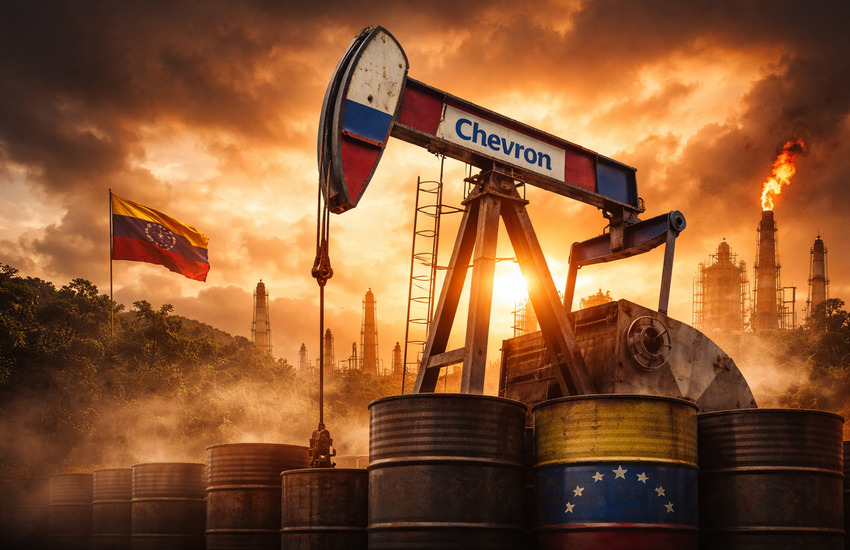
Chevron’s (NYSE:CVX) century-long presence in Venezuela is turning into a high-stakes test of geopolitics, oil strategy, and corporate resilience. As the U.S. government doubled down on sanctions targeting the Maduro regime, Chevron aligned closely with the Trump administration to remain the last major American oil company with operations in the country. CEO Mike Wirth has played a careful long game, using diplomatic leverage and legal maneuvering to secure what he sees as a “catbird seat” over some of the world’s richest oil reserves. Despite legal risks, reputational backlash, and political volatility, Chevron’s presence is being framed as a strategic counterweight to Chinese and Russian influence in Latin America. The question now is whether the company’s persistence will pay off if Venezuela transitions to a more open political regime. Or whether the legal and geopolitical cost will outweigh the prize.
U.S. Sanctions Architecture & License Durability
Chevron’s Venezuela strategy hinges on the durability of its U.S. license, which permits limited joint operations with PdVSA, Venezuela’s state oil company. This license, granted and modified multiple times by the U.S. Treasury’s Office of Foreign Assets Control (OFAC), is what separates Chevron from peers like Exxon and Conoco, who exited Venezuela after asset nationalizations. But make no mistake: it’s fragile. The license depends on the whims of U.S. foreign policy, which has swung sharply under different administrations.
The Trump administration’s 2025 re-election brought renewed focus on Venezuela, including blockades of sanctioned tankers and a dramatic naval buildup in the Caribbean. Chevron, however, received carve-outs that allowed it to continue operations under strict conditions—no cash payments to the Maduro regime, oil shipments tightly monitored, and joint-venture profits partially redirected. Yet even with these protections, compliance is a tightrope walk. Any breach, perceived or real, could result in revoked access.
The bigger issue is that “limited” doesn’t mean inconsequential. Chevron still ships around a third of Venezuela’s output and retains operational control in some joint ventures. The ability to maintain even partial flows under sanctions gives Chevron a unique position not just in Venezuela but in the broader conversation about U.S. energy diplomacy. “Chevron Venezuela oil investment” isn’t just a business headline—it’s now policy shorthand.
Trump Administration Alignment & Chevron’s Washington Leverage
Mike Wirth has invested as much in Washington as he has in Venezuela’s oilfields. His relationship with former President Trump, now back in office, has been pivotal. Wirth was among the few CEOs with direct access to Trump during energy policy briefings. Chevron also donated significantly more than rivals to Trump’s inaugural committee, underscoring the strategic value of political access.
This alignment paid off. While rivals like Repsol, ENI, and Shell saw their Venezuelan projects curtailed or paused, Chevron received continued, albeit narrowed, permissions. The Trump administration treated Chevron as a stabilizing force—an American anchor in a zone where China and Russia have made aggressive moves. Wirth further positioned the company as a key actor in a future democratic Venezuela, hoping to outlast Maduro and reap the rewards of early commitment.
But there are risks to this cozy dynamic. Chevron’s perceived closeness to Trump could be a liability if U.S. political power shifts again. More importantly, the notion of Chevron as a strategic tool raises legal questions under international norms and opens the door to retaliation from Maduro’s allies. Still, the “Chevron Venezuela oil investment” remains a live test case in how companies lobby for geopolitical advantage while operating in sanctioned territories.
On-The-Ground Operating Reality With PdVSA
Operating in Venezuela isn’t just a policy issue. It’s a logistical, legal, and operational challenge. Chevron’s joint ventures with PdVSA are fraught with complexity. Half the oil produced goes to the Venezuelan government under existing terms, raising questions about indirect support to a sanctioned regime.
Moreover, Chevron is responsible for navigating everything from crude transport under blockade to securing parts for aging infrastructure under import restrictions. The risk of sanctions blowback is real. Any perceived deviation from the license’s narrow scope could invite scrutiny from regulators, activists, or even competitors.
Still, being on the ground gives Chevron a front-row seat to any changes. It employs about 3,000 people locally and maintains production levels that, while small globally, are vital regionally. For Chevron, the ability to say, “We never left,” could be its strongest card if or when Venezuela reopens. But that same continuity is a double-edged sword. The reputational cost of doing business with an authoritarian regime could linger, especially if human rights violations remain unaddressed.
“Chevron Venezuela oil investment” continues to be shaped by day-to-day operational decisions. Every barrel moved, contract signed, and JV renegotiated feeds into a broader narrative that is being watched not just by Wall Street, but by Washington and Caracas alike.
Venezuela Political Endgame & The “Option Value” Of Being First In Line
Ultimately, Chevron’s bet comes down to one big question: what happens after Maduro? Venezuela’s democratic movement, led by figures like María Corina Machado, has signaled that Chevron’s presence, while controversial, could be key to rebuilding the oil sector. Even opposition figures acknowledge that Chevron’s technical expertise and capital will be essential to lifting output from today’s 900,000 barrels a day to multi-million-barrel levels.
That’s the option value. By staying in, Chevron positions itself to scale quickly if sanctions are lifted or if a new regime takes power. It also has contractual claims that could be honored more readily than claims by companies that left. But there’s no guarantee. A power vacuum or contested transition could lead to nationalizations, civil unrest, or international legal disputes over legacy agreements.
Chevron hasn’t engaged directly with the democratic opposition, keeping its bets hedged. But make no mistake: if a new order takes hold, being first in line could mean billions in long-term upside. Or it could mean renegotiating everything from scratch amid political chaos.
In this context, the “Chevron Venezuela oil investment” is not just about barrels—it’s about timing, diplomacy, and risk tolerance in one of the world’s most volatile petrostates.
Conclusion: The Prize, the Politics, and the Risk
Chevron’s long game in Venezuela is a masterclass in geopolitical risk-taking. The alignment with the Trump administration has granted it operational continuity when few others have remained. Its “catbird seat” over Venezuela’s oil reserves could unlock future value if the country stabilizes and opens to Western capital. But the legal, reputational, and political risks are substantial and still unresolved.
From a valuation perspective, Chevron currently trades at LTM EV/EBITDA of 14.75x and a P/E of 22.97x. Its price-to-sales multiple has come down to 2.43x, reflecting market caution. While not cheap, these levels suggest that investors are pricing in both the upside from global projects and the uncertainty embedded in bets like Venezuela.
As the “Chevron Venezuela oil investment” plays out, its outcome could set a precedent for how U.S. companies operate under sanctions, influence policy, and position themselves for geopolitical resets. The oil is there. The question is whether Chevron will still be in position when the doors fully reopen.
Disclaimer: We do not hold any positions in the above stock(s). Read our full disclaimer here.