

Continue Reading With Our 7-Day Free Trial
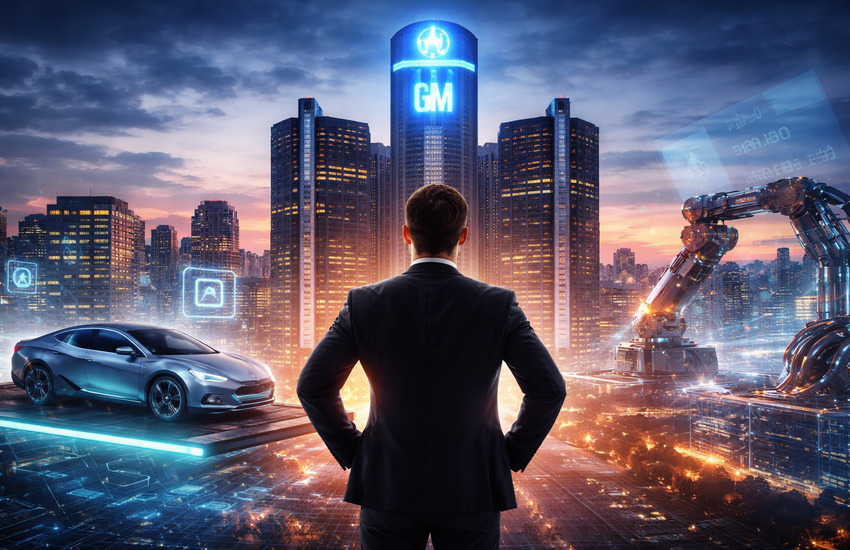
Sterling Anderson’s journey from clashing with Elon Musk to reshaping General Motors (NYSE:GM) may be one of the most unexpected executive arcs in recent auto industry history. Once a Tesla Autopilot leader and co-founder of the autonomous trucking company Aurora, Anderson joined GM in June 2025 as Chief Product Officer. What seemed like a puzzling career move at the time has since evolved into one of the most intriguing leadership shifts in the industry. Anderson is not just another Silicon Valley transplant—he now leads GM’s entire vehicle portfolio, from internal combustion to EVs, and oversees software, AI, and autonomy initiatives.
His expanding mandate is sparking conversation inside GM and on Wall Street: Could he be next in line after CEO Mary Barra? And more critically—can GM, under Anderson’s watch, finally pull off a software-and-autonomy strategy that has long remained aspirational? The “Sterling Anderson GM Leadership” question isn’t just about succession. It’s about whether GM can actually pivot from legacy automaker to tech-first mobility company.
Mandate Expansion & CEO-Succession Signaling
When Sterling Anderson joined GM, few expected he would quickly become central to the company’s tech revival—and a credible CEO candidate. But his remit keeps growing. After taking on global product development, Anderson now oversees GM’s AI initiatives and software integration across all vehicle platforms. His inclusion on GM’s executive strategy team—a tight inner circle typically reserved for long-tenured insiders—sends a clear signal from Mary Barra and the board: his leadership is more than a technical play.
This move isn’t just about org charts. It reopens the conversation about CEO succession, which has been messy in recent years. Several would-be heirs, from Dan Ammann to Dhivya Suryadevara, have exited stage left. Mark Reuss and CFO Paul Jacobson remain contenders, but Anderson’s elevation adds fresh intrigue. His outsider status might actually be an asset, particularly in a company desperate to show it can innovate. “Sterling Anderson GM Leadership” has gone from rumor to real boardroom topic—and it’s reshaping how GM is positioning its post-Barra future.
Software & Autonomy Roadmap Credibility
Anderson is now in charge of executing GM’s latest big tech promise: delivering “eyes-off” autonomy in an electric Cadillac SUV by 2028. On paper, it’s ambitious. GM has spent over $10 billion on Cruise, its now-paused robotaxi program, without bringing a truly driverless product to market. By contrast, Anderson built and shipped functioning autonomous trucks at Aurora—and that track record is what GM is now betting on.
He’s bringing Cruise veterans back into the fold, attempting to salvage institutional knowledge, and unify GM’s fragmented autonomy strategy under a singular vision. But credibility still hinges on proof. That means functioning software-defined vehicles, cleaner OTA updates, and real-world demos that don’t just impress tech insiders but convince investors and regulators alike. Integration with Super Cruise and OnStar will be closely watched for execution fidelity. Unless GM can hit real milestones in 2026 and 2027, even Anderson’s credibility could wear thin. “Sterling Anderson GM Leadership” isn’t just a bet on who leads—it’s a test of whether GM can keep any software promises.
EV Economics & Product Portfolio Execution
Even as GM proclaims EVs are its “North Star,” economic reality is forcing painful recalibrations. The company took a $1.6 billion impairment charge this year, citing low EV demand, rising costs, and battery inefficiencies. It shelved the BrightDrop commercial van program and is converting its Orion Assembly plant back to ICE production by 2027. All this lands squarely on Anderson’s desk as the new product chief.
Despite setbacks, Anderson is doubling down on long-term EV viability. That includes work on lower-cost LMR battery chemistries and a streamlined architecture to reduce per-unit complexity. GM sold 67,000 EVs in Q3 2025—good enough for a #2 market share in the U.S.—but future success depends on margins, not market share. The company says it will “build to demand,” avoiding the industry’s incentive wars. Investors will be watching for disciplined product launches and gross margin improvement. “Sterling Anderson GM Leadership” is only credible if EV economics stop bleeding red ink.
Organizational Stability & Culture
GM has long struggled to retain high-profile tech talent. Anderson’s arrival is promising—but it triggered another wave of exits, including the company’s software engineering chief. That’s the paradox GM must resolve: integrating Silicon Valley speed into a Detroit operating model known for its bureaucracy.
Internally, Anderson has defended GM’s controversial employee ranking system, drawing mixed reviews. He’s also bringing back Cruise personnel—a risky move, given the unit’s safety issues and regulatory overhang. Still, employees in GM’s autonomy division reportedly welcomed his leadership, hoping for continuity and renewed focus. Whether Anderson can build a durable team around him remains uncertain. The past decade is littered with short stints by tech execs. GM doesn’t just need a new brain—it needs an entirely new nervous system.
How the culture evolves under Anderson’s influence will determine execution. “Sterling Anderson GM Leadership” isn’t just about what he builds—it’s about whether others stick around long enough to help build it.
Conclusion: A High-Wire Act With Deep Stakes
Sterling Anderson’s rise inside General Motors is bold, fast, and loaded with implications. He brings technical legitimacy at a time when GM’s autonomy and software strategy desperately need it. His expanding influence, product control, and board-level proximity make him a natural successor to Mary Barra. Yet this also magnifies the pressure: can GM finally deliver on a tech-forward vision that has remained just that—a vision?
On the positive side, Anderson is rebuilding credibility with clear targets and fresh leadership. He’s cleaning up the EV strategy and pushing for architectural improvements. On the downside, GM’s past struggles with talent retention, tech integration, and execution consistency remain unsolved.
From a valuation standpoint, GM trades at a modest 17.3x trailing P/E and 20.5x LTM EV/EBIT, with a levered free cash flow yield of 11.6%. Those are conservative multiples given the transformation narrative—but investors will need more than just a compelling story. Execution will be key.
The “Sterling Anderson GM Leadership” arc might just redefine what comes next for one of America’s most iconic companies. But the outcome, as ever with GM, will depend on more than just who’s in the driver’s seat.
Disclaimer: We do not hold any positions in the above stock(s). Read our full disclaimer here.