

Continue Reading With Our 7-Day Free Trial
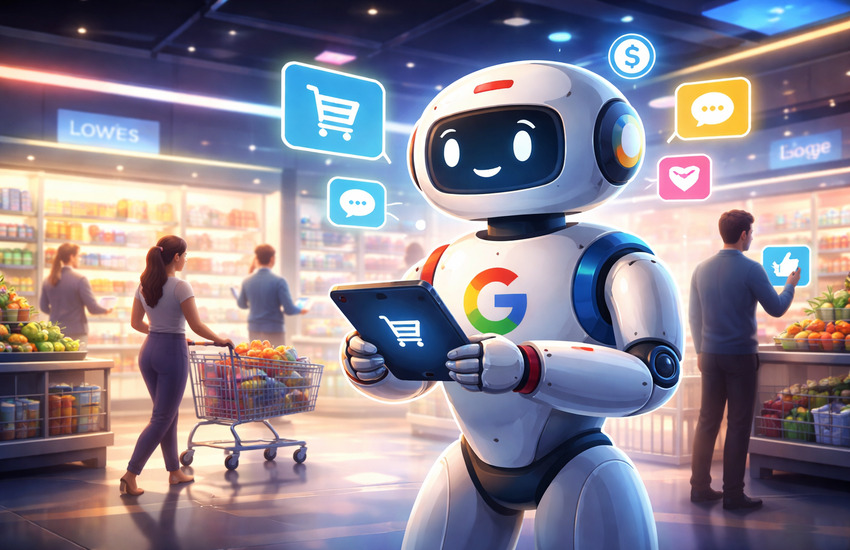
Google (NASDAQ:GOOGL) is doubling down on the future of shopping—and it involves bots doing the buying. Last week, the company launched “Gemini Enterprise for Customer Experience,” a suite of AI agent tools designed specifically for retailers. These AI agents can help shoppers discover products, offer customer support, and even place orders—all through natural language interactions. Think of them as ChatGPT, but trained to help you buy groceries, pizza, or paint. Retailers like Kroger, Lowe’s, and Papa Johns are already piloting these tools, signaling serious momentum behind what some are calling “agentic commerce.”
The move also sharpens the competitive race with Microsoft (Copilot) and OpenAI (ChatGPT + Instant Checkout), who are embedding retail directly into AI assistants. But for retailers, the choice between building their own AI agents or plugging into third-party platforms like Gemini or ChatGPT isn’t just about tech. It’s a strategic trade-off: control vs. convenience, loyalty vs. scale, data ownership vs. vendor risk. As AI agents become the new storefront, the stakes are rising fast.
Retailers Build Owned Agents To Retain Loyalty, Basket Size & Margins
Retailers are wary of handing over their customer relationships to external chatbots. By building their own AI agents with tools like Google’s Gemini Enterprise, companies like Kroger and Lowe’s are betting they can deliver a personalized experience while keeping control over user data, product discovery, and checkout flows.
Yael Cosset, Kroger’s Chief Digital Officer, explained their pilot AI shopping agent this way: “Things are moving at a pace that if you’re not already deep into [AI agents], you’re probably creating a competitive barrier or disadvantage.” Kroger’s agent lives inside their mobile app and personalizes experiences based on user behavior, flavor preferences, price sensitivity, and even time constraints. The goal? Keep users inside Kroger’s ecosystem and prevent leakage to third-party discovery tools like ChatGPT or Copilot.
Lowe’s is taking a similar approach. Their AI assistant, called “Mylow,” is built on Google’s backend and has more than doubled online conversion rates. For a category like home improvement—where margins and upselling matter—owning the shopping experience is key. When retailers use their own AI agents, they can guide customers through bundled purchases, offer add-ons, and maintain a branded interaction. That’s hard to do when your customer is chatting through a generic AI interface owned by someone else.
Google AI shopping agents offer a middle path: letting retailers build “owned” AI experiences while tapping into Google’s infrastructure, models, and tooling. The control may not be absolute, but it’s a step above handing the reins to an outside platform. And in this emerging era of agentic commerce, control might be the most valuable currency.
Google Productizes Agent Infrastructure, Reducing Time-To-Market & Cost
Building AI agents from scratch is no small feat. It requires access to infrastructure, large language models (LLMs), customer data integration, natural language understanding, and backend fulfillment support. For most retailers, especially mid-sized chains, that’s a non-starter. That’s why Google’s launch of Gemini Enterprise for Customer Experience matters.
The product offers prebuilt agents optimized for domains like food ordering, customer support, and shopping assistance. Papa Johns, which doesn’t build its own AI models, is using Google’s food-ordering agent to allow customers to place orders via voice, photo, or chatbot. According to Kevin Vasconi, Chief Digital Officer, “I don’t want to be an AI expert in terms of building the agents. I want to be an AI expert in terms of, ‘How do I use the agents?’”
By reducing the technical lift, Google AI shopping agents make it economically viable for a broader set of retailers to adopt agentic commerce. And because they’re built on Google Cloud’s infrastructure and its proprietary AI models like Gemini 2.5, the performance is competitive out of the box. Agents understand context, respond fluidly, and are increasingly multimodal—responding to text, voice, and images.
It’s also fast. Google said over 700 companies have already adopted Gemini Enterprise agents. With off-the-shelf capabilities and enterprise APIs, the time-to-market has gone from quarters to weeks. In fast-moving retail categories, that speed matters. But the trade-off is flexibility: what you gain in speed and ease, you may lose in customization and strategic independence.
Platform Checkout Features Shift Discovery To Chatbots, Threatening Retailer Ad Revenue
OpenAI’s Instant Checkout and Microsoft’s Copilot are moving fast into agentic shopping. These tools let users buy directly from within the chatbot interface, turning the AI into a full-stack storefront. That sounds efficient—until you realize what it means for brands and retailers.
If more customers discover products through third-party chatbots, the value of retailer-owned websites and marketing channels declines. Retailers lose the chance to upsell, cross-sell, or collect first-party data. And as Alphabet itself noted in its Q3 earnings call, embedding products in third-party agents “risks hurting customer loyalty and could take away add-on sale opportunities. It could also dent ad revenue.”
That’s a serious concern. Many retailers rely heavily on on-site search, sponsored listings, and personalized recommendations to drive incremental purchases. If discovery shifts to third-party agents, that advertising surface disappears. Retail media networks—a $45B+ industry—depend on traffic staying inside the retailer ecosystem.
By enabling branded AI agents, Google AI shopping agents let retailers keep product discovery and checkout within their own platforms. This protects not just revenue per user, but also data integrity and loyalty loops. But it’s a delicate balance: plug into Google too deeply, and you risk recreating the same dependency problem you were trying to avoid.
Data Access, Governance & Model Churn Create Lock-In & Quality Risk
Even as Google AI shopping agents promise speed and scale, they introduce a new layer of platform dependency. Retailers must integrate their data with Google’s infrastructure—product catalogs, inventory systems, user preferences—to get the full benefit of the AI assistant. But in doing so, they tether themselves to the model’s behavior, evolution, and black-box logic.
One executive put it plainly: “The tech we build can become outdated in two weeks.” That’s the risk of rapid AI iteration. Today’s best practices can become tomorrow’s legacy, especially as models like Gemini 3.0 or future Google updates change how agents behave. Retailers risk mismatches between their business logic and the agent’s decision-making—especially if they don’t control the full stack.
Data governance also matters. If customer and behavior data is processed within Google’s ecosystem, what guarantees do retailers have around exclusivity, privacy, or reuse? Alphabet (NASDAQ:GOOGL) insists it allows partners to retain ownership of their data. But in a competitive landscape where every click, dwell time, and cart abandonment signal has value, the trust but verify principle applies.
Finally, model churn poses operational risk. If a vendor like Google deprecates a model or shifts strategic focus, retailers are left scrambling. And retraining, reconfiguring, or migrating agents is non-trivial. So while the upfront benefits of Google AI shopping agents are real, the long-term cost may be entrenchment in a platform you can’t easily leave.
Final Thoughts: Powerful Tools, But Strategic Trade-Offs
Google’s (NASDAQ:GOOGL) move into retail agents with Gemini Enterprise is well-timed and well-structured. Retailers want AI capabilities, but most lack the tools to build them from scratch. Google AI shopping agents lower that barrier. They offer discovery, support, and ordering tools that can drive conversion, reduce friction, and improve personalization.
At the same time, they intensify the AI arms race with OpenAI and Microsoft, and force retailers into critical choices about control, data, and platform lock-in. Kroger and Lowe’s are betting that owned agents are worth the effort. Papa Johns is betting that convenience outweighs customization.
Investors should note: Google is pricing in a lot of AI optimism. As of January 2026, its LTM valuation multiples are lofty—31x EBIT, 26.9x EBITDA, and a 1.8% FCF yield. That suggests the market already expects success from initiatives like Gemini Enterprise. Whether that plays out depends not just on Google, but on whether retailers choose to build their own agents or let Google do it for them.
Disclaimer: We do not hold any positions in the above stock(s). Read our full disclaimer here.