


Continue Reading With Our 7-Day Free Trial
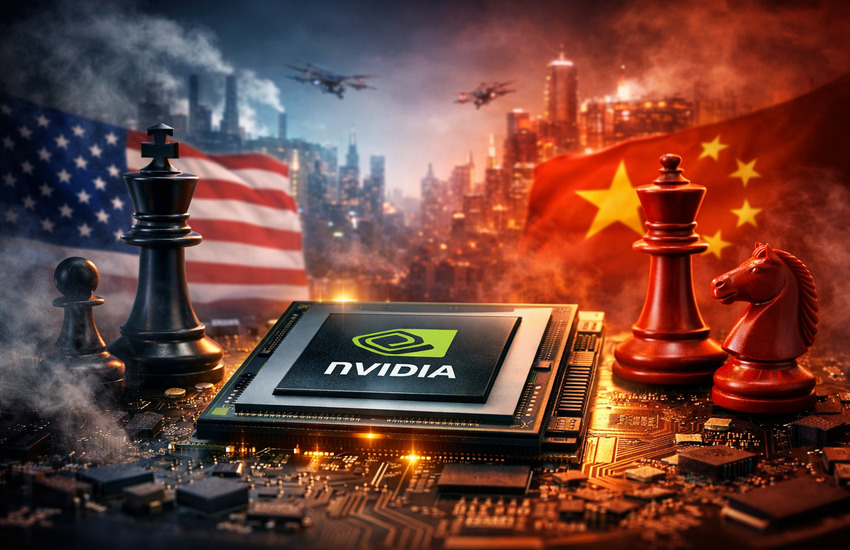
After months of lobbying, Nvidia Corp (NASDAQ:NVDA) finally received U.S. approval to resume selling its H200 artificial intelligence chips to China. On the surface, the decision appears simple: reopen access to the world’s largest chip market and restore a revenue stream interrupted by export controls. Markets initially treated the announcement as a relief event.
But the reality is more complex. The approval arrived with political discretion, regulatory friction, and strategic tension baked in. Both Washington and Beijing retain tools to slow, limit, or reshape Nvidia’s access. That uncertainty affects revenue visibility, competitive positioning, and the long-term balance of power between U.S. and Chinese AI ecosystems.
US Export Policy Whiplash
The approval to sell H200 chips did not come as a blanket green light. It arrived through a case-by-case licensing framework involving the U.S. Departments of Commerce, State, Defense, and Energy. Commerce completed its analysis. State did not. That divergence stalled licenses and froze customer orders despite public authorization.
This structure makes execution fragile. Export controls now function less like fixed rules and more like discretionary policy levers. A shift in political sentiment or security concerns can tighten access quickly. For Nvidia, supply planning and customer commitments now depend on interagency judgment rather than demand alone.
The risk no one’s modeling yet is how long partial approval can persist before it starts reshaping customer behavior and internal capital allocation at Nvidia, turning regulatory uncertainty into a structural constraint rather than a temporary disruption. Over time, customers delay infrastructure decisions and Nvidia is forced to plan conservatively, even with formal approval in place.
China’s Conditional Access & Hidden Controls
Beijing’s response has been just as cautious. Publicly, China has criticized U.S. export controls as discriminatory. Privately, it has imposed its own constraints. Authorities approved limited imports of H200 chips, but restricted their use in sensitive sectors. Military, government, and critical infrastructure deployments remain tightly controlled.
This creates a narrow channel for Nvidia. Only select commercial buyers qualify, and purchases often come with conditions. Reports suggest Chinese regulators are encouraging buyers of U.S. chips to also purchase domestically produced alternatives. That approach protects local suppliers while limiting dependence on foreign technology.
Trust remains an issue. China is wary of embedding American hardware deeply into strategic systems. That concern led Beijing to restrict Nvidia’s earlier H20 chip in 2025. The same logic applies to the H200. China wants AI progress, but not long-term reliance.
Nvidia’s Revenue Opportunity vs Execution Risk
The revenue opportunity is real. China represents roughly one-third of global semiconductor demand. Nvidia CEO Jensen Huang has highlighted the scale of future Chinese AI spending. Even partial access would matter.
Execution risk, however, is growing. Chinese customers are waiting for license clarity and final conditions. Orders have not converted into firm commitments. Nvidia has responded by requiring full upfront payment with no refunds or configuration changes. That shifts risk away from Nvidia, but also discourages cautious buyers.
Timing adds another layer. The H200 is no longer Nvidia’s most advanced chip. While still competitive, it trails newer platforms already shipping elsewhere. Nvidia must sell enough volume to matter without undermining its broader product roadmap.
The Acceleration Of China’s Domestic AI Chip Rivals
The most durable impact of restricted access may be strategic. Every delay reinforces China’s push for self-sufficiency. Domestic chipmakers are gaining momentum, capital, and policy support. Companies like Huawei Technologies, Cambricon Technologies, and Moore Threads Technology are direct beneficiaries.
These chips still lag Nvidia on raw performance. But Chinese AI developers have shown they can achieve competitive results with less compute through efficient architectures and software optimization. Parity is not required to reduce dependence.
Over time, limited access accelerates substitution. Once domestic ecosystems mature, regaining lost share becomes far harder, regardless of future policy shifts.
Final Thoughts: A Strategic Re-Entry With Structural Limits
Nvidia’s return to China after approval to sell H200 chips is neither a clear win nor a decisive setback. It preserves market presence and slows immediate displacement, but it does not restore certainty. Both Washington and Beijing retain powerful levers over scale, timing, and usage.
From a revenue standpoint, China now looks like an option rather than a foundation. Strategically, the move buys time while competitive dynamics continue to shift. Valuation sharpens the trade-off. Nvidia trades around 24x LTM revenue, roughly 40x LTM EBIT, and about 46x LTM earnings. Those multiples reflect expectations of sustained leadership. China supports that story, but no longer anchors it.
Disclaimer: We do not hold any positions in the above stock(s). Read our full disclaimer here.