

Continue Reading With Our 7-Day Free Trial
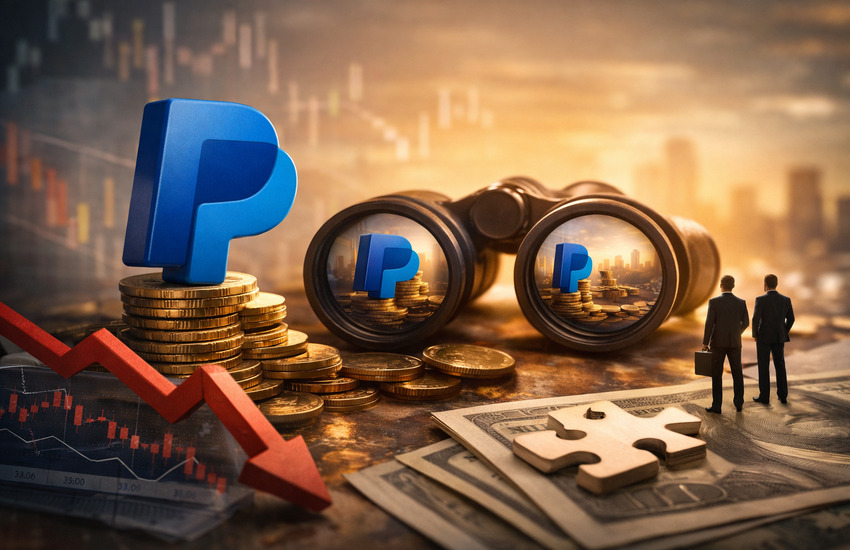
PayPal (NASDAQ:PYPL) ripped higher on Feb. 23, 2026, after Bloomberg reported early-stage takeover interest from potential suitors. The move came after a rough year, with the stock down about 44% before the bounce. The rumor mill said some parties are sniffing around the whole company, while others prefer specific pieces. That matters, because PayPal is not just one business anymore. It is a bundle of checkout, Venmo, merchant processing, credit, and newer bets like “agentic” commerce. The timing also wasn’t random. PayPal just posted a weak Q4, with branded checkout slowing hard and 2026 guidance coming in soft. Then came a leadership shakeup, with Enrique Lores set to become CEO on March 1. Investors now have a clear question. Is this a deal moment, a fix-it moment, or both?
Takeover Chatter & Valuation Reset
A stock doesn’t need to be “cheap” to attract buyers. It needs to be cheaper than it used to be. That is the setup PayPal walked into. The shares had fallen for a year, and sentiment was already fragile. Bloomberg’s report said the company had met with banks after receiving unsolicited interest. It also suggested a split. One large rival was said to be studying a full-company purchase. Others were said to be looking at assets. That range is important. A whole-company deal needs a buyer willing to underwrite the turnaround. An asset deal can focus on the parts that look healthier today.
The “parts versus whole” question is not academic here. PayPal has big components with different stories. Venmo is growing, and it is more monetized than it used to be. Enterprise Payments has been improving profitability and adding paid services. Buy Now, Pay Later keeps scaling. Meanwhile, online branded checkout is the headache. That mix can invite different bidders. A strategic buyer might want checkout scale and consumer relationships. A financial buyer might prefer a carve-out that can be run leaner. And a competitor might want specific rails, merchants, or distribution.
The other magnet is valuation compression. Based on the figures you provided dated Feb. 23, 2026, PayPal was trading around 1.28x LTM EV/Revenue and about 6.38x LTM EV/EBITDA. LTM P/E was about 8.14x. Those are far below where the stock sat earlier in 2024 and 2025. A lower multiple can make deal math easier. It can also make “asset math” easier. Buyers can argue that separate pieces deserve higher multiples than the bundle. That does not mean a deal happens. The report itself said talks were preliminary. Still, the reset changes the conversation.
Earnings & Guidance Credibility Gap
The buyout talk landed on top of a fresh bruise. PayPal’s Q4 results highlighted a real slowdown in the core branded checkout engine. Management said online branded checkout TPV grew 1% on a currency-neutral basis in Q4. That was down from 5% in Q3. They also said the deceleration was larger than expected. They pointed to three buckets. U.S. retail weakness was one. Germany was another. Cooling in travel, ticketing, crypto, and gaming was the third. Then they added a fourth, quieter bucket. Execution issues made the pressure worse.
Guidance is where trust often gets tested. For 2026, PayPal guided to branded checkout growth that was only “slightly positive to low-single digits.” That is not the kind of line that calms investors. It also matters because management said branded checkout represents over half of profit dollars. On the profit side, they framed 2026 as a transition year. They expected targeted growth investments to create about a 3-point headwind to transaction margin dollar growth. They also planned about $6 billion of share repurchases, plus a dividend that had just started. The message was clear. Spend more now, and accept muted near-term optics.
There was another credibility hit. PayPal backed away from the specific multi-year outlook shared at the prior Investor Day. Management said the e-commerce environment was tougher than expected. They also said the rollout and merchant adoption pace did not match assumptions. So they chose to guide one year at a time. That can be reasonable. It also raises uncertainty. For investors, the near-term watch list is simple. Do branded checkout trends stabilize quarter by quarter? Does guidance get less squishy? And do the “investment headwinds” show up as measurable traction, not just new slide titles?
Competitive Pressure On Branded Checkout
Branded checkout is PayPal’s classic “button at checkout” business. It is also where competitive pressure shows up most visibly. Management described two drivers that sound mundane, but matter a lot. One is “presentment,” meaning where PayPal appears on the page. Another is friction, meaning how easy it is to authenticate and pay. They said PayPal performs far better when it is placed above competitors. They also said upstream messaging for Buy Now, Pay Later can lift volume. The catch is that PayPal does not control those levers. Merchants do. And merchants have many priorities.
The company also admitted a key go-to-market mistake. They expected merchants to adopt at scale because conversion improves. That assumption did not hold, especially for large merchants. Big merchants want hands-on support, custom integration, and clear economics. PayPal said it had operational and deployment issues that slowed progress. It also said it sometimes rolled out the redesigned checkout without biometric enablement. That matters because biometrics and passkeys can cut friction. Management claimed biometrics can amplify conversion lifts in testing, sometimes by multiple points, at complex merchants. But “in testing” is not the same as “everywhere.”
Competition is also not standing still. PayPal cited pressure in Germany from alternative payment methods. It pointed to macro softness too, but competition was part of the story. In the U.S., it noted a middle-income skew, which can be more sensitive to retail swings. PayPal’s plan for 2026 is built around three themes: experience, presentment, and selection. “Selection” is their word for giving consumers a reason to choose PayPal. That includes rewards, co-marketing, and loyalty. If this works, it should show up in checkout share, not just app engagement stats. Investors should watch merchant placements, adoption of the “target experience,” and whether branded checkout growth starts closing the gap with e-commerce.
Leadership Shakeup & Catalysts To Watch Next
Leadership changes tend to arrive when patience runs out. PayPal’s board appointed Enrique Lores as CEO effective March 1. Jamie Miller served as interim CEO during the transition. The company framed the change as execution-driven, not strategy-driven. That framing matters, because a new CEO can spook partners and employees. Management also said Enrique had been closely involved as board chair. They said he helped shape strategy and even reviewed the 2026 guidance. So the message was continuity on plan, with a faster clock and tighter discipline.
What does “execution” mean in PayPal’s own words? It meant moving too slowly on branded checkout deployments. It meant not focusing enough on the highest-impact merchants. It meant rolling out product changes without bundling biometrics. It also meant not winning enough on presentment. PayPal said strategic merchants represent about 25% of branded checkout volume today. It formed dedicated teams for those merchants in January. That is a very specific operating change. The company also talked about “tying economics to performance” in some cases. That hints at more incentive-based deals. Those can drive placement, but they can also pressure near-term margins.
There are also catalysts that are not purely “checkout.” Venmo revenue grew about 20% in 2025 to $1.7 billion, excluding interest income. Enterprise Payments improved profitability and expanded its value-added services bundle. BNPL TPV passed $40 billion in 2025, up more than 20%. PayPal also described early work in “agentic commerce,” with Store Sync connecting merchants to chat platforms. It said this is not expected to matter much in 2026, which is a useful expectation-setter. The near-term catalyst list is more grounded. Watch Q1 branded trends versus Q4. Watch biometric adoption progress. Watch PayPal Plus rollout timing and cohort results. And watch whether deal chatter becomes anything more than chatter.
Final Thoughts
PayPal’s Feb. 23 pop was a reminder that markets love optionality. A takeover rumor creates optionality fast. It also arrived when the stock was already priced for disappointment. The underlying story, though, is still about execution in branded checkout. Management has a plan, but 2026 guidance suggested only modest near-term improvement. The leadership change adds urgency, and it may also add disruption risk. Meanwhile, stronger pockets like Venmo and Enterprise Payments help cushion the model.
Valuation is the other side of the scale. On the LTM figures you shared as of Feb. 23, 2026, PayPal traded around 1.28x EV/Revenue, 6.38x EV/EBITDA, and about 8.14x P/E. Those are low versus the company’s own recent history in 2024 and 2025. Low multiples can reflect real problems. They can also reflect a “prove it” discount. What investors watch next is straightforward. Branded checkout needs clearer stabilization. Merchant placement wins need to show up in reported growth. And any deal talk needs to move from “interest” to “terms” before it deserves much weight.
Disclaimer: We do not hold any positions in the above stock(s). Read our full disclaimer here.