


Something unusual is happening on the internet. And if you blink, you might miss it.
For nearly three decades, the web has worked in a simple loop. You search for something. A website appears. You click. Ads follow. Then you buy something. That system built the modern internet. Google thrived on it. Retailers relied on it. And companies like Amazon (NASDAQ:AMZN) perfected it.
But artificial intelligence is quietly breaking that loop.
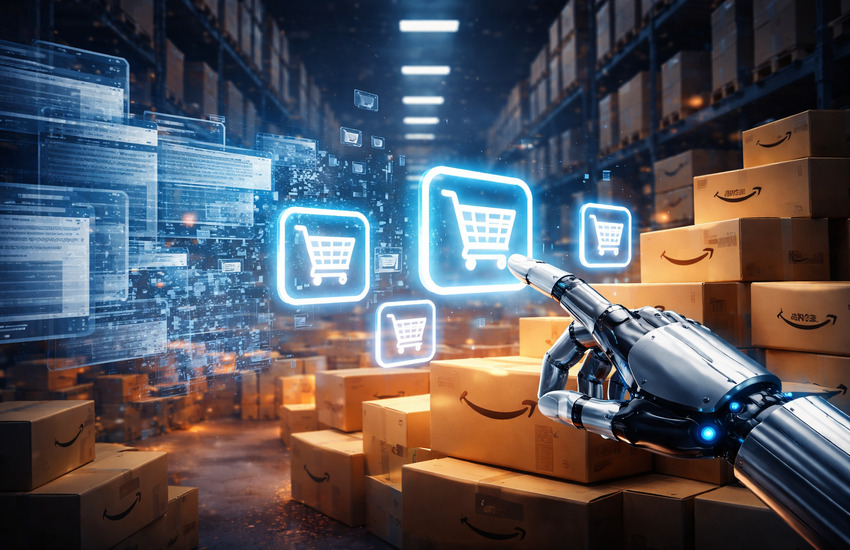
Instead of browsing websites, people increasingly ask AI assistants to do the work. The AI researches products, compares prices, and sometimes even completes purchases. The website becomes optional.
That shift may sound subtle. It isn’t.
Amazon’s recent legal fight with AI company Perplexity hints at a much bigger battle. It is not simply about data access or scraping rules. It is about who controls the next interface of the internet.
If AI agents become the front door to shopping, websites could slowly lose their central role. The question now is not whether this transition happens. The real question is who owns the new gateway.
AI Agents Are Compressing The Internet’s Shopping Funnel
For most of the internet’s life, the path to a purchase followed a simple funnel: a user performed a Google search, visited a website, browsed a product page, and then proceeded to checkout.
That funnel powered advertising, search engine optimization, and much of the digital economy.
AI agents change that structure almost overnight. Instead of visiting multiple websites, users can simply ask an assistant to handle the task. The AI collects product data, compares options, and presents a recommendation. In some cases, it completes the purchase automatically.
The result is a compressed funnel. The website disappears from the journey. A user asks a question. The AI returns a result. The transaction follows.
Amazon’s own executives have acknowledged this shift. During the company’s latest earnings call, CEO Andy Jassy said the primary way companies will get value from AI is through agents. These agents can operate autonomously and perform complex tasks with minimal user input.
This may sound like a technical detail. But the implication is larger. The internet’s main interface could shift from webpages to AI assistants.
If that happens, the value of being a destination website changes dramatically. Companies would instead compete to be recommended by the AI.
Amazon Is Building Its Own AI Interface Before Someone Else Does
Amazon clearly sees where this shift might lead. Rather than waiting for outside platforms to control the shopping experience, the company is building its own AI layer.
Its flagship experiment is an AI shopping assistant called Rufus. The assistant helps users research products, track prices, and answer detailed questions about items across the Amazon marketplace.
The adoption numbers are already notable. According to Amazon’s latest disclosures, more than 300 million customers used Rufus during 2025. Customers who use the assistant are about 60% more likely to complete a purchase.
Rufus does more than answer product questions. It can track price changes and automatically buy items when they reach a target price. Amazon is also experimenting with a feature called “Buy for Me,” which allows the assistant to purchase products from other websites on behalf of the user.
In other words, Amazon is preparing for a world where the assistant—not the website—drives the transaction.
This is a defensive move as much as an innovative one. If AI agents become the dominant interface for shopping, Amazon would prefer that interface to belong to Amazon.
Otherwise, the company risks losing direct access to customers.
The Real Battle Is Over Who Controls The Customer Interface
The tension between Amazon and emerging AI platforms reflects a deeper platform war.
If consumers begin shopping through AI assistants, the assistant effectively becomes the gatekeeper. It decides which products appear first. It decides which retailer gets the sale.
For Amazon, this scenario carries obvious risks. The company has spent decades building a direct relationship with customers through its website and mobile app. That relationship powers everything from Prime subscriptions to advertising revenue.
An outside AI agent could weaken that connection. Instead of visiting Amazon, a shopper might ask an AI assistant to find the best deal. The AI might send the order to Amazon. Or it might send it somewhere else.
This is why Amazon executives have discussed the role of “horizontal agents.” These are AI assistants that sit between consumers and retailers. They act as a middle layer between the customer and the store.
From Amazon’s perspective, that middle layer introduces friction. It also introduces competition for control of the customer experience.
Retailers have traditionally fought for traffic. In the AI era, they may instead fight for algorithmic preference.
The new question becomes simple: when an AI assistant makes a recommendation, whose product does it choose?
The Advertising Model Of The Web Faces A Quiet Disruption
The shift toward AI-driven shopping also threatens another pillar of the internet economy: advertising.
Retail media advertising has grown rapidly over the past decade. Amazon’s advertising division alone generated $21.3 billion in quarterly revenue in its latest report. That business relies heavily on shoppers browsing product listings, seeing sponsored placements, and clicking through recommendations.
AI agents operate differently.
An AI assistant rarely scrolls through ads or sponsored listings. Instead, it returns a direct answer. That answer may include a product recommendation, but it does not necessarily include advertising placements.
This dynamic could compress one of the fastest-growing segments of digital advertising. If fewer users browse product pages, retailers may lose some opportunities to display ads.
Amazon appears aware of this possibility. The company continues to expand its advertising tools and AI-driven marketing capabilities. It has introduced advertising agents that help brands design and optimize campaigns using Amazon’s data.
Yet the structural question remains. If shopping increasingly happens through AI assistants, the traditional advertising model tied to page views may gradually change.
The future of retail advertising could depend less on visibility and more on recommendation algorithms.
Final Thoughts
The debate around AI agents and shopping may still feel abstract. But the signals are becoming clearer. AI assistants are evolving from simple chat tools into autonomous agents that can research, compare, and purchase products.
Amazon is preparing for that shift. It is investing heavily in AI infrastructure through AWS, developing its own shopping assistant, and experimenting with agent-driven commerce. The company appears determined to remain close to the customer even if the interface changes.
From a valuation perspective, investors continue to assign a premium to Amazon’s scale and growth profile. As of March 2026, the company trades around 3.26× LTM enterprise value to revenue, 16.05× LTM EV/EBITDA, and roughly 29.66× LTM price-to-earnings. These multiples reflect expectations that Amazon can maintain strong growth in areas such as cloud computing, advertising, and AI-driven services.
Whether AI ultimately replaces the website as the internet’s primary interface remains uncertain. What seems clearer is that companies across the digital economy are preparing for that possibility.
Amazon’s latest moves suggest the company does not intend to watch that transformation from the sidelines. Instead, it appears focused on ensuring that if the website era fades, the next interface still runs through Amazon.
Disclaimer: We do not hold any positions in the above stock(s). Read our full disclaimer here.