


Continue Reading With Our 7-Day Free Trial
Meta Platforms (NASDAQ:META) just made the kind of acquisition that sounds small until you zoom out. The company acquired Assured Robot Intelligence, a humanoid robotics startup focused on helping robots understand, predict, and adapt to human behavior. On its own, that sounds like another AI tuck-in deal. Fine. Interesting. Maybe a little sci-fi.
But place it next to Mark Zuckerberg’s latest earnings-call language, and the story gets much bigger. Meta is not just talking about chatbots anymore. It is talking about personal agents, business agents, AI glasses, shopping assistants, visual understanding, and models that help people achieve goals throughout the day. Zuckerberg said Meta’s goal is to build agents that understand user goals and work “day and night” to help achieve them. That matters. A chatbot answers questions. An agent does things. A robot does things in the physical world.
The Robot Is Really The Agent
The easy version of this story is that Meta bought a humanoid robot startup. The better version is that Meta may be buying a missing piece of the agent stack. Meta does not need to become Boston Dynamics overnight. It also does not need to start shipping robot butlers with Instagram stickers. The near-term value is likely software: intelligence that helps machines understand people, spaces, intent, and messy real-world behavior.
That timing matters. On the latest call, Zuckerberg focused heavily on personal superintelligence. He framed Meta AI as more than an assistant. He described personal and business agents that can understand user goals and help act on them. That makes robotics feel less random. A chatbot answers. An agent does things. A robot does things in the physical world.
This is why the deal can matter even if Meta never sells a humanoid robot under its own brand. The company may care more about the “brain” than the body. Humanoid robots are expensive, difficult to manufacture, and hard to scale. But robotic intelligence can feed glasses, smart assistants, commerce tools, home devices, and future agent experiences. The deal is not proof Meta has a robotics business. It is evidence that Meta is studying the next interface.
The Metaverse Pivot Moves From Escape To Presence
For years, Meta’s futuristic pitch was built around the metaverse. You put on a headset, stepped into a virtual world, and showed up as an avatar. It was ambitious. It was also easy to mock. Wall Street saw Reality Labs losses. Consumers saw bulky headsets. The jokes practically wrote themselves.
The robotics angle flips that story. The metaverse was about escaping into a digital world. Robots are about bringing AI back into the real one. People may not want another virtual meeting room. But they may want an assistant that remembers where they left their keys, helps compare products, reads a room, or supports simple daily tasks. That is still futuristic. It is just more grounded.
Zuckerberg did not say Meta is abandoning VR. He said Meta remains a major investor in the space. But he also said the company is focused on making VR sustainable while investing more in AI and glasses. That is the subtle shift. AI is becoming the operating system. VR, glasses, apps, and maybe robots are becoming surfaces. Meta tried to own the next screen. Now it may be trying to own the layer beyond screens.
Glasses Could Become The Bridge To Robot Roommates
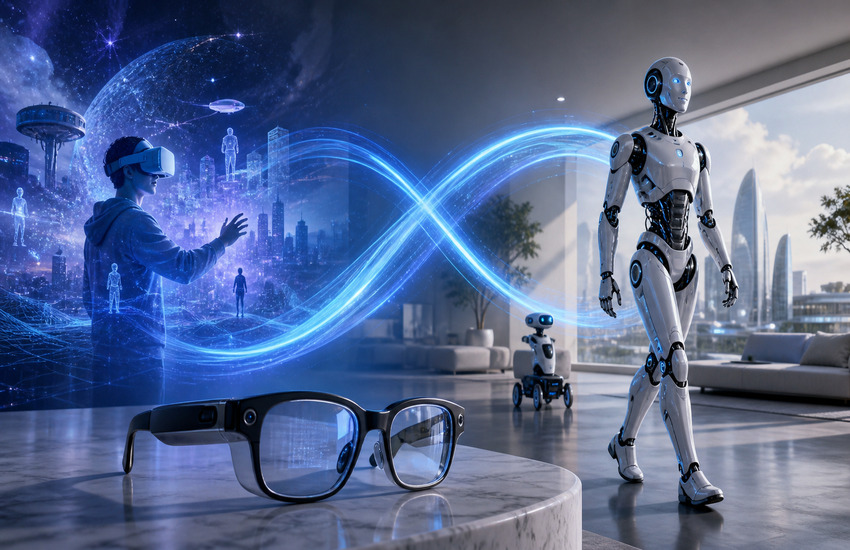
The most practical bridge between today’s Meta and tomorrow’s robot story is not a humanoid machine. It is AI glasses. That sounds odd at first. Glasses sit on your face. Robots move through physical spaces. But both need the same ingredients: visual understanding, memory, context, and a personal assistant that can help in real time.
Meta’s call made that bridge clearer. Zuckerberg said the company’s AI glasses are designed to update easily with new AI models and features. He also said he wants glasses to evolve from answering questions into a personal agent that is with you all day, helping users remember things and achieve goals. That is a big clue hiding in plain sight.
Glasses may be more important than robots over the next few years. They train users to ask AI about the world around them. They also give Meta feedback on voice, vision, memory, and context. The robot roommate may be the viral headline. The glasses are the stepping stone. If Meta wants AI to understand the physical world, glasses are the first wearable sensor. Robots could be the later moving platform.
The Spending Math Makes This Story Messier
Now for the less shiny part. Meta’s robot-flavored future is arriving during a very expensive AI buildout. The company raised its 2026 capital expenditure outlook to $125 billion to $145 billion. That is not pocket change. Management cited higher component pricing and added data-center costs tied to future capacity.
The reason is simple. Agents need compute. Better agents need more compute. Agents used by billions of people need a staggering amount of compute. Susan Li said Meta’s infrastructure investments are meant to support future model training and provide the inference capacity needed to deliver personal and business agents at global scale. Meta is not just funding a product cycle. It is funding a new operating layer.
The bull case is that Meta has earned some patience. Its core ad machine remains strong, and the company still has the scale to fund aggressive bets. But the bear case is not silly. The market has seen expensive future-building before. Robotics could take even longer than AI chat or glasses. This acquisition does not prove Meta has found the next iPhone. It does show Meta is thinking beyond feeds, chatbots, and headsets.
Final Thoughts
Meta’s acquisition of Assured Robot Intelligence is not really about a robot walking into your living room tomorrow. It is about where Meta thinks computing is going. The company appears to be building toward AI that can understand goals, interpret the physical world, assist through glasses, help businesses, guide shopping, and maybe one day operate through machines. That is a bigger story than “Meta bought a startup.” It is also more interesting than another metaverse obituary.
The balanced view is simple. Meta has the distribution, cash flow, AI talent, and ad engine to pursue this kind of long-term platform shift. It also has a history of spending heavily on futures that take longer than investors prefer. Robotics makes the AI story more exciting, but it also makes the capital allocation debate sharper.
Valuation reflects that mix. As of May 1, 2026, Meta traded at 7.25x LTM EV/Revenue, 14.26x LTM EV/EBITDA, 17.60x LTM EV/EBIT, and 22.15x LTM P/E. Those multiples are not distressed. They also sit below several earlier 2025 peaks, suggesting the market has already cooled somewhat on the story. At this valuation, the stock is not priced like a sleepy ad company. It is being valued as a profitable AI platform with expensive optionality. That feels fair. The robot may grab the headline, but the real test remains familiar: can Meta turn another strange future into durable earnings power?
Disclaimer: We do not hold any positions in the above stock(s). Read our full disclaimer here.