
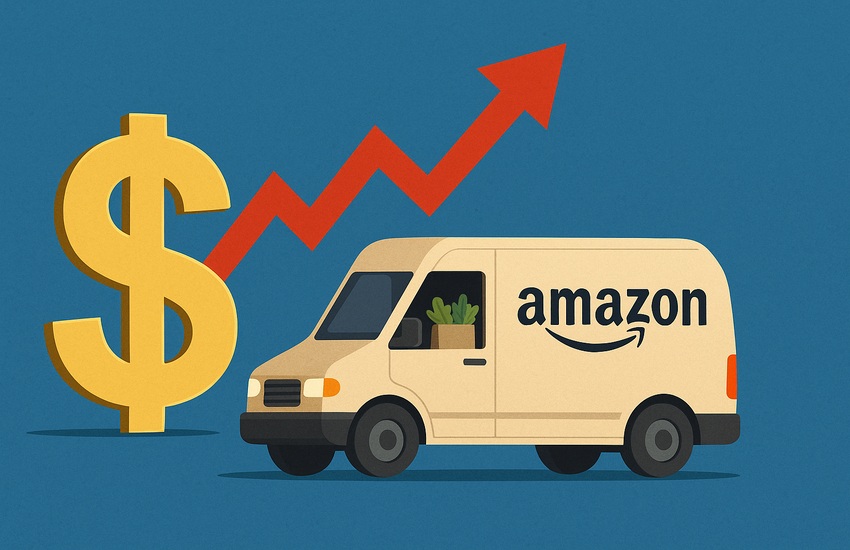
Amazon’s (NASDAQ:AMZN) bold move to expand same-day perishable grocery delivery to over 2,300 U.S. cities is now intersecting with an equally bold policy shift from the Federal Reserve. With the central bank announcing a rate cut for the first time in two years, Amazon finds itself in a macro environment that could supercharge its delivery ambitions—or complicate them. The Fed’s monetary easing lowers borrowing costs, boosts consumer liquidity, and alters capital allocation across sectors. All of these ripple effects touch Amazon’s logistics-heavy, thin-margin grocery operation. In this article, we examine four key drivers—Accelerated Network Expansion Driving Grocery Share Capture, Strengthening Logistics Flywheel and Enhanced Prime Utility, Unproven Economics and Margin Pressure in Perishable Delivery, and Heightened Competitive and Operational Constraints for Scaling—to understand how rate cuts could shape the future of Amazon same-day grocery delivery. As interest rates fall and e-commerce competition heats up, Amazon’s dominance might come at a cost, especially for smaller players struggling to keep up. Let’s unpack both the upside and the risk.
Accelerated Network Expansion Driving Grocery Share Capture
Amazon has leveraged the Fed’s rate cut as a green light for scaling infrastructure. By more than doubling its same-day grocery delivery footprint to over 2,300 cities, Amazon is signaling that logistics investment is full speed ahead. Lower borrowing costs reduce the hurdle rate on capital expenditures, making large-scale network buildouts more attractive. That includes last-mile hubs, micro-fulfillment centers, and rural delivery routes that previously may have seemed unprofitable.
This expansion allows Amazon to capture grocery share in underserved areas. Many of the cities now getting same-day grocery services are suburban or rural, where competition is sparse and customer loyalty can be won through convenience. The timing aligns with consumers growing more accustomed to quick fulfillment—what used to be a novelty is now expected. By integrating groceries with its existing product catalog, Amazon deepens Prime’s value proposition.
In this rate environment, scale is leverage. Amazon same-day grocery delivery isn’t about winning every order today—it’s about becoming the default platform as consumer habits shift. And with the Fed’s monetary easing reducing capital costs, Amazon is structurally advantaged to accelerate into markets others can’t afford to reach.
Strengthening Logistics Flywheel & Enhanced Prime Utility
Amazon’s delivery ecosystem is not a collection of isolated services. It’s a flywheel where faster delivery leads to more Prime usage, which drives more seller participation and advertising revenue. The expansion of Amazon same-day grocery delivery intensifies that loop. Groceries are a high-frequency category. Getting shoppers to use Amazon for milk or lettuce increases touchpoints—and long-term stickiness.
Rate cuts improve the economics of investing in logistics optimization. With lower costs of debt, Amazon can justify doubling down on AI-driven routing systems, robotics, and delivery partnerships. It also has more room to experiment with services like the “Add to Delivery” feature, which streamlines order bundling and reduces fulfillment costs per unit.
The increased utility of Prime is also key. If a household uses Amazon for both groceries and general goods, churn probability drops. This bundling effect is even more potent in a low-rate world, where households may shift spending habits toward consolidated platforms that offer value and ease. As more same-day grocery users convert to regular Amazon customers, the company extends its ecosystem lock-in.
Unproven Economics & Margin Pressure In Perishable Delivery
Despite the scale and innovation, Amazon same-day grocery delivery remains a business with questionable near-term profitability. Perishables introduce spoilage risk, narrow delivery windows, and higher labor intensity. Unlike dry goods or digital services, grocery margins are tight—often in the low single digits. And while the Fed’s easing offers capital breathing room, it doesn’t fix the core issue: grocery is a hard business.
Amazon’s infrastructure and data give it an edge in efficiency, but that doesn’t eliminate cost friction. Fuel, packaging, inventory shrinkage, and returns still drag on margins. And because fresh food has variable demand based on seasonality and regional preferences, forecasting is harder. Even with AI, perfection is elusive.
Lower rates may fund expansion, but they don’t guarantee margin improvement. If the grocery push increases volume but fails to achieve scale economies, Amazon could face margin dilution. And in a rate-sensitive market, valuation premiums come under pressure if operating leverage doesn’t materialize. For now, Amazon can absorb these costs thanks to other revenue streams—but that may not always hold.
Heightened Competitive & Operational Constraints For Scaling
Easier monetary policy often means one thing in tech: more competition. The Fed’s rate cut opens the door for startups to raise money and for incumbents to revisit growth strategies. That means Amazon won’t be the only player eyeing the grocery aisle. From Walmart to Instacart, rivals will feel emboldened to reinvest.
Yet while competition rises, operational constraints persist. Cold-chain logistics is difficult to replicate. Regional grocers may try to partner with delivery apps, but coordination issues and data fragmentation weaken their offerings. Amazon, with its end-to-end control, still holds the edge. But maintaining that edge gets harder as scale increases. Labor remains a bottleneck, especially in high-turnover warehouse roles. Regulatory scrutiny may also rise as Amazon dominates more verticals.
At the same time, consumer expectations are rising. Once same-day delivery becomes normalized, slowdowns or fulfillment issues carry more reputational risk. Amazon must continue investing just to maintain its lead—and even with falling rates, that requires careful capital allocation. The grocery opportunity is real, but it’s a street fight.
Final Thoughts: Expansion Meets Easing, But Watch The Margins
The Federal Reserve’s recent rate cut adds fuel to Amazon’s growing logistics machine—especially in the grocery aisle. Amazon same-day grocery delivery now reaches over 2,300 U.S. cities, a number likely to grow even more as cheaper capital greases the gears of expansion.
Lower rates support consumer spending and let Amazon double down on infrastructure without crushing its balance sheet. But this tailwind also creates more competition and compresses already thin margins in groceries and delivery.
Amazon’s LTM multiples remain elevated—18.54x EV/EBITDA and 32.75x P/E—which suggest the market already expects perfection. If volume growth continues and consumer demand holds, Amazon may justify these valuations. But any softness in spending, inflation rebound, or operational misstep could turn monetary easing from a gift into a burden.
In a low-rate world, Amazon has room to grow. But in the grocery aisle, every margin point still counts.
Disclaimer: We do not hold any positions in the above stock(s). Read our full disclaimer here.