

Support 100% Independent Research With Our 7-Day Free Trial
Apple just made its boldest AI move in years—and the market barely flinched. On December 1, 2025, the iPhone maker quietly announced that John Giannandrea, its head of AI since 2018, would retire in spring 2026. His replacement? Amar Subramanya, a seasoned AI executive with prior stints at both Google’s DeepMind and, most recently, Microsoft. Subramanya now holds the title of VP of AI and will report to Craig Federighi, Apple’s software boss. The shift comes at a pivotal moment for Apple’s AI ambitions—amid stiffening competition from Microsoft, Google, and OpenAI, and just months after a lukewarm rollout of “Apple Intelligence.”
While Giannandrea’s exit marks the end of a chapter, Subramanya’s arrival signals a tighter focus on execution. And with Apple’s stock at an all-time high and iPhone 17 sales surging, investors aren’t sweating the leadership change—yet. But this Apple AI Leadership Change could be more than a footnote. Here’s what it means for the company’s future.
Apple Bets On Execution Over Vision
The most notable shift in Apple’s AI leadership transition is strategic: Amar Subramanya will have a narrower scope than his predecessor. While Giannandrea reported directly to CEO Tim Cook and oversaw everything from Siri to foundation models, Subramanya will report to Craig Federighi and focus more squarely on execution—specifically, Apple’s on-device AI models, research, and safety protocols. That’s a big cultural signal.
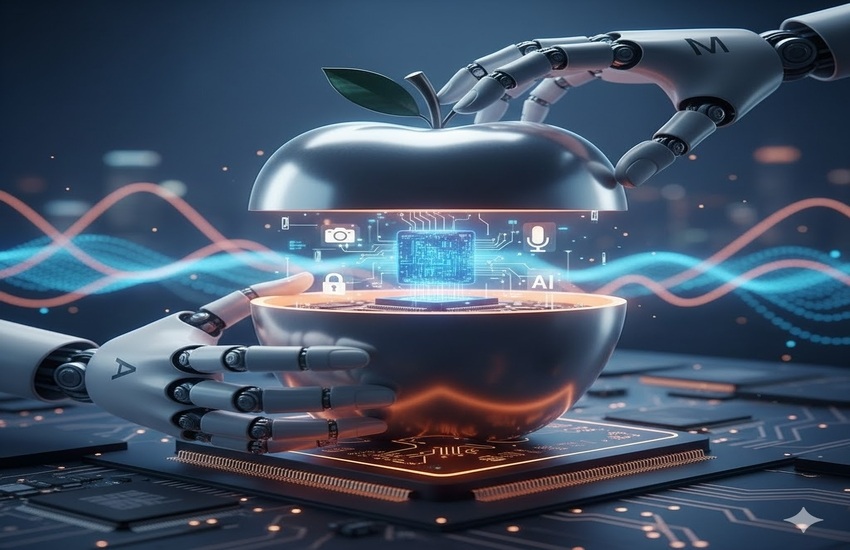
Apple has long been criticized for lagging behind in cloud-based AI compared to peers like Microsoft and Google. But instead of chasing OpenAI’s model arms race, Apple is doubling down on making AI work seamlessly on-device. Features like Live Translation, personalized Siri, and photo cleanup tools are designed to run efficiently on Apple’s A19 Pro and M5 chips. Subramanya’s engineering pedigree—at Microsoft, he led real-time AI for Teams—aligns with that philosophy.
In short, this Apple AI Leadership Change isn’t about building the most powerful models. It’s about making AI useful, private, and invisible. That’s Apple’s comfort zone—and Subramanya is being brought in to scale it.
Silicon Strategy Gives Apple A Unique Edge
Another key pillar of Apple’s AI story is hardware—and few companies can match its chip integration. Apple designs its own silicon: the A-series for iPhones, M-series for Macs, and specialized neural engines that power everything from facial recognition to real-time transcription. With the new M5 chips, AI performance is up to 3.5x faster than last year’s M4.
Subramanya’s arrival bolsters this strategy. He’ll oversee AI features that are deeply tied to Apple silicon, leveraging the company’s end-to-end control over chips, devices, and software. That’s a luxury Microsoft and Google don’t have. Apple doesn’t need to build massive cloud infrastructure to serve AI features. Instead, it focuses on local performance, privacy, and efficiency—an approach that resonates with its premium user base.
This is also a hedge against geopolitical risk. With chip production increasingly shifting to the U.S. and India, and with Apple launching its own AI server manufacturing plant in Houston, it’s reducing its reliance on Taiwan and China. In the long run, that could help preserve margins—and buffer Apple from supply shocks and tariff costs that have recently topped $1.4 billion per quarter.
In this context, the Apple AI Leadership Change looks like a continuation of a broader hardware-centric AI strategy, not a pivot to an LLM arms race.
Market Momentum Buys Apple Time—For Now
If there’s one reason Apple isn’t facing more heat over its AI efforts, it’s this: the stock is soaring. Shares are up 16% since mid-October 2025, beating the S&P 500 by 12 percentage points. The rally has been fueled by better-than-expected iPhone 17 sales, especially in key markets like India, South Asia, and Western Europe.
Wall Street expects double-digit iPhone sales growth in the holiday quarter—helped by a strong refresh cycle and new features like ProMotion displays and 8x telephoto cameras. Apple’s AI missteps, like the delayed launch of the new Siri, have been largely shrugged off by investors.
Services revenue also hit a record $28.8 billion in the September quarter, growing 15% year-over-year. The momentum here is organic—Apple Pay, Apple Music, and App Store growth all contributed. Even advertising set a new high. With EPS of $1.85 and operating cash flow of $29.7 billion last quarter, Apple’s financial engine remains solid.
As long as the business fundamentals stay this strong, the Apple AI Leadership Change will remain a subplot, not the headline. But that leash isn’t infinite.
The Competitive Gap Is Still Very Real
Here’s the bear case: Apple may be too far behind in the AI race to catch up. While the company excels at refining features for its ecosystem, it lacks a marquee foundation model like GPT-4 or Gemini. Microsoft is embedding Copilot into every layer of Windows and Office. Google is racing ahead with Gemini 2. Meta is open-sourcing its LLaMA models. And OpenAI is now working on its own AI hardware with Jony Ive.
Apple’s AI strategy relies on running models efficiently on-device. That’s smart—but also limiting. If the next wave of consumer applications require more compute than iPhones or Macs can handle, Apple risks being boxed out of generative AI’s most transformative use cases.
Regulatory risks also loom. From EU mandates on third-party app stores to U.S. antitrust scrutiny, Apple’s services profits could get squeezed. Services are a key pillar of its future growth, and AI features alone may not offset regulatory drag.
This Apple AI Leadership Change is happening while rivals are ramping up AI investments and launching new products faster. If Apple’s new Siri doesn’t land in 2026 with a bang, investor patience could wear thin.
Final Thoughts: Cautiously Watching the Silicon Strategy Play Out
The Apple AI Leadership Change represents more than a new face—it signals a doubling down on Apple’s existing AI approach: on-device, privacy-first, and tightly integrated with its hardware. Amar Subramanya brings the right background for this job, but he inherits a tough challenge. Competitors are moving fast, and Apple needs to prove that its unique strategy can still deliver must-have features in a rapidly evolving landscape.
Apple’s trailing valuation multiples reflect market confidence—for now. As of December 1, 2025, the stock trades at a lofty 37.95x LTM P/E and 31.29x EV/EBIT, with a free cash flow yield of just 3.1% . That leaves little room for disappointment.
Whether Subramanya can transform Apple Intelligence from a lagging brand into a core asset will define Apple’s AI narrative for the next decade. Until then, the market’s giving Apple the benefit of the doubt. But in the world of AI, standing still is never safe.
And that’s what makes this Apple AI Leadership Change worth watching!
Disclaimer: We do not hold any positions in the above stock(s). Read our full disclaimer here.