
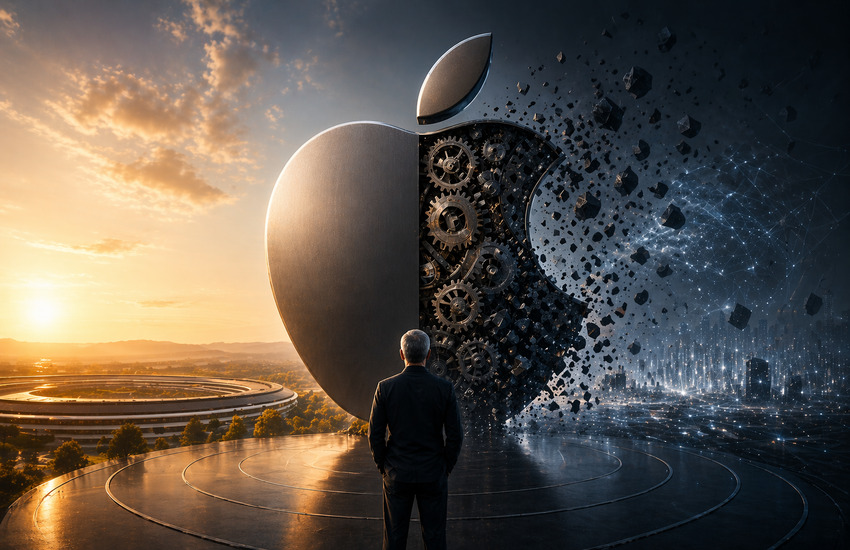
Apple (NASDAQ:AAPL) is entering a new chapter, but the most important question is not simply who replaces Tim Cook. It is whether the company he leaves behind has become durable enough to keep compounding without the architect who helped build the modern machine.
Cook did not just scale Apple. He turned it into a system. That system linked the iPhone, services, supply chain, capital allocation, and ecosystem loyalty into one compounding loop that kept generating more cash from the same installed base.
That is what makes this transition so interesting. Steve Jobs led Apple as a vision-driven product company. Cook turned it into something more institutional and repeatable.
Recent results still show huge strength, with record revenue, strong iPhone demand, and a services engine that keeps expanding margins. Yet leadership transitions at this scale are rarely about continuity alone.
John Ternus is inheriting a business that looks highly optimized. The real issue is whether a company optimized for efficiency and stability can remain adaptable when new cycles are shaped by AI, platform shifts, and faster forms of competition.
The Cook Era Built A System, Not Just A Company
Tim Cook’s defining achievement was not launching a single breakthrough product on the scale of the original iPhone. It was building a corporate structure that could keep extracting value from an existing ecosystem at extraordinary scale.
Apple’s latest quarter made that plain. The company posted record revenue of $143.8 billion, while iPhone revenue alone reached $85.3 billion, up 23% year over year. That is not just product demand. It is evidence of a machine that still converts installed base strength into upgrades, cash flow, and downstream monetization with remarkable consistency.
The deeper point is that Apple no longer behaves like a classic hardware company. The iPhone is still the center of gravity, but it now functions more like the front door to a larger economic system.
More than 2.5 billion active devices create a base that supports services, accessories, payments, subscriptions, and app spending. That makes the system more resilient, but also more dependent on internal coordination.
Supply chain execution, software integration, customer loyalty, and capital return all reinforce one another. Cook’s legacy, then, is less about operational excellence in isolation and more about institutional design.
Apple became a company that compounds through structure, not just through invention.
The Business Now Compounds Through Interdependence
One reason this transition matters so much is that Apple’s model has become deeply interdependent. iPhone demand supports the installed base. The installed base feeds services. Services lift margins. Strong margins support buybacks, research spending, and ecosystem investment.
That loop is easy to overlook because each segment is often discussed on its own. In reality, Apple’s strength comes from how tightly the pieces work together.
Services revenue reached $30 billion, up 14% year over year, while services gross margin rose to 76.5%. These are not side metrics. They show how the system turns customer attachment into a very profitable recurring layer.
That structure also explains why Apple has been rewarded with such a premium market position. Investors are not simply paying for a large consumer technology franchise. They are paying for a business model that appears unusually durable.
But interdependence cuts both ways. A tightly linked system can be highly efficient, yet less flexible when the environment shifts. The more Apple perfects throughput across hardware, services, and capital returns, the more important adaptability becomes.
At a certain point, the central question is no longer whether the system works. It is whether the system can bend without breaking its core advantages.
Peak Optimization Can Become Its Own Risk
This is where the handoff from Cook to Ternus becomes more than a succession story. Apple’s recent earnings call showed a company operating with enormous precision, but also under visible strain in places that matter.
Management pointed to very strong iPhone demand, lean channel inventory, and supply constraints tied to advanced nodes. Memory pricing was also rising. None of that suggests weakness in the usual sense.
It suggests a system running very close to peak efficiency.
That can be a strength, but it can also narrow the room for adjustment when external conditions change. The less obvious risk is not that Apple suddenly stops executing well.
The risk is that extreme optimization reduces strategic optionality.
A system designed to maximize stability, margin quality, and capital efficiency may become slower to respond when the next cycle rewards experimentation and aggressive investment. This matters because Apple now faces a market reshaped by artificial intelligence and new platform behavior.
If the operating model is tuned for refinement, then reinvention becomes harder to organize. At this scale, the danger is not failure. It is becoming too optimized to flex comfortably.
John Ternus Inherits A Proof Obligation
John Ternus is stepping into a role that carries a different burden than a normal CEO transition. He is not being asked to rescue a struggling business. He is being asked to validate that the business can sustain itself as a system.
That distinction matters. Ternus comes from hardware, which fits a company still anchored by devices. But the next phase of value creation may depend on more than hardware leadership alone.
It will depend on how well Apple can keep integrating devices, services, software, and AI-driven capabilities without losing the discipline that defined the Cook era.
The latest earnings call offered a clue about that challenge. Apple’s AI strategy appears measured rather than maximal.
Management emphasized Apple Intelligence, on-device functionality, private cloud compute, and a collaboration with Google. That approach fits the existing system. Apple is extending its platform rather than rebuilding it.
The question for investors is whether that is disciplined strength or system inertia. Ternus therefore inherits more than a company. He inherits a proof obligation.
He must show that the machine can keep compounding when the rules of the next cycle may not fully reward the same habits that made the previous one so successful.
Final Thoughts
Apple remains one of the highest-quality large-cap businesses in the market. It still combines scale, brand power, ecosystem depth, and cash generation in a way that few peers can match.
That helps explain why its valuation remains elevated.
On a trailing basis, Apple has traded around 9.08x LTM EV/Revenue, 19.18x EV/Gross Profit, 25.86x EV/EBITDA, 28.03x EV/EBIT, and 34.63x P/E. These multiples suggest the market continues to price Apple as a premium franchise with durable economics.
The neutral interpretation is that the valuation still reflects confidence in the system Cook built. Investors appear willing to pay for continuity because the business keeps producing strong operating results and high-quality cash flow.
At the same time, premium multiples also leave less room for strategic missteps if the next technology cycle rewards greater flexibility.
John Ternus does not need to reinvent Apple overnight. But the market is likely to focus on whether the system remains self-sustaining without Cook’s steady hand.
That is what makes this transition more than a leadership change. It is a live test of whether Apple’s compounding model can keep working on its own.
Disclaimer: We do not hold any positions in the above stock(s). Read our full disclaimer here.