


Continue Reading With Our 7-Day Free Trial
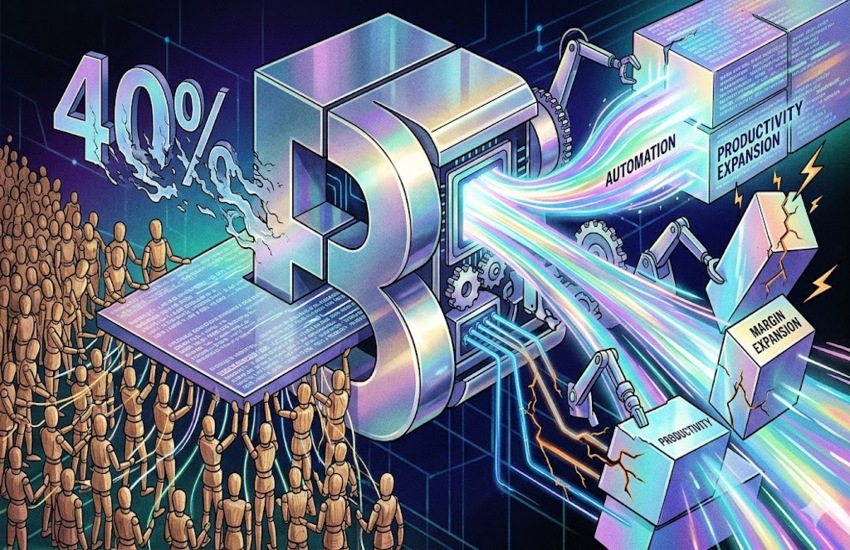
Block (NYSE:SQ) just made one of the boldest moves in corporate America this year. CEO Jack Dorsey announced the company will cut roughly 40% of its workforce, shrinking from more than 10,000 employees to under 6,000. The reason wasn’t weak revenue or a balance sheet crisis. It was artificial intelligence. Dorsey said AI tools have fundamentally changed what it means to run a company, and he wants Block built as an “intelligence-native” organization. Investors clearly liked what they heard. Shares surged more than 20% after hours, interpreting the move as a decisive margin reset. Gross profit is accelerating, adjusted operating income is set to jump 54% in 2026, and Rule of 40 has been achieved. But here’s the real question: Is this a credible reinvention around AI-driven productivity, or a high-risk bet that software can replace human scale without breaking the culture or the business model?
AI As An Operating Model Reset
Dorsey isn’t framing this as cost cutting. He’s framing it as an operating philosophy change. His core thesis is simple: intelligence tools now change how companies are built and managed. He believes most firms are late to this realization. Block wants to get ahead of it.
Internally, the company has already seen AI boost engineering output. Management says production code shipped per engineer has risen more than 40% since September. Tasks that once took weeks are now handled by smaller teams in a fraction of the time. That productivity shift gave leadership confidence to redesign the organization around fewer people and more automation.
This reset also follows a structural shift inside Block. The company historically operated as two semi-separate entities: Square and Cash App. Functionalizing those businesses created overlap reductions and clearer shared capabilities. AI then became the multiplier layered on top of that simplification.
The company now wants intelligence embedded everywhere. Decision-making, underwriting, product design, and customer service are all being reshaped. Dorsey described four priorities: core customer capabilities, composable interfaces, proactive intelligence using real-time data, and an internal intelligence model to orchestrate operations.
That last piece matters. Block processes massive amounts of real transactional data across merchants and consumers. Management believes that data can power tools like ManagerBot for sellers and MoneyBot for consumers. In theory, that creates proactive prompts instead of reactive dashboards.
The ambition is not just to automate tasks. It’s to allow customers to build features directly on top of Block’s infrastructure. That could expand the value delivered per merchant or per Cash App user. But it also requires flawless execution and customer trust.
Cost Discipline & Margin Leverage
While AI is the headline, margin math is the engine. Block delivered $10.36 billion in gross profit in 2025, up 17% year over year. In the fourth quarter alone, gross profit rose 24% to $2.87 billion. Adjusted operating income grew 46% in Q4.
For 2026, management now guides to $12.2 billion in gross profit, up 18%. More striking is adjusted operating income guidance of $3.2 billion, up 54%. Margins are expected to expand steadily through the year, with nearly 60% of operating income landing in the second half.
A 40% workforce reduction directly lowers the cost base. The company expects $450 million to $500 million in restructuring charges, but the long-term impact is a structurally leaner expense profile. Management has said the full benefit will be more visible in the back half of 2026.
This comes as lending scales aggressively. Borrow originations surged more than 200% year over year in Q4. Cash App primary banking actives grew 22% to 9.3 million. These customers generate nearly 10 times the gross profit of peer-to-peer-only users.
Square’s gross payment volume is also reaccelerating, running above 12% growth quarter to date in Q1. Sales-led new volume added grew 62% year over year in Q4. Hardware remains a near-term headwind, but management sees it as customer acquisition investment.
Put it together and the thesis becomes clearer. Growth is intact. Operating leverage is improving. AI-driven productivity reduces labor intensity. Investors interpreted that combination as a durable margin expansion story rather than a distress signal.
Share Rally Reflects Investor Buy-In
The market reaction was swift. Shares rallied more than 20% after the announcement. That kind of move signals belief that the restructuring strengthens, not weakens, the model.
Block has already returned significant capital. It repurchased $2.3 billion of shares in 2025 alone. Raising 2026 guidance only months after Investor Day adds to management’s credibility.
Valuation also plays a role. On a trailing basis as of late February 2026, Block trades at about 1.27x LTM revenue and 3.08x LTM gross profit. LTM price-to-earnings sits near 10.9x. LTM EV/EBIT is roughly 22.25x. Forward multiples are even lower, with NTM EV/EBITDA around 7.66x and NTM P/E near 18.4x.
Those are not peak fintech valuations. The stock has compressed meaningfully over the past year. Investors may see the AI reset as a catalyst to re-rate margins and earnings growth rather than revenue growth alone.
Free cash flow also looks healthier. NTM levered free cash flow yield sits around 7.2%. That provides a cushion if execution wobbles. It also gives management flexibility for buybacks or reinvestment.
In short, the rally suggests shareholders see discipline, not desperation. They appear willing to underwrite the idea that AI-driven productivity plus lending growth can support a leaner and more profitable Block.
Execution, Cultural, & Reputational Risks Ahead
Still, cutting 40% of a workforce is not a minor adjustment. It is a cultural shock. Even if financial metrics improve, morale and institutional knowledge can suffer.
Block insists this is not a response to weakness. The company posted strong growth and beat expectations in Q4. That may help credibility internally. But employees losing roles in a profitable year could feel blindsided.
There is also execution risk. AI tools can increase productivity, but they are not infallible. Lending, compliance, and fraud prevention are high-stakes areas. Overreliance on automation without adequate oversight could create operational risk.
Competition remains intense. Square competes with firms like Fiserv, Shopify, and Toast. Cash App faces pressure from banks and digital wallets. Shrinking the workforce while competitors invest aggressively requires confidence that AI offsets scale disadvantages.
Reputation is another variable. Broader fears about AI displacing jobs are growing. Block’s move could reinforce narratives about technology replacing human labor. That may affect recruiting, partnerships, or regulatory scrutiny.
Finally, product velocity must prove out. Management promises faster decisions and shipping cycles. Investors will watch whether new initiatives like Cash App Green, Borrow expansion, and AI-driven seller tools translate into durable engagement and monetization gains.
Final Thoughts
Block’s decision to cut roughly 40% of its workforce is one of the most aggressive AI-driven restructurings in fintech. The company is not retrenching due to collapsing growth. Gross profit is accelerating, lending is scaling, and guidance for 2026 has been raised. Markets interpreted the move as a margin and efficiency reset, reflected in a sharp share rally.
At the same time, this is a high-stakes transformation. The bet is that AI can replace layers of human scale without eroding culture, risk controls, or customer trust. Execution will matter more than narrative.
From a valuation perspective, Block does not look stretched. LTM P/E around 10.9x and NTM EV/EBITDA near 7.7x suggest the market is not pricing perfection. Multiples have compressed materially over the past year. That gives room for upside if margins expand as planned, but also signals skepticism.
In the end, this AI-led downsizing is neither clearly reckless nor clearly revolutionary. It is a strategic pivot with measurable financial logic and measurable operational risk. Investors will now watch whether the leaner, intelligence-native Block can deliver on its ambitious promises.
Disclaimer: We do not hold any positions in the above stock(s). Read our full disclaimer here.