

Continue Reading With Our 7-Day Free Trial
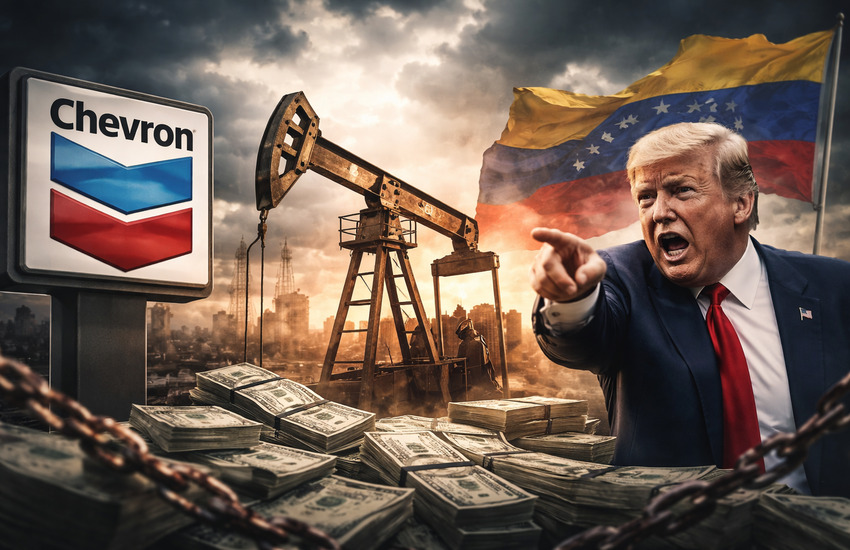
It’s a standoff that pits shareholder caution against political ambition—and Chevron (NYSE:CVX) is right in the middle. Just weeks after the dramatic ouster of Nicolás Maduro, President Trump is urging U.S. oil companies to flood Venezuela with $100 billion in investment to rapidly reboot its shattered oil sector. Leading the charge, at least in theory, is Chevron—the only major U.S. player still operating in Venezuela. But there’s a catch: Chevron has zero appetite for risking capital under volatile conditions. Oil prices are low, legal uncertainties remain, and no one’s quite sure if Venezuela is truly “open for business” or just temporarily reopened under new management.
Chevron’s top brass, including CEO Mike Wirth, are walking a tightrope. On one side is a president eager to slash domestic oil prices with an influx of cheap Venezuelan crude. On the other is a skeptical Wall Street watching Chevron’s every move. The heart of the Chevron Trump Venezuela strategy is about navigating risk, realism, and return.
Political Stability & Post-Maduro Governance Credibility In Venezuela
The first question any Chevron executive—or Chevron shareholder—is asking is simple: is Venezuela finally stable? The answer, so far, is… maybe. While Maduro’s dramatic exit has been welcomed in Washington, Caracas remains a high-risk political environment. There’s still no clear legal framework for contract sanctity, and Chevron can’t base a multi-billion-dollar bet on a handshake at Mar-a-Lago.
The Trump administration’s narrative is that Venezuela is now free, democratic, and ready to pump. But for corporations, the bar is higher. Chevron isn’t just looking for a regime change; it wants institutional reform, legal guarantees, and operational safety. That hasn’t materialized yet. Even though Chevron already has infrastructure and people on the ground, expanding that footprint without long-term political visibility isn’t something CEO Mike Wirth is willing to do quickly.
The Chevron Trump Venezuela strategy thus reveals a wider disconnect between political urgency and business risk. Chevron’s caution isn’t just about Caracas—it’s about what happens if things fall apart again and assets are stranded. For now, the company’s Venezuela ambitions remain more theoretical than tangible.
Economics Of Heavy Crude Amid Trump’s Low-Price Oil Ambitions
Trump wants oil at $50 a barrel. Venezuela’s heavy crude can barely break even at $40. That’s the math Chevron has to live with. Venezuelan oil isn’t West Texas light—it’s dense, costly to refine, and logistically complex. Add sanctions, aging infrastructure, and unreliable local supply chains, and suddenly the economics get even murkier.
Amos Hochstein, a former Biden energy adviser, put it bluntly: “You can’t spend billions on sub-$40 oil. That doesn’t happen anywhere in the world.” Chevron knows this. The company’s upstream margins are under pressure globally, and betting on heavy crude with thin margins just doesn’t fit its capital discipline strategy.
Even as Trump dreams of “tremendous wealth” coming out of Venezuela, the reality is that Chevron has more profitable options elsewhere—like the Permian, where it’s already producing over a million barrels a day at lower cost. The economics just don’t justify a Venezuela ramp-up, no matter how enthusiastic the White House might be. Again, the Chevron Trump Venezuela strategy seems more political soundbite than investment blueprint.
Legal & Sanctions Framework Governing U.S. Oil Contracts In Venezuela
This is the part that lawyers lose sleep over. Venezuela is still technically under U.S. sanctions. While Chevron has a special license to operate there, any expansion will require updated authorizations—and that opens a Pandora’s box of legal risk. Can contracts signed under Trump hold up under a future administration? What happens if lawsuits emerge from local partners or international watchdogs?
Chevron’s legal teams are quietly signaling red flags. Signing new agreements under potential “duress,” as some analysts have phrased it, could expose the company to challenges down the road. The lack of contract sanctity and the questionable independence of Venezuela’s judicial system further complicate matters.
From a U.S. energy policy perspective, this highlights a broader contradiction: Washington wants private companies to act like geopolitical tools while also expecting them to manage fiduciary risk. That’s not how public companies operate—especially ones like Chevron, where every dollar is scrutinized. The Chevron Trump Venezuela strategy can’t move forward until there’s legal clarity, and that won’t happen overnight.
Chevron’s Capital Discipline Versus Political Pressure & Shareholder Risk Tolerance
Chevron’s approach to capital allocation has been one of the most disciplined in the sector. CFO Eimear Bonner reaffirmed this during the company’s Q3 2025 earnings call, emphasizing strong cash flow, cost discipline, and a cautious approach to international expansion. Venezuela simply doesn’t check enough boxes yet.
Chevron (NYSE:CVX) is facing a valuation environment that leaves little room for adventurous spending. Its LTM EV/EBITDA multiple has climbed to 9.93x and its P/E is now 23.44x—up nearly 50% over the past year. That means expectations are high, and investor patience for risky, long-horizon bets is low. With better returns available from low-risk domestic projects like the Permian or strategic plays like Guyana and Kazakhstan, there’s no incentive to rush into Venezuela.
Trump’s recent meeting with Chevron Vice Chairman Mark Nelson was more theater than commitment. Nelson promised to “help boost output” but stopped short of pledging any dollar amount. Meanwhile, CEO Wirth is recovering from knee surgery but very much engaged in the company’s strategic direction—working with Chevron’s government affairs team to politely dodge any hasty moves.
Ultimately, Chevron is playing the long game. It’s not defying Trump—it’s just refusing to compromise capital discipline. And that’s a theme we’re likely to hear a lot more of in the next Investor Day, particularly as the Chevron Trump Venezuela strategy comes under more scrutiny.
Final Thoughts: A Delicate Balance Between Vision & Value
Chevron’s strategic dilemma in Venezuela offers a rare lens into the friction between U.S. political goals and corporate governance. The White House wants quick action. Wall Street wants careful risk management. Chevron is stuck trying to satisfy both while preserving shareholder value.
On one hand, Chevron is uniquely positioned in Venezuela with existing infrastructure and regulatory clearance. On the other, it faces a storm of legal, political, and financial uncertainty. Oil prices remain below the threshold needed to justify heavy investment. And Venezuela’s post-Maduro government, while different in name, hasn’t yet earned global corporate trust.
For investors, the company’s current valuation—with an LTM EV/EBIT of 19.67x and FCF yield shrinking to 6.0%—suggests little tolerance for geopolitical detours. Chevron’s steady cash returns, strong balance sheet, and disciplined portfolio management remain its calling card. Venezuela may still be part of its future—but not until the Chevron Trump Venezuela strategy becomes more strategy and less political spectacle.