


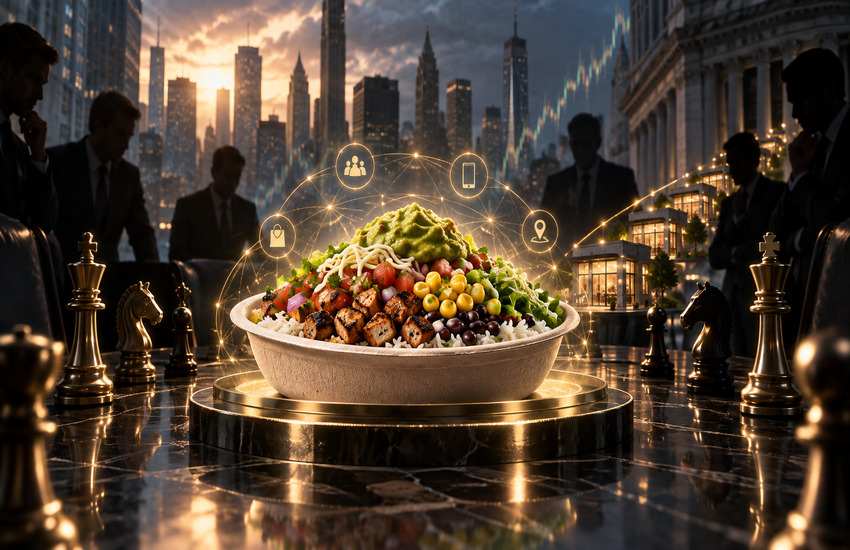
Chipotle Mexican Grill (NYSE) has suddenly found itself at the center of Wall Street takeover chatter. Chipotle Acquisition Speculation has increased after traders recently pointed to a Betaville “uncooked” alert suggesting the restaurant chain may have attracted acquisition interest. No potential buyer has been identified, and there is no confirmed deal or formal approach. Still, the speculation was enough to draw attention as Chipotle shares climbed roughly 4% that day, although the stock was already higher before the report circulated.
The bigger question is why Chipotle would attract takeover interest in the first place. Its latest results offer several clues. The company is still opening restaurants at a rapid pace. Its international ambitions are expanding. Digital sales now represent a large part of the business, while its loyalty ecosystem has 23 million active members. At the same time, slower comparable-sales growth and margin pressure have complicated the near-term picture. That combination makes the takeover chatter worth examining—even if the rumor ultimately leads nowhere.
Chipotle’s Restaurant Economics & Expansion Runway Remain Powerful
One reason Chipotle could attract attention is straightforward: its restaurant expansion model continues to produce strong economics. Management said new restaurant productivity remains around 80%, while year-two cash-on-cash returns are approximately 60%. Those figures have held up even as the company has increased its development pace.
Chipotle expects to open roughly 350 company-owned restaurants in 2026, with about 80% featuring a Chipotlane. Management believes North America can eventually support at least 7,000 locations. Importantly, opening more stores has not dramatically weakened existing locations. The company estimates that new openings reduce comparable restaurant sales by roughly 100 basis points, consistent with historical levels. These economics provide useful context for the recent Chipotle Acquisition Speculation.
Operational improvements add another layer. Chipotle’s high-efficiency equipment package, or HEEP, is already installed in more than 1,000 restaurants. The company expects approximately 2,000 installations by year-end. HEEP locations are producing two to three more entrées during their busiest 15-minute period than the broader system. Management says these improvements are translating into hundreds of basis points of comparable-sales improvement. For any hypothetical buyer, that means Chipotle offers both an existing restaurant base and a long runway for additional units.
Chipotle combines powerful restaurant economics, international white space, digital scale and a debt-free balance sheet with slower comparable-sales growth and margin pressure. That mix helps explain why takeover speculation has attracted attention despite no identified buyer or confirmed approach. The central question is whether that strategic appeal can overcome the valuation an acquirer would need to justify.
Chipotle’s roughly 60% year-two cash-on-cash returns, strong new-store productivity and long expansion runway could sustain attractive unit growth for a buyer.
Elevated valuation remains the clearest transaction obstacle because any acquirer may need to justify both existing multiples and a shareholder takeover premium.
Watch for any identified bidder, formal approach or transaction terms that clarify whether takeover speculation develops into a credible acquisition process.
Chipotle’s expansion economics and digital ecosystem create strategic optionality, but the transaction debate ultimately turns on price. Without an identified bidder or formal approach, the question is whether the company’s growth runway can justify acquisition economics at still-substantial valuation multiples.
International Expansion & Chipotle Acquisition Speculation
Chipotle remains closely associated with the American restaurant market, but its international footprint is becoming increasingly important. A potential acquirer would not simply be buying the existing U.S. business. It would also gain an early-stage global expansion platform.
Europe provides an encouraging example. Management said each European country delivered high-single-digit comparable-sales growth during the second quarter. Chipotle has spent several years aligning those restaurants with its North American culinary, training, and operating standards. Management now believes the economics support additional investment.
The company is also entering new markets through experienced local partners. Chipotle recently opened its first restaurant in Monterrey, Mexico, through Alsea. More Monterrey locations are planned, followed by Mexico City in 2027. South Korea is expected to receive its first Chipotle restaurants in 2026, while Singapore is targeted for early 2027 through SPC Group.
Expansion is underway in the Middle East as well. Chipotle has entered Abu Dhabi and Qatar and plans to move into Saudi Arabia. Management believes the Middle East could eventually support hundreds of restaurants. Outside Western Europe, partner-operated expansion should allow Chipotle to pursue new markets without relying entirely on company-owned development. That international runway adds another dimension to Chipotle Acquisition Speculation.
Digital Growth & Loyalty Create Another Valuable Layer
There is more behind Chipotle than physical restaurants. During the second quarter, digital sales reached $1.3 billion and represented 38.3% of total sales, up from 35.5% a year earlier. That creates a sizable digital relationship with customers alongside the traditional restaurant business.
Chipotle Rewards now has 23 million active members, yet management still sees considerable room for expansion. Nearly 90% of owned digital transactions are associated with Rewards. In physical restaurants, however, only around 20% of transactions currently scan for Rewards. The revamped program has already produced a nearly 20% increase in daily enrollments.
Technology is also moving deeper into restaurant operations. Chipotle is testing an AI-based “cook to needs” system that forecasts demand and helps employees prepare the appropriate amount of fresh food. Its digital makeline technology is designed to improve order accuracy, speed, and consistency. These digital assets help explain why Chipotle Acquisition Speculation involves more than simply the value of its restaurant locations.
Then there is menu innovation. Chipotle Honey Chicken generated an attachment rate above 25%, while management says limited-time offerings can produce hundreds of basis points of transaction lift. The combination of customer data, loyalty, menu innovation, and faster restaurant execution gives Chipotle several ways to increase customer frequency without depending entirely on new restaurant openings.
Strong Fundamentals Meet A More Complicated Near-Term Story
The takeover thesis becomes more interesting because Chipotle is not operating without challenges. Second-quarter revenue increased 9.3% to $3.3 billion, but comparable restaurant sales rose only 2.2%. Transaction growth was 1%. Restaurant-level margin fell 220 basis points year over year to 25.2%.
Management also reported softer trends during the second half of July. It expected roughly 1% comparable-sales growth for the third quarter, including an assumed 200-basis-point sales headwind related to broader industry concerns around cyclospora. Chipotle emphasized that it was not implicated in the issue and does not use the products involved in that discussion. Full-year comparable-sales growth was projected in the low-single-digit range.
Costs provide another pressure point. Food costs reached 29.7% of sales, while labor costs were 25%. Beef, freight, wages, insurance, maintenance, and utilities have all created pressure.
Yet Chipotle retains substantial financial flexibility. It ended Q2 with about $800 million in cash, restricted cash, and investments, with no debt. The company also repurchased more than $1.3 billion of stock during the first half. For a hypothetical acquirer, the attraction would therefore come with a tension: strong long-term unit economics alongside softer near-term growth and elevated operating costs. That tension is an important part of the Chipotle Acquisition Speculation rather than a reason to assume a transaction is inevitable.
Final Thoughts
The takeover chatter surrounding Chipotle remains exactly that: chatter. There is no identified bidder in the report, and the information does not establish that a transaction will happen. But Chipotle’s underlying business helps explain why the speculation has attracted attention.
The company combines strong new-store economics, substantial North American white space, early international expansion, a large digital business, 23 million active Rewards members, and a debt-free balance sheet. Against that, investors have to consider slower comparable-sales growth, margin compression, consumer caution, and the price an acquirer would have to pay.
Chipotle’s strategic appeal is clear; valuation remains the transaction hurdle.
That last point matters because Chipotle still carries substantial valuation multiples despite a significant compression from 2025 levels. As of September 28, 2026, the shares traded at approximately 3.63x LTM enterprise value-to-revenue, 19.63x LTM EV/EBITDA, 23.50x LTM EV/EBIT, and 29.52x LTM diluted earnings. A year earlier, those multiples stood at roughly 4.82x, 24.14x, 28.39x, and 34.71x, respectively.
So Chipotle is cheaper relative to its own recent valuation history, but its multiples still place a meaningful price on future growth. Any buyer would likely need to justify not only Chipotle’s existing valuation, but also whatever takeover premium shareholders might demand. That may ultimately be the biggest obstacle in this story—and the reason the identity of any potential buyer matters almost as much as the reasons someone might want Chipotle in the first place.
Disclaimer: We do not hold any positions in the above stock(s). Read our full disclaimer here.