


Continue Reading With Our 7-Day Free Trial
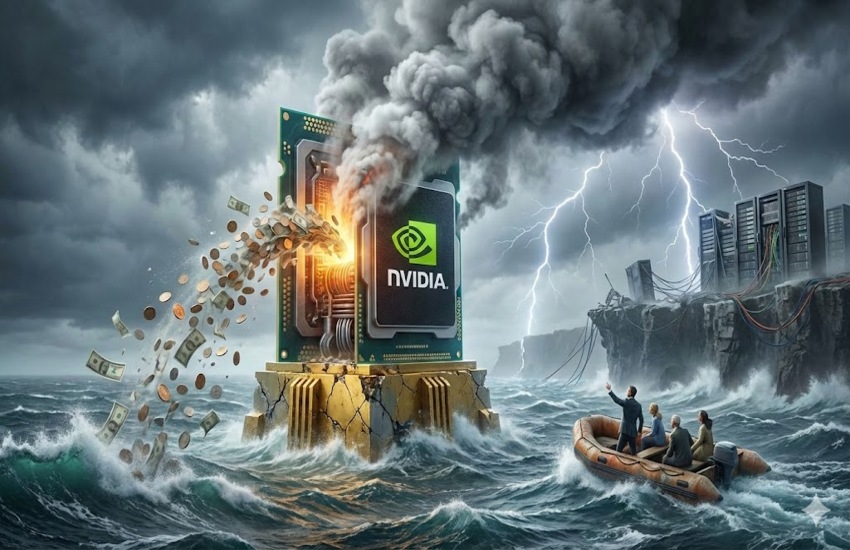
Is The Nvidia AI Hype Over? That question took center stage this week after shares of Nvidia (NASDAQ:NVDA) dropped 4.4% on Tuesday, reflecting not just broader market weakness but a sharp turn in investor sentiment around artificial intelligence. While the Dow and S&P 500 also saw declines, Nvidia’s dip stood out. It wasn’t just about macro jitters or Trump-Greenland headlines. It was about AI itself.
Deutsche Bank analysts made waves by declaring “the honeymoon is over” for AI, questioning whether the massive spending surge behind companies like OpenAI is sustainable. Their report, citing a $9 billion cash burn by OpenAI in 2025 (expected to balloon to $17 billion in 2026), injected new doubt into a sector that’s driven Nvidia’s meteoric rise. Nvidia’s own deep exposure to AI infrastructure—and its multibillion-dollar entanglement with OpenAI—raises real questions about where things go from here, especially with OpenAI eyeing a public offering by 2027 and planning $1.4 trillion in data center investments.
Let’s unpack the four biggest issues investors need to consider.
Broad Market Risk-Off Rotation Weighs On Megacap Technology Valuations
The recent decline in Nvidia’s stock can’t be seen in isolation. Across the board, investors are rotating out of high-growth, high-multiple tech names in favor of safer assets like gold and cash. The S&P 500 and Dow Jones both dropped over 2% this week, and chipmakers like Broadcom fell even more than Nvidia.
Why? A cocktail of macro uncertainty, inflation stickiness, and geopolitical headlines (yes, including Trump’s Greenland ambitions) has investors nervous. Even well-positioned companies like Nvidia are getting caught in the sell-off. And when you add in Nvidia’s sky-high valuation—its last-twelve-month (LTM) price-to-earnings multiple still hovers above 44x, and its LTM EV/Revenue is over 22x—you see why investors might hesitate.
In the short term, it doesn’t help that Nvidia’s valuation has soared ahead of earnings growth. Yes, the company is growing fast, but it still trades at a next twelve months (NTM) EV/EBITDA of 20x. For a company so exposed to AI buildout cycles, that’s expensive when risk-off sentiment rules the day.
Investor Skepticism Grows Over Durability & Monetization Of The AI Boom
AI has had a good run. Nvidia’s data center revenue grew from $3 billion in 2020 to $115 billion in 2025, and the company forecasts $191 billion this fiscal year. But now, the mood has shifted. Investors are no longer asking “how fast can it grow?” but rather, “what’s the return?”
Deutsche Bank’s latest note reflects this shift. In their words, the AI gold rush could be unsustainable if monetization doesn’t keep up with spending. Tech giants may be piling into AI, but use cases that truly drive revenue at scale are still emerging. This gap between infrastructure investment and actual cash flow is becoming harder to ignore.
This brings us back to the core question – Is The Nvidia AI hype over? It might not be “over,” but it’s definitely being re-evaluated. Some AI players may struggle to convert spending into profits. And if customers of Nvidia—especially hyperscalers and LLM builders—start pulling back, Nvidia’s revenue trajectory could slow. Already, there’s talk of overcapacity in some AI clusters.
OpenAI’s Accelerating Cash Burn Raises Sustainability & Funding Concerns
OpenAI is a prime example of this new skepticism. With reported cash burn of $9 billion in 2025 and a projected $17 billion in 2026, even its $20 billion run-rate revenue raises red flags. The company is adding ads to its free and low-tier ChatGPT services, but those are still early efforts.
And here’s where it gets tricky for Nvidia: OpenAI isn’t just a customer. They’re partners. Nvidia is reportedly investing up to $100 billion in OpenAI, while OpenAI is committing to leasing up to $350 billion worth of Nvidia chips. This is not just a vendor-client relationship. It’s a deeply intertwined financial bet.
Now after factoring all this in, let us ask ourselves this key question ONCE AGAIN – Is The Nvidia AI hype over? Not quite, but there’s real concern that if OpenAI stumbles—either financially or operationally—the ripple effects could hit Nvidia hard. And with a possible IPO for OpenAI looming in 2027, there’s added pressure to show financial sustainability. If markets sniff weakness, valuations across the AI stack could compress.
Nvidia’s Deep Financial Exposure To AI Infrastructure Spending Concentrates Risk
Nvidia has become synonymous with AI infrastructure. The firm has visibility into $500 billion in cumulative Blackwell and Rubin revenue through 2026, and believes it can capture a meaningful chunk of the projected $3 trillion to $4 trillion in annual AI infra spend by 2030.
But that comes with risk. AI infrastructure is capital intensive and deeply cyclical. As Nvidia CFO Colette Kress noted, the company saw $51.2 billion in data center revenue in Q3 alone, driven by hyperscaler buildouts. However, demand is not infinite. Capital expenditure budgets can and do contract.
Moreover, Nvidia’s heavy investments in physical AI factories, strategic data center partnerships, and customized racks (like Blackwell Ultra) mean its cost base is expanding fast. The firm has even discussed gross margins fluctuating depending on supply chain input costs.
The fact remains that investor tolerance for concentrated risk is definitely lower now. If hyperscalers slow spending or new regulatory hurdles emerge, Nvidia could face a painful reset.
Final Thoughts: Nvidia Faces Reality Check But Retains Strategic Strength
Nvidia’s decline this week is a reminder that no stock, no matter how well-positioned, is immune to broader market pressures or shifting investor sentiment. The Deutsche Bank “honeymoon is over” call may prove to be early or overblown, but it taps into a valid concern: can AI companies keep spending at this pace, and will they see the returns?
On one hand, Nvidia still dominates in hardware, software (Cuda), and networking. Its partnership web spans from OpenAI to Anthropic, and its moat is reinforced by customer switching costs. Yet on the other, its LTM valuation of 44x P/E and over 30x EV/EBIT suggests expectations are sky-high. The question isn’t just “how fast can Nvidia grow?” but “can that growth justify the price?”
That’s what the market is starting to wrestle with. Investors should be prepared for more volatility ahead—even if Nvidia remains the face of AI.
Disclaimer: We do not hold any positions in the above stock(s). Read our full disclaimer here.