

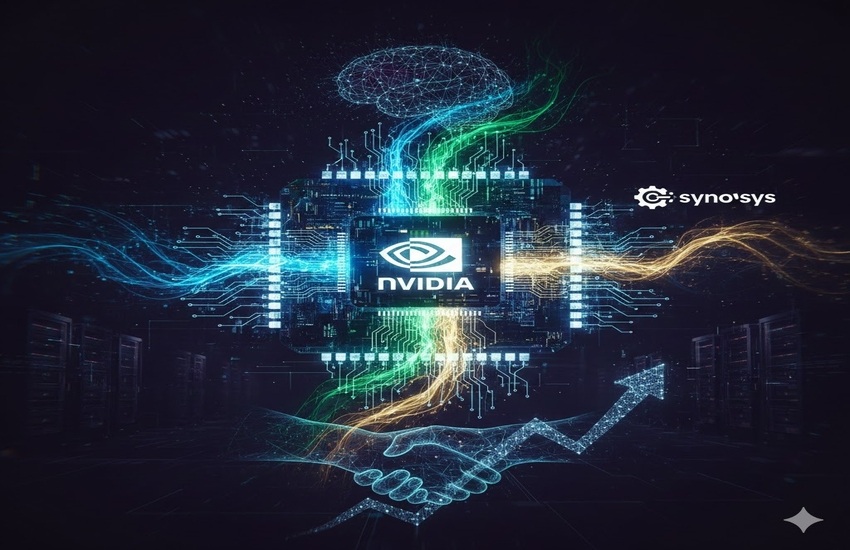
Nvidia is back at it again. On December 1, the chipmaker disclosed a $2 billion investment in Synopsys, one of the semiconductor industry’s key software players. The move wasn’t just a passive stake. This is part of a strategic partnership aimed at embedding Nvidia’s AI-computing stack directly into the software tools used to design the next generation of chips. Synopsys shares jumped nearly 7% on the news, while Nvidia added another deal to its AI empire. This collaboration integrates Nvidia’s tech into Synopsys’ chip-design platforms, allowing both companies to co-develop AI-powered tools and even jointly market them.
This is more than financial synergy. It’s a full-stack technological handshake. It comes as Nvidia’s leadership in GPUs and AI software (CUDA, NVLink, Grace Blackwell) continues to anchor trillion-dollar data center buildouts. At the same time, Nvidia has invested in AI firms like OpenAI, Anthropic, and CoreWeave, sparking concerns about circular deal-making. But unlike those arrangements, the Nvidia Synopsys AI partnership doesn’t come with chip purchase obligations. It’s positioned as a true “tech upgrade” for the chip industry. Let’s dig into why this matters so much.
A Deeply Embedded AI Play
The Nvidia Synopsys AI partnership isn’t just financial. It’s architectural. By embedding Nvidia’s AI tools into Synopsys’ chip-design software, the companies are setting a new standard for how future chips will be conceived, tested, and brought to market. Synopsys, based in California, already powers the backbone of semiconductor design. Its software helps companies model and simulate complex silicon layouts before a single wafer is printed.
Now, imagine injecting AI into that pipeline. Instead of manually configuring billions of transistors, AI agents can assist in designing faster and more efficient architectures. Nvidia’s CUDA platform and GPUs become central not only in running AI models but also in designing the chips that will run them. This creates a flywheel effect: Nvidia tech helps build better chips, which in turn run Nvidia-powered models more efficiently.
For Nvidia, this is about moving upstream. Rather than only selling GPUs for AI inference and training, it’s embedding its influence into the design phase of hardware itself. This strategic depth bolsters its moat in AI infrastructure, especially as hyperscalers dabble with in-house silicon. CUDA switching costs are already high. Now, Synopsys becomes another layer of glue sticking Nvidia deeper into the chip stack.
Strategic Continuity With A Twist
The Nvidia Synopsys AI partnership fits neatly into Jensen Huang’s recent playbook. Nvidia has been spreading its bets across the AI stack—from foundational models to networking gear. Earlier this year, Nvidia made headlines with investments in CoreWeave, a specialized cloud provider, and Anthropic, the ChatGPT competitor. These deals, though, came with baggage. Critics flagged concerns about circularity: Nvidia funds companies who then buy Nvidia’s chips, inflating demand and valuations in a tightly looped ecosystem.
With Synopsys, that concern is muted. This isn’t about a customer pre-buying GPU clusters. There’s no obligation to purchase Nvidia chips. Synopsys isn’t a startup scaling compute; it’s a design software powerhouse that’s been in the game for decades. Nvidia isn’t trying to juice short-term demand here—it’s setting standards.
And those standards will matter. Synopsys tools are used not only by Nvidia but also by rivals like AMD, Intel, and fabless players like Qualcomm. The fact that the AI tools built with Nvidia will be accessible to Synopsys’ other customers underscores the non-exclusive nature of this deal. It’s a rare instance where Nvidia’s tech could benefit even its competitors.
This also dovetails with Nvidia’s shift from being a chipmaker to becoming an AI infrastructure company. At Supercomputing ‘25, Nvidia emphasized how NVLink Fusion and Blackwell-based systems were transforming everything from inference to simulation. Now, they’re adding the chip-design phase to their domain.
A Competitive Edge As AI Enters The Hardware Core
As the semiconductor industry leans more into AI, the Nvidia Synopsys AI partnership could set a new precedent. Traditionally, AI has sat on top of the chip stack—models and data running on silicon built years prior. But AI is now influencing the very structure of that silicon. Nvidia is betting that AI-assisted chip design will be the next frontier.
This could be especially important as the industry grapples with design bottlenecks. Building smaller, faster, more energy-efficient chips is getting harder. And costs are skyrocketing. By layering AI into electronic design automation (EDA), Synopsys and Nvidia may help engineers speed up time-to-market while improving energy efficiency.
From a business standpoint, this is also an entry into a somewhat defensive space. Nvidia’s core GPU business, while booming, faces long-term risks from hyperscalers like Google and Amazon developing in-house chips. Investing in Synopsys offers Nvidia more control over the design language of future chips—including those made by rivals.
It’s also worth noting that Synopsys tech is already used by Tesla and Alphabet. The partnership could give Nvidia indirect influence over the tools used by these firms, even if they don’t buy Nvidia chips directly.
But The Circularity Cloud Still Hangs
Despite the optimism, it’s fair to ask: Does the Nvidia Synopsys AI partnership really escape the circular-deal narrative?
The short answer: partly. Nvidia insists there’s no requirement for Synopsys to purchase its chips. And Synopsys isn’t a cloud operator or model trainer, which helps. But Nvidia still bought $2 billion worth of Synopsys stock—at $414.79 per share—for a 2.6% stake. That’s not passive. And it positions Nvidia as both a technology partner and a shareholder, which could raise questions about governance or preferential treatment down the line.
Also, this partnership adds another layer of Nvidia influence over how chips are designed, marketed, and even simulated. For critics already concerned about Nvidia’s reach across AI infrastructure, this move may confirm fears that one player is centralizing too much of the ecosystem.
There’s also the broader industry question: Will Nvidia’s dominance stifle competition in AI tooling and chip design? Synopsys’ other customers—some of whom compete with Nvidia—might be wary. Yes, the tools are still available to everyone. But when one major chipmaker is embedded in the workflow software of the entire sector, the power dynamics shift.
Final Thoughts: Smart Move Or Strategic Overreach?
The Nvidia Synopsys AI partnership marks another chapter in Nvidia’s expansive AI infrastructure strategy. By linking its AI capabilities with Synopsys’ dominant chip-design software, Nvidia is planting deeper roots in the silicon lifecycle—long before chips are built or sold.
This fits with Nvidia’s push to become an end-to-end AI infrastructure provider. From GPUs and CUDA software to data center switches and digital twins, the company is everywhere. Now, it’s upstream too—at the blueprint stage.
That said, Nvidia’s valuation remains steep. With LTM EV/EBIT at 38.6x and EV/EBITDA at 37.72x, expectations are sky-high. This Synopsys deal doesn’t immediately move the revenue needle, but it does strengthen Nvidia’s long-term moat. Whether that’s enough to justify its current multiples depends on how durable this AI capex wave proves to be.
For now, the Nvidia Synopsys AI partnership is a signal. Nvidia isn’t just powering AI. It wants to shape how AI chips are born. And that, like everything Nvidia does these days, is worth watching.
Disclaimer: We do not hold any positions in the above stock(s). Read our full disclaimer here.


