

Continue Reading With Our 7-Day Free Trial
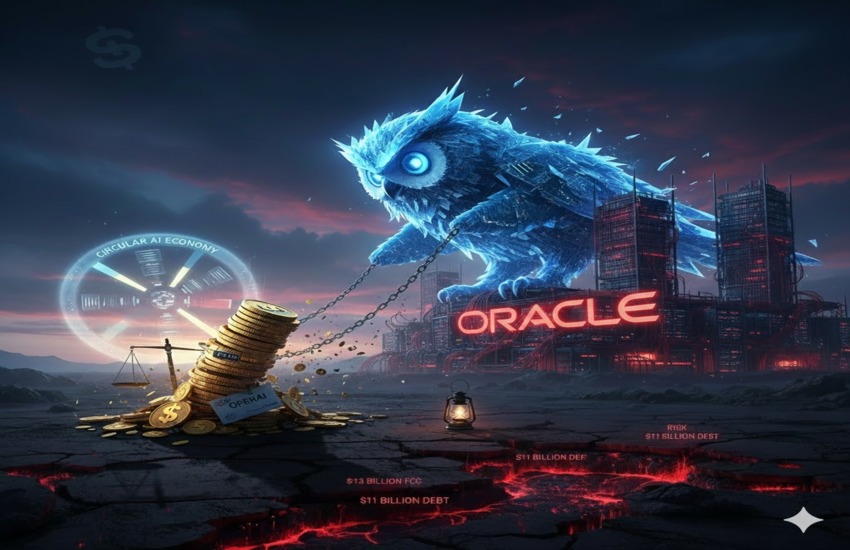
Oracle’s (NYSE:ORCL) AI ambitions may have been too big, too fast. The company’s sprawling plans to build a national footprint of AI data centers suffered a high-profile blow this week after reports surfaced that Blue Owl Capital walked away from a major funding partnership. While Oracle insists Blue Owl was simply outbid for the Michigan data center project, the market response was immediate: shares slid 4.4% and bond prices declined. This isn’t just about one broken deal. It’s about how Oracle AI data center funding fits into what some are calling the Circular AI Economy—a flywheel of speculative demand, expensive buildouts, and highly concentrated customer bets, especially OpenAI. With $111 billion in debt and a staggering $13 billion in negative free cash flow over the past year, Oracle’s balance sheet is feeling the strain. The Oracle Blue Owl breakup may be a canary in the coal mine for investors questioning the long-term sustainability of this funding as financial conditions tighten.
Ballooning Debt & The Fragile Economics Of AI Infrastructure
One of the biggest red flags in Oracle’s AI cloud story is financial leverage. Oracle sold $18 billion in new debt this fall, pushing total debt to $111 billion. Meanwhile, lease obligations soared by $152 billion in just three months. Those aren’t small numbers—especially for a company with negative $13 billion in free cash flow over the last 12 months. What’s behind the ballooning liabilities? Oracle is racing to build data centers at a scale that few outside of government contractors have ever attempted. The problem is, the economics of these projects are opaque at best.
Oracle says it won’t pay lease costs until the data centers are up and running. But the back-loaded nature of those obligations doesn’t make them go away. Investors are rightly concerned about how Oracle plans to fund the “Circular AI Economy” — in which AI startups like OpenAI book massive contracts they can’t yet pay for, and hyperscalers like Oracle build infrastructure on faith. At some point, someone has to front the bill. And with credit markets tightening, the Oracle Blue Owl breakup could signal investor hesitance to keep underwriting that faith.
Blue Owl’s Exit Is A Sentiment Shift In Disguise
The Oracle Blue Owl breakup isn’t just a headline; it’s a flashing neon sign that institutional appetite for funding hyperscale AI infrastructure may be peaking. Blue Owl, a private credit powerhouse known for yield-focused discipline, reportedly backed out of a deal to fund a one gigawatt data center in Michigan. Oracle and its partners claim Blue Owl was simply outbid. But the Financial Times suggests otherwise. Either way, the optics matter. Funding partners are reassessing the risk profile behind Oracle AI data center funding, not just the returns.
Oracle’s most high-profile customer, OpenAI, inked a $300 billion cloud contract—but doesn’t have $300 billion. That raises obvious concerns. If funding partners like Blue Owl are walking away, it’s likely not just about price. It’s about risk. The AI hype cycle may be cooling just as real-world costs are rising. And for Oracle, the risk isn’t just in one project falling through. It’s in the broader shift where debt markets, which once viewed AI infrastructure as bulletproof, are now applying the same credit discipline they do elsewhere.
AI Hype Isn’t Always Free Cash Flow Friendly
Let’s talk about the elephant in the server room: AI is expensive. Oracle’s pivot to AI infrastructure has come with enormous upfront capital commitments. CapEx hit $12 billion last quarter alone. That’s a record. And the result? A free cash flow loss of $10 billion—just in one quarter. When you stack that up against the company’s current valuation multiples, the picture gets trickier. Oracle trades at a steep 33.5x LTM P/E and 32.24x LTM EV/EBIT. Those are rich valuations for a company not generating positive free cash flow.
AI is supposed to be the engine of future profits. But for now, it’s the anchor on present cash flows. The Circular AI Economy depends on rapid scaling, recurring revenue, and the assumption that end users will eventually pay up. But with interest rates higher and equity markets more selective, the cost of waiting for those future profits is rising. If Oracle can’t keep up with the pace of monetization, it risks becoming a cautionary tale of how chasing AI hype too aggressively can backfire on a balance sheet.
Demand Is Still There—& Oracle Has What Others Don’t
Despite the noise around the Oracle Blue Owl breakup and debt concerns, Oracle does have one big thing going for it: real customer demand. Cloud revenue is growing, and Oracle Cloud Infrastructure (OCI) posted 66% year-over-year growth. GPU-related revenue shot up 177%, and the pipeline includes major names like Meta and NVIDIA. Oracle’s multicloud strategy and integrated data–infrastructure–application stack remain genuine differentiators. If demand continues converting into durable, high-margin revenue, the strain around Oracle AI data center funding could ease over time.
More importantly, Oracle is the only provider offering an integrated stack across data, infrastructure, and applications. That means enterprise customers looking toep their data secure while leveraging AI have a real reason to consider Oracle. Plus, Oracle’s AI Data Platform is positioned to help AI models reason across siloed enterprise data—a capability few can match. If Oracle can convert its bookings to revenue at scale while keeping margins intact, the long-term upside is real. But that “if” now comes with more caveats than it did just a quarter ago.
Final Thoughts: Still Building, But Now Under Scrutiny
Oracle’s AI strategy is a bold bet on the future of cloud infrastructure, but recent developments are injecting more skepticism into that bet. The Oracle Blue Owl breakup is more than just a footnote—it reflects shifting sentiment around the viability and financing of large-scale AI data center buildouts. With $111 billion in debt, negative cash flow, and rich LTM valuation multiples (33.5x P/E and 24.16x EV/EBITDA), the market is right to ask whether the math adds up.
Still, Oracle’s unique product suite and strong demand signal there’s a viable path forward—if management can keep costs aligned with revenue growth. For now, the company sits at the center of the Oracle AI data center funding debate. And whether it ends up a dominant AI infrastructure provider or a case study in overreach may depend less on AI itself and more on the old-fashioned principles of capital discipline and risk management.
Disclaimer: We do not hold any positions in the above stock(s). Read our full disclaimer here.