


Continue Reading With Our 7-Day Free Trial
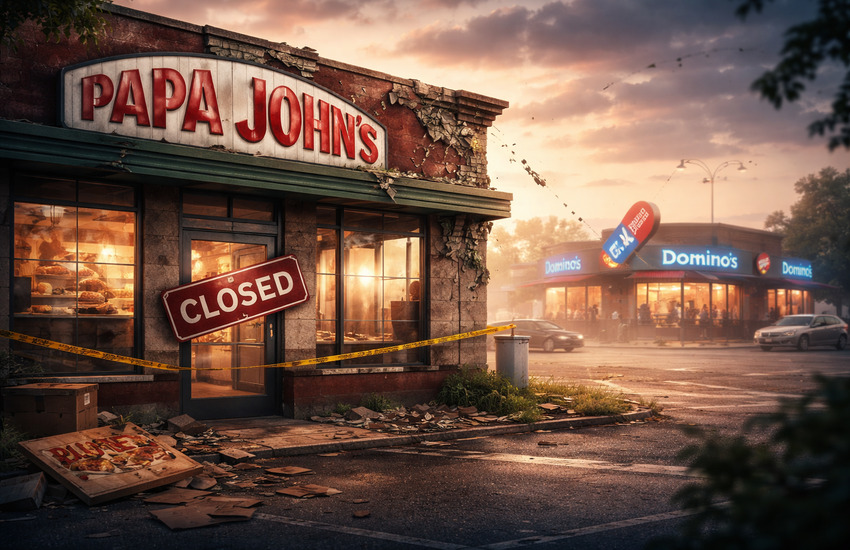
When Papa John’s International (NASDAQ:PZZA) announced it would close 300 U.S. stores by 2027, slash menu items, and cut about 7% of its corporate workforce, the move sounded dramatic. It was. The fourth-largest U.S. pizza chain is trying to reset its business in a category that hasn’t grown in two years. Same-store sales are soft. Profit fell 42% in the latest quarter. Revenue dropped more than 6%. Investors responded by sending the stock down nearly 9% in a single session.
Management says the closures target underperforming restaurants that no longer make economic sense. Most are franchisee-owned and many will shut this year. At the same time, the company is simplifying its menu and trimming costs. The big question for investors is simple: Is this a smart retrenchment that restores margins, or a sign that Papa John’s is losing ground to stronger rivals like Domino’s Pizza?
Papa John’s plans to close 300 North American stores by the end of 2027. Most of them are franchise locations. That detail matters. When a franchisor shutters units, it often signals strain at the operator level. These stores were deemed largely unprofitable and in need of heavy reinvestment. Instead of doubling down, management chose to cut them loose.
Store Closures Expose Franchise Weakness
This review followed a systemwide analysis of restaurant-level performance. Executives said sales patterns had shifted. Some units no longer generated enough volume to justify rent, labor, and marketing spend. In a better environment, operators might hold on and hope for recovery. Today, many simply cannot.
Franchisees are feeling pressure from higher wages, food costs, and discount-heavy promotions. Pizza is a value category. When traffic slows, operators rely on deals to drive orders. That keeps volumes moving but squeezes margins. If a store’s sales base is already thin, promotional activity can tip it into the red.
For Papa John’s corporate office, weak franchise economics are a red flag. Franchise royalties depend on gross sales, not profits. If operators close stores, royalty streams shrink. So while pruning underperformers may lift system averages, it also reduces total footprint and revenue scale.
The closures are framed as proactive portfolio optimization. That may be true. But they also reflect structural weakness within parts of the network. In franchising, healthy operators expand. Strained operators retrench. The difference is hard to ignore.
Flat Pizza Demand & Price-Sensitive Consumers
The broader pizza category is not offering much help. According to industry data, U.S. fast-food pizza sales have been roughly flat for the past two years. That means operators are fighting for share rather than riding category growth. In flat markets, the strongest brands tend to gain at the expense of weaker ones.
Consumers are also more price sensitive. Inflation has cooled, but household budgets remain tight. Pizza has long positioned itself as affordable comfort food. Yet even here, customers are hunting for deals. That shifts power to chains with the most efficient digital platforms and scale-driven cost advantages.
Papa John’s acknowledged a weak consumer environment in its latest results. Fourth-quarter revenue fell 6.1% to $498 million. Net income dropped 42% to $8.6 million. Those are not minor declines. They suggest that traffic and ticket size both came under pressure.
Discounting may help win short-term orders, but it erodes profitability. If every chain leans into coupons, no one truly wins. Meanwhile, delivery aggregators take their cut. Labor remains elevated relative to pre-pandemic levels.
In this environment, marginal stores suffer first. That is likely why so many Papa John’s units failed the profitability test. When demand stalls and promotions rise, the weakest links in the system get exposed.
Turnaround Levers On Costs & Menu Simplification
Beyond store closures, management is pulling internal levers. About 7% of corporate staff has been reduced. The goal is leaner operations and lower overhead. In addition, the company is trimming its menu. Papadias sandwiches and Papa Bites are being eliminated.
Menu simplification can sound small. It is not. Fewer items mean faster kitchen execution, lower ingredient waste, and simpler training. It can also sharpen brand identity. Papa John’s wants to focus on core pizza offerings and improve baking consistency.
Complex menus add operational drag. Each new product requires marketing spend, supply chain coordination, and in-store execution. When traffic is weak, complexity becomes a cost center. By cutting lower-performing items, management hopes to raise average unit efficiency.
Still, cost cuts alone rarely create growth. They can stabilize margins, but they do not automatically rebuild demand. Investors often reward restructuring when it is paired with visible top-line momentum. In Papa John’s case, revenue is currently declining. That makes the turnaround harder to sell.
Stripping out one-time charges, adjusted earnings of 34 cents per share slightly beat expectations. Yet the market focused on the bigger picture: falling sales, shrinking profit, and unit closures. Efficiency gains may help over time, but the path is not instant.
Competitive Pressure From Domino’s & Sector Consolidation
The competitive backdrop is unforgiving. Domino’s has openly said it is gaining market share, particularly from Pizza Hut and Papa John’s. Its CEO recently declared that the only disruption in pizza is the one Domino’s is creating. That is not subtle.
Domino’s benefits from scale, a strong loyalty program, and a tech-forward ordering platform. When consumers trade down or hunt for value, it can respond aggressively without breaking its economics. Papa John’s does not enjoy the same margin cushion.
Meanwhile, Pizza Hut’s parent is exploring strategic alternatives and closing around 250 U.S. stores. That signals consolidation pressure across the industry. Weaker locations are being culled. Stronger players are sharpening their competitive edge.
In this kind of shakeout, middle-tier brands often struggle most. They lack the premium cachet of fast-casual pizza concepts and the scale efficiency of the largest chains. Papa John’s is trying to reposition itself by tightening operations and focusing on core strengths.
Whether that is enough depends on execution. Market share losses can become self-reinforcing. Once a brand slips in relevance, regaining traffic requires sustained investment and consistent messaging. Cost cutting buys time. It does not guarantee regained leadership.
Final Thoughts
Papa John’s decision to close 300 stores, streamline its menu, and cut corporate roles reflects both discipline and distress. On the positive side, management is confronting weak units rather than propping them up. Simplification could improve restaurant-level margins and stabilize franchise health.
On the negative side, revenue is declining, profits have dropped sharply, and category growth is flat. Investors punished the stock because restructuring alone does not solve demand weakness or competitive pressure from Domino’s.
From a valuation standpoint, the shares now trade around 0.94x LTM enterprise value to revenue and about 10.6x LTM EV/EBITDA. The LTM P/E sits near 34x after earnings compression, while forward P/E has fallen closer to the mid-teens. The dividend yield is above 6%. Those multiples suggest the market sees risk but not collapse.
The turnaround may improve efficiency. The open question is whether efficiency can translate into renewed growth. For now, Papa John’s is shrinking to stabilize. Whether that sets the stage for expansion remains uncertain.
Disclaimer: We do not hold any positions in the above stock(s). Read our full disclaimer here.