

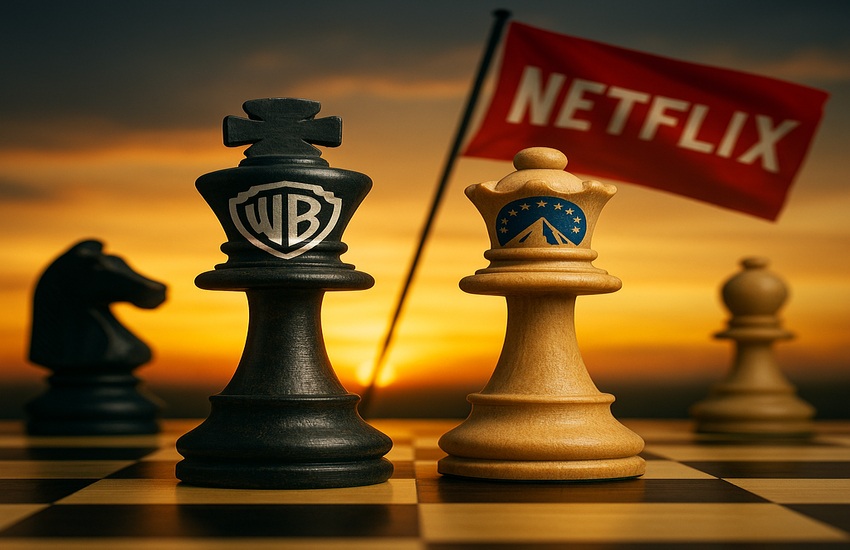
Just days after Netflix stunned Hollywood with a $72 billion deal to acquire the studio and streaming assets of Warner Bros. Discovery (WBD), Paramount Skydance swooped in with a $108.4 billion hostile counterbid. And not just any counteroffer—this one is a full-cash, full-company tender directly to shareholders, bypassing Warner’s board entirely. On the surface, the move might look desperate. But dig a little deeper, and you’ll find that “Paramount bids for Warner” isn’t just about valuation—it’s about survival, scale, and perhaps even legacy.
David Ellison, the CEO of the newly merged Paramount Skydance, is banking on a bold, high-stakes maneuver to bring WBD’s powerhouse content under one roof. That includes CNN, HBO, DC Comics, and the Harry Potter franchise. It’s also a last-ditch shot at outmaneuvering Netflix in the streaming wars. But is WBD worth this kind of premium? Can Paramount actually pull this off—or will Netflix simply wait it out and win by attrition?
Let’s break down the bullish and bearish drivers behind this headline-grabbing bid.
Bold Bid, Bigger Library: The Scale Play Paramount Can’t Ignore
The core logic behind why Paramount bids for Warner is simple: scale. Streaming is a brutal business where only a few global giants are expected to survive. With 79 million Paramount+ subscribers and 122 million for HBO Max, the combined total—after removing overlaps—gets you roughly 200 million global subs. That would make the merged entity a serious contender next to Netflix (over 300 million subs) and Disney (around 220 million).
More importantly, it’s about deepening the content moat. Combining Paramount’s portfolio (Top Gun, Mission: Impossible, SpongeBob, CBS) with Warner Bros. IP (Harry Potter, DC, HBO originals) creates an unrivaled studio stack. It’s a Disney-esque move—but without Mickey Mouse. And Ellison knows that the only way to build a “global home of storytelling” is to own more of the best stories.
This scale matters not just for direct-to-consumer (D2C) efforts but for driving licensing revenue, box office returns, and advertising heft. A bigger footprint means more leverage when negotiating with distributors, platforms, and even advertisers—especially as linear declines. For Paramount, it’s a swing-for-the-fences moment that may be its last best shot to stay relevant in the age of streaming.
Cash Is King: Paramount’s Offer Looks Cleaner Than Netflix’s
Let’s talk money. Paramount’s $30-a-share offer is entirely in cash, representing an $18 billion premium over Netflix’s $23.25 cash offer. That alone is why “Paramount bids for Warner” is catching attention from investors. But there’s more to the story.
Netflix’s offer includes $4.50 in its own stock and leaves WBD shareholders holding the bag for the Global Networks spin-off, a highly leveraged and declining business segment. Paramount, on the other hand, is offering to acquire all of WBD—linear and streaming included—which, from a certainty standpoint, is far simpler.
David Ellison has backing from heavyweight financiers, including RedBird Capital, Bank of America, Citi, and Apollo. Sovereign wealth funds from Saudi Arabia, Qatar, and Abu Dhabi are also in—but with no voting rights, which helps with regulatory optics. This deal also claims fewer antitrust hurdles. Netflix already has dominant share in streaming, and adding HBO Max could raise regulatory red flags. Paramount’s argument is: “We’re the underdog. This makes us more competitive.”
So for shareholders, the cash is real, the deal is whole, and the path to regulatory approval might just be faster.
Reality Check: Can Paramount Actually Digest Warner Bros?
Here’s where things get tricky. Paramount may be offering more cash, but it’s not exactly sitting on mountains of its own. The company’s market cap is around $15 billion—tiny compared to the $108 billion bid. That means heavy financing and a highly leveraged balance sheet if the deal closes.
Paramount’s LTM TEV/EBITDA sits at 10.73x, and its TEV/EBIT at 13.34x. Not outrageous, but elevated. Its free cash flow multiple went from 14x to a negative 13.92x—meaning it’s burning more than it’s earning. Levered FCF yield? Negative. And the dividend yield has dropped to 1.4%, reflecting tightening capital discipline.
While the promise of $6 billion in synergies sounds enticing, many of those cuts would likely come from overlapping corporate functions and tech stacks. Both companies have already undergone rounds of layoffs. Bain helped sketch this plan, but real execution remains to be seen.
In short: “Paramount bids for Warner” might make sense on paper, but the real-world integration challenge—managing two massive content ecosystems, streaming platforms, and cultures—could be overwhelming.
Netflix Isn’t Just Bigger—It’s Smarter in M&A
Let’s not forget: Netflix isn’t exactly standing still. Its $72 billion offer may be lower in cash, but it’s structured for strategic advantage. It only wants the profitable parts—HBO, Warner Studios, and streaming—not the aging cable assets. That leaner deal is easier to close, even if it faces regulatory pushback.
Netflix’s business model is also more resilient. It generates stronger margins, has global pricing power, and doesn’t rely on linear TV revenue to stay afloat. It doesn’t need to do this deal—but if it does, it strengthens its already dominant position.
Plus, there’s regulatory gamesmanship at play. While Trump-era favoritism might lean toward Paramount (with Ellison and Kushner ties), Netflix’s bid comes with a $5.8 billion breakup fee—a sign of confidence. If Paramount wins, it has to pay Netflix $2.8 billion. That’s a steep toll just to switch dance partners.
Netflix could still raise its offer—or simply let Paramount’s finances strain under pressure. Either way, it’s playing a long game. And its war chest gives it options Paramount doesn’t have.
Final Thoughts: High Stakes, Heavy Lifting & A Hollywood Cliffhanger
“Paramount bids for Warner” is a high-risk, high-reward maneuver that reflects both strategic urgency and financial boldness. There’s undeniable appeal in combining two storied media empires under one roof. It could catapult Paramount into the top tier of global content providers, finally giving it the scale it needs in streaming.
But the financials don’t lie. Paramount’s LTM TEV/EBITDA of 10.73x and EBIT multiple of 13.34x suggest it’s already priced for perfection. With negative free cash flow and declining dividends, the runway to deliver on its promises is narrow.
Meanwhile, Netflix has the advantage of size, simplicity, and staying power. Its leaner deal structure could prove easier to execute. Paramount’s best shot lies in winning over shareholders directly and avoiding a bidding war that it can’t afford to lose.
In the end, this isn’t just a corporate power play. It’s a referendum on who gets to shape the next era of Hollywood—and how much that future is really worth.
Disclaimer: We do not hold any positions in the above stock(s). Read our full disclaimer here.


