

Continue Reading With Our 7-Day Free Trial
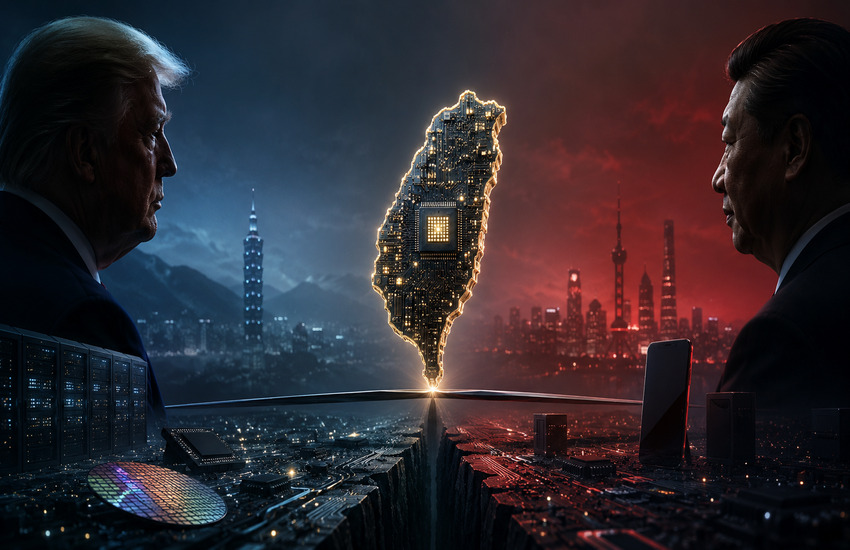
The market may enter the Trump-Xi summit watching tariffs, oil, and trade promises. But the most important sentence could be about Taiwan. China reportedly wants Washington to move from saying it “does not support” Taiwan independence to saying it “opposes” Taiwan independence. That sounds tiny. In semiconductor markets, it is not tiny at all. The distinction sits near the center of strategic ambiguity, and strategic ambiguity sits near the center of global chip valuations.
The reason is simple. Taiwan is not just another node in the supply chain. It is the pressure point for the advanced chips powering artificial intelligence, smartphones, servers, networking, and memory. Taiwan Semiconductor Manufacturing Company (NYSE: TSM), NVIDIA Corporation (NASDAQ: NVDA), Advanced Micro Devices (NASDAQ: AMD), Apple Inc. (NASDAQ: AAPL), Qualcomm Incorporated (NASDAQ: QCOM), Broadcom Inc. (NASDAQ: AVGO), ASML Holding (NASDAQ: ASML), and Micron Technology (NASDAQ: MU) all have different exposure. But none are fully outside the blast radius.
This is not a call on politics. It is a call on risk pricing. The wording itself may not change this quarter’s earnings. It could still change the multiple investors are willing to pay for those earnings.
Taiwan Is The Hidden Multiple Inside AI Stocks
For Taiwan Semiconductor Manufacturing Company, the impact is direct. TSMC is not merely a supplier. It is the manufacturing base case for much of the AI trade. In 2025, the company generated about $122 billion in U.S.-dollar revenue and reported a gross margin near 60%. Those are elite economics for a business that also sits inside one of the world’s most sensitive geopolitical zones.
A shift in U.S. language on Taiwan would not automatically reduce TSMC’s wafer shipments. The near-term order book may remain strong. The mechanism is different. Investors would likely demand a higher geopolitical discount on future cash flows. That can compress valuation multiples even when revenue growth remains healthy. For TSMC, the issue is not product-market fit. The issue is location-market risk.
NVIDIA Corporation faces a second-order version of the same problem. Nvidia’s latest reported quarter showed $57 billion of revenue, with data-center revenue at $51.2 billion. That makes the company’s valuation highly sensitive to confidence in AI infrastructure continuity.
If Taiwan risk rises, Nvidia’s earnings estimates may not fall immediately. Cloud customers still need GPUs. The pressure would show up first in the multiple. Investors may ask whether future Blackwell-class supply, packaging, and foundry capacity deserve the same certainty premium. Advanced Micro Devices has a similar issue. Its data-center segment produced $5.8 billion of revenue in the March 2026 quarter, making it increasingly exposed to the same AI hardware cycle.
The differential exposure matters. TSMC carries the most direct geographic risk. Nvidia carries the most visible AI-demand risk. AMD carries both AI opportunity and competitive catch-up risk. Broadcom Inc. has a different profile. Its AI exposure is tied more to custom accelerators and networking chips. Broadcom reported $5.2 billion of AI revenue in its fiscal third quarter, giving it leverage to the same buildout, but with a different customer mix.
The Smartphone Supply Chain Gets Repriced Before Earnings Do
Apple Inc. is not usually treated as a Taiwan-risk stock. It should be. Apple’s exposure is not just China demand or China assembly. It is also the advanced silicon inside the iPhone, Mac, and iPad ecosystem. Those chips depend heavily on advanced foundry capacity. When Taiwan risk rises, Apple’s margin question becomes less about demand and more about continuity, inventory buffers, and supply-chain redundancy.
Apple reported quarterly revenue of $102.5 billion in its fiscal fourth quarter of 2025. That scale gives Apple more bargaining power than almost any hardware company. It also means small supply shocks can become large dollar events.
The earnings mechanism is not dramatic at first. Apple can hold more inventory. It can prepay capacity. It can diversify assembly. But each mitigation can tie up working capital or raise operating complexity. That can weigh on gross margin over time. The valuation mechanism is cleaner. If investors see Taiwan as less protected by U.S. language, Apple’s multiple could reflect more supply-chain risk.
Qualcomm Incorporated is exposed differently. Qualcomm sells chipsets and licenses intellectual property across the smartphone ecosystem. A Taiwan wording shift would not hit Qualcomm the same way it hits Apple. Apple has device-level margin exposure. Qualcomm has handset-cycle exposure, Android supply-chain exposure, and China customer exposure.
That distinction matters. A softer Taiwan stance could help stabilize broader U.S.-China relations in the short run. That might support smartphone demand and Chinese OEM sentiment. But if it raises longer-term Taiwan uncertainty, it can pressure the chip supply chain that makes those phones possible. Qualcomm sits between those forces. It may benefit from trade calm, while still facing foundry and end-market uncertainty.
Capex Insurance Becomes The Quiet Profit Headwind
The market often talks about Taiwan risk as a binary event. That is too crude. The more investable issue is capex insurance. If companies become less comfortable relying on one geographic hub, they spend more to duplicate capacity elsewhere. That can protect supply. It can also dilute returns.
TSMC is already expanding globally. But global redundancy is expensive. It takes years. It also rarely matches the cost structure of the original cluster. Taiwan’s semiconductor ecosystem works because suppliers, engineers, customers, and logistics networks sit close together. Recreating that system in multiple regions can protect revenue. It can also pressure returns on invested capital.
ASML Holding is a different kind of beneficiary and risk carrier. ASML sells the lithography systems that advanced fabs require. The company reported 2025 net sales of €32.7 billion, with a gross margin of 52.8%. If governments and chipmakers fund more regional fabs, ASML may see durable tool demand.
But even ASML is not immune. More fragmented semiconductor capex can shift timing, customer mix, and export-control exposure. The company may sell into a world with more fabs. Yet those fabs may be less efficient. Investors then have to decide whether higher tool demand offsets policy friction. That is not a simple bullish or bearish setup.
For Nvidia, AMD, Broadcom, and Apple, capex insurance shows up indirectly. They do not all own fabs. But they pay for security through supply agreements, pricing, product timing, and inventory strategy. A higher-cost semiconductor system can flow into margins slowly. It can also reduce the future operating leverage that investors currently embed in AI and premium-device valuations.
Export Controls & Taiwan Language Are Becoming One Trade
Taiwan language does not sit alone. It is increasingly tied to tariffs, rare earths, AI chips, and investment access. The uploaded summit coverage notes that China may seek softer technology restrictions, tariff relief, or changes to U.S. language around Taiwan. It also notes that Beijing wants greater stability while Washington wants to preserve supply-chain access.
That matters for Nvidia and AMD. Both are exposed to U.S. export-control policy on advanced AI chips. A summit that stabilizes relations could reduce the risk of sudden escalation. But a summit that trades Taiwan language for other concessions could create a different concern. Investors may worry that policy predictability is becoming more transactional.
Micron Technology has a separate vulnerability. Memory is cyclical, capital-intensive, and strategically important. Micron’s earnings are driven by DRAM, NAND, and high-bandwidth memory demand. Taiwan risk can affect memory through customer confidence, server supply chains, and regional capex plans. It also sits near the broader U.S.-China technology contest.
Broadcom is somewhere between Nvidia and Micron. Its custom AI chips and networking products benefit from hyperscale AI spending. But custom silicon also depends on complex manufacturing relationships. If Taiwan risk raises the cost of supply assurance, Broadcom’s AI margins may face more scrutiny. That is especially important because investors increasingly value Broadcom as an AI infrastructure compounder, not just a diversified semiconductor company.
The differential exposure is therefore not about who is “safe.” It is about where the hit lands. Nvidia and AMD face valuation sensitivity around AI continuity. Micron faces cycle and policy sensitivity. Broadcom faces AI margin and customer-concentration sensitivity. Apple faces device margin and launch-timing sensitivity. TSMC faces the cleanest geographic risk premium.
Final Thoughts
The Taiwan wording issue may look small on paper. It is not small for markets. The difference between “does not support” and “opposes” could influence how investors price supply-chain certainty, geopolitical risk, and the durability of AI-related earnings.
The impact would vary by company. Taiwan Semiconductor Manufacturing Company carries the most direct geographic exposure. NVIDIA Corporation and Advanced Micro Devices are more exposed through AI hardware supply and valuation multiples. Apple Inc. faces device-chain and margin complexity. Qualcomm Incorporated has handset and China demand exposure. Broadcom Inc. and Micron Technology sit closer to AI infrastructure, memory, and custom silicon risk.
The key is monitoring, not guessing. Investors should watch the exact Taiwan wording after the summit, any comment on arms sales, export-control language, and whether companies start discussing higher supply-chain costs. Valuation multiples across AI and semiconductor stocks already assume a high degree of continuity. A wording shift would not automatically break that assumption. But it could make the market pay closer attention to how much continuity is really worth.
Disclaimer: We do not hold any positions in the above stock(s). Read our full disclaimer here.