


Continue Reading With Our 7-Day Free Trial
Oil markets have entered one of their most volatile periods in years. Crude surged above $100 per barrel, with West Texas Intermediate reaching roughly $109 and Brent briefly approaching $120, as the war involving the United States, Israel, and Iran disrupted shipping through the Strait of Hormuz. That narrow passage normally handles about 20% of global oil flows, and tanker traffic has slowed sharply amid security fears.
The price shock has already rippled through financial markets. U.S. stock futures fell sharply as energy prices jumped, while global equity indices posted their largest weekly declines in months. At the same time, crude futures have surged roughly 36% in a single week, one of the largest moves since the contract began trading.
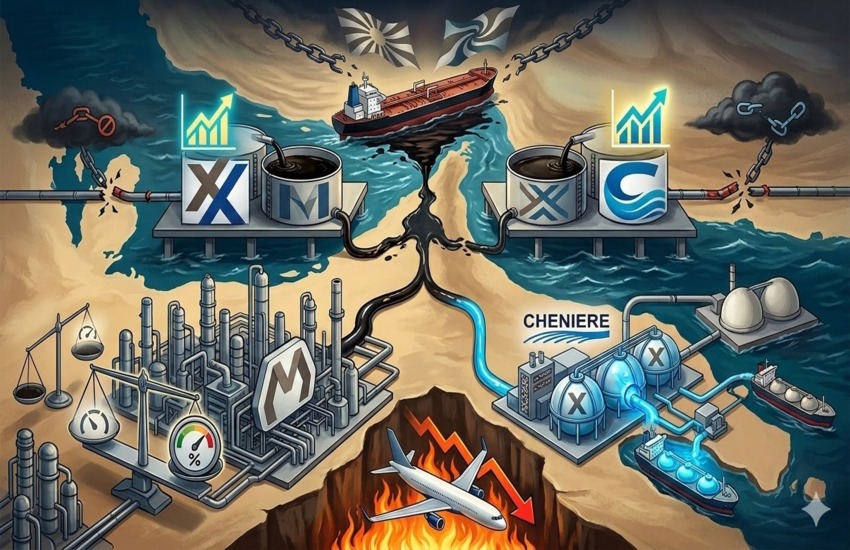
At first glance, the biggest winners appear obvious. Large oil producers such as Exxon Mobil (XOM) and Chevron Corporation (CVX) typically benefit when crude prices spike. Refiners such as Marathon Petroleum (MPC) and Valero Energy (VLO) could also see improved margins depending on refined-product spreads.
But the situation unfolding in the Persian Gulf is not a typical commodity rally. Production shut-ins across the Middle East, LNG supply disruptions, and the potential closure of a strategic chokepoint suggest the real impact may unfold unevenly across specific companies over the next 12–24 months.
What The Market Has Priced So Far
Energy prices moved first. Brent crude jumped more than 25% in a short period, while gasoline prices in the United States have already climbed to their highest levels since August 2024.
Yet equity markets reacted in a more complicated way. Global stock markets declined even as oil surged, reflecting concerns that rising energy costs could push inflation higher and slow economic growth.
Energy equities themselves show mixed signals. Sector ETFs tied to exploration and production have rallied strongly over the past year, with the SPDR S&P Oil and Gas Exploration ETF rising roughly 36% over twelve months. Technical indicators now suggest some of those stocks may be extended.
That divergence raises a critical question for investors. If crude prices continue rising because of supply disruptions rather than demand strength, the beneficiaries may not be evenly distributed across the industry. Integrated producers, refiners, and exporters could face very different earnings dynamics depending on how the supply shock evolves.
Which brings the focus back to the companies most exposed to global crude flows, including Exxon Mobil and Chevron, whose earnings sensitivity to oil prices is substantial, but whose global operations also expose them to logistical disruptions if shipping constraints or production shut-ins begin to ripple through global energy supply chains.
Integrated Majors: Exxon Mobil & Chevron Face A Price Tailwind With Operational Complexity
The most immediate beneficiaries of higher oil prices are large integrated producers such as Exxon Mobil (XOM) and Chevron Corporation (CVX). Both companies generate substantial revenue from upstream production, meaning rising crude prices typically expand operating cash flow and improve margins.
When oil prices spike, upstream earnings usually react quickly because production costs change far more slowly than selling prices. This dynamic historically expands profit margins during commodity upcycles.
However, the current shock introduces operational uncertainty. The Strait of Hormuz normally carries roughly a fifth of global crude shipments, and disruptions to that corridor can create physical bottlenecks rather than simply higher prices. If exports from the Gulf remain constrained, producers elsewhere may benefit from stronger pricing while also facing volatility in global trading flows.
For Exxon Mobil and Chevron, which operate globally across refining, trading, and production assets, the earnings effect depends not just on crude prices but also on how long supply disruptions persist and how quickly alternative shipping routes stabilize the market.
Refining Margin Dynamics: Marathon Petroleum & Valero Energy
The refining sector could see a different kind of impact. Marathon Petroleum (MPC) and Valero Energy (VLO) generate profits from the spread between crude oil prices and refined products such as gasoline and diesel.
When crude rises rapidly due to supply disruptions, refiners sometimes benefit if product prices rise faster than feedstock costs. But that relationship is not guaranteed. If crude spikes sharply while demand weakens because consumers reduce spending, refining margins can compress.
Gasoline prices have already risen sharply as oil moved above $100. U.S. retail fuel prices climbed more than 13% within days of the conflict escalating, reflecting the lag between crude supply and refined fuel distribution.
For refiners like Marathon Petroleum and Valero, the key question is whether product demand remains resilient if consumers begin to treat higher gasoline prices as a constraint on discretionary spending.
LNG Disruption & Global Energy Markets: Cheniere Energy
The crisis has also spilled into natural gas markets. A drone attack forced the closure of Qatar’s Ras Laffan LNG facility, removing roughly one-fifth of global LNG supply from the market temporarily.
That disruption could benefit companies tied to liquefied natural gas exports, including Cheniere Energy (LNG), one of the largest U.S. LNG exporters.
Europe and Asia rely heavily on imported LNG, and the sudden tightening of supply has already pushed global gas prices higher. If the outage persists or delays expansion projects such as Qatar’s North Field development, alternative LNG suppliers could see stronger demand.
For Cheniere Energy, the opportunity lies in redirecting cargoes toward markets willing to pay higher prices. But the broader energy shock also raises the possibility of policy responses, including coordinated releases of strategic reserves, which could eventually moderate commodity prices.
Airlines & Fuel Exposure: Delta Air Lines
Higher oil prices also ripple through industries that consume energy rather than produce it. Delta Air Lines (DAL), like other global airlines, faces immediate exposure to jet fuel costs when crude prices surge.
Jet fuel prices in Europe have already reached record levels, and similar trends have emerged in U.S. markets as diesel and gasoline prices rise alongside crude.
For airlines, fuel is one of the largest operating expenses. Rapid price increases can compress margins unless ticket prices rise enough to offset the cost. That adjustment usually occurs gradually, meaning short-term profitability can be sensitive to energy volatility.
Delta Air Lines therefore represents the opposite side of the energy shock: a company whose earnings sensitivity increases when oil prices rise quickly rather than gradually.
Where The Market May Be Underreacting
One of the less obvious dynamics emerging from the crisis is the divergence between commodity prices and energy equities.
Crude oil has surged dramatically, yet technical indicators suggest some oil stocks may be vulnerable to near-term pullbacks after extended rallies. For example, shares of Exxon Mobil have shown signs of weakening momentum despite higher oil prices, with technical indicators suggesting a potential move toward lower levels if the rally stalls.
At the same time, LNG infrastructure companies such as Cheniere Energy could see a longer tail of demand if global gas supply remains constrained.
Over the next 6–24 months, investors may find that the companies most affected are not those most directly tied to oil prices, but those exposed to shifts in global energy trade flows.
Long-Term Structural Implications
Beyond the immediate price spike, the crisis highlights structural changes in global energy markets.
The Strait of Hormuz remains one of the world’s most critical chokepoints. Any disruption forces producers, refiners, and traders to rethink shipping routes, storage capacity, and geopolitical risk.
For energy companies, this may translate into higher capital allocation toward logistics infrastructure, diversified export routes, and supply resilience.
For investors, the bigger implication may be that geopolitical risk premiums return to commodity markets after years of relative stability. Oil, natural gas, and even hard assets such as gold may trade with structurally higher volatility as markets price a more fragmented geopolitical environment.
Final Thoughts
The surge in oil prices above $100 per barrel reflects one of the most significant energy disruptions in years. While higher crude prices can benefit producers such as Exxon Mobil and Chevron, the broader ripple effects across refiners, LNG exporters, and fuel-intensive industries create a far more uneven landscape.
Marathon Petroleum and Valero Energy may experience shifting refining margins depending on demand resilience. Cheniere Energy could see stronger LNG demand if global gas supplies remain constrained. Airlines such as Delta Air Lines face immediate cost pressures as fuel prices rise.
Over the coming months, the key variable will be the duration of the supply disruption through the Strait of Hormuz. Investors will need to watch not just the price of oil but how the shock reshapes global energy flows and corporate earnings exposure across the sector.
Disclaimer: We do not hold any positions in the above stock(s). Read our full disclaimer here.