


Continue Reading With Our 7-Day Free Trial
OpenAI (NASDAQ:GOOGL) just made the next big move in the AI race. OpenAI introduces ChatGPT ads this year, starting with tests in the U.S. in the coming weeks. These ads will show up for free-tier users. Paid plans like Plus, Pro, Business, and Enterprise will stay ad-free. The ads are expected to appear at the bottom of answers, clearly labeled, and separate from the response. OpenAI says ads won’t change how ChatGPT answers questions. It also says ads won’t show for users expected to be under 18, and won’t appear near sensitive topics like health, mental health, or politics.
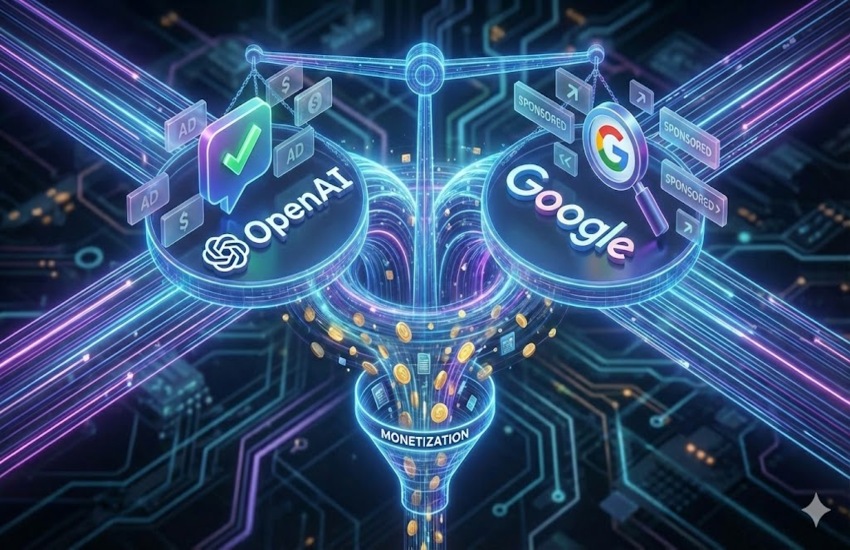
This matters because it looks a lot like Search monetization, but inside a chat interface. That is where Google makes its money. And Google already knows it. It’s pushing AI Overviews, AI Mode, and new ad formats that sit inside AI answers. The next phase is clear: more AI shopping, more sponsored placements, and more paid Gemini tiers.
ChatGPT Ads Open New Revenue Stream While Keeping Core Answers Separate
OpenAI introduces ChatGPT ads with a structure that looks intentionally “non-intrusive.” The ads are planned to sit at the bottom of answers, and OpenAI says they will be clearly labeled. That placement matters. It keeps the response itself clean. It also makes the ad feel like a follow-on option. For a lot of users, that may reduce the “this is now spam” reaction. It also lines up with the reason OpenAI gave for the change. It wants more people to access the product with fewer limits, without forcing a subscription.
This move also creates a second engine for monetization. Subscriptions are one engine. Ads become another. That’s familiar playbook territory. It is how most consumer internet businesses scale. And it helps with the reality that AI is expensive to run. Competitors are already doing it too. The article points to Microsoft Copilot and Perplexity adding advertising or sponsored content.
Now look at what else OpenAI did at the same time. It launched ChatGPT Go globally at $8 a month. That is a clean middle tier. It offers more than free, but less than Plus. OpenAI describes it as giving expanded access to its latest model, plus more messages, uploads, and image creation. That price point is not random. It’s built for people who don’t want $20 a month.
From a business angle, OpenAI introduces ChatGPT ads and a cheaper plan in the same breath. That widens the funnel in two directions. Free gets monetized. Paid becomes more reachable. And the product gets stickier over time. The bigger question is simple. How many user workflows shift from search to chat once ads arrive?
User Trust & Privacy Concerns May Shape Adoption Of Ad-Supported ChatGPT
When OpenAI introduces ChatGPT ads, the biggest risk is trust. Not because ads exist. People accept ads. The issue is what users think ads will do to answers. OpenAI is trying to get ahead of that. It says ads will be separate from the chatbot’s answer. It also says ads will not affect how the model responds to questions. That’s an important promise to make, especially early. It’s the difference between “helpful tool” and “paid influence machine” in a user’s mind.
The guardrails also tell you what OpenAI is worried about. During the tests, ads won’t appear on accounts where the user is expected to be under 18. Ads also won’t show near sensitive topics. Health and mental health are specifically called out. Politics is too. That is likely about risk management as much as ethics. Sensitive categories create reputation risk fast. They also create regulatory heat. So OpenAI is drawing a boundary line from day one.
But even with guardrails, user perception will shape adoption. Ads at the bottom can feel light. But they also make ChatGPT feel more like a feed. Some users will shrug. Others will switch to a paid plan. That could be the point. The “free with ads, paid without ads” model nudges upgrades. It also creates segmentation. It separates power users from casual users.
This is also where competition shows up. Google is already blending AI and monetization in Search. It has years of advertiser relationships. And it has a massive data flywheel. If chat ads become normal, it will be harder for any player to stay “pure.” That includes OpenAI. So the trust question becomes strategic. If users accept ads inside chat, the format becomes permanent. If they reject it, the rollout slows. Either way, the whole market learns quickly.
Google May Monetize Gemini Via Sponsored Results In AI Search Replies
Google is not waiting around. It’s already building an AI Search experience that can carry ads. The earnings transcript makes that very clear. In Q3, Google said AI is driving an “expansionary moment” for Search. It highlighted AI Overviews and AI Mode as key growth drivers. AI Mode rolled out globally across 40 languages. It reached over 75 million daily active users, and queries doubled over the quarter. AI Overviews scaled even larger. Google said it is now scaled to over 2 billion users. That scale is a serious moat.
On monetization, Google’s messaging was direct. For AI Overviews, it said monetization is approximately the same rate at the current baseline. Ads can appear below and within the AI response. That sounds like the first wave. It also said it’s testing ads in AI Mode. That’s the second wave. If OpenAI introduces ChatGPT ads, Google has every reason to speed up this test loop. It does not want “chat monetization” to become the default ad format without Google leading it.
Google also rolled out AI Max in Search globally in September. It described it as the fastest-growing AI-powered search ads product. It is already used by hundreds of thousands of advertisers. In Q3 alone, AI Max unlocked billions of net new queries. Google framed it as better intent prediction and better matching. Kayak grew conversion value by 12% in early tests after turning on AI Max. SoFi used Performance Max and saw a 39% improvement in conversion volume year over year.
The core point is simple. Google is pushing ads closer to “answers” and “actions.” That is where AI interfaces live. It also means Google can defend pricing and performance. Even if user behavior changes, the ad format can adapt.
Gemini Paid Tiers & Cloud APIs Could Drive Enterprise Subscription Growth
If OpenAI introduces ChatGPT ads, Google’s best defense is not just ads. It is paid AI access. It is enterprise distribution. And it is cloud pricing power. Google Cloud had a standout quarter in the transcript. Cloud revenue grew 34% to $15.2 billion. Cloud operating income rose 85% to $3.6 billion. Operating margin expanded to 23.7%. Cloud backlog grew 46% sequentially to $155 billion. And Google said it signed more $1 billion+ deals through Q3 than in the prior two years combined.
The AI angle is the growth lever. Google said revenue from products built on its generative AI models grew more than 200% year over year. It also said nearly 150 customers processed around 1 trillion tokens each over the past year. Google is pushing a full portfolio: Gemini, Imagen, Veo, Chirp, and Lyria. It is also pushing custom infrastructure. It offers both GPUs and its own TPUs, including the Ironwood TPU. It highlighted plans from Anthropic to access up to 1 million TPUs.
On subscriptions, Google is building a parallel path. It crossed 300 million paid subscriptions, led by Google One and YouTube Premium. And it launched Gemini Enterprise, which it called the “front door” for AI in the workplace. It already crossed 2 million subscribers across 700 companies. That’s a meaningful base. It also changes the model. Ads are not required in enterprise. Pricing, seats, and API usage become the monetization engine.
This is where Gemini can monetize in multiple ways. Paid plans can sit at the consumer level. Sponsored results can sit inside AI Search replies. Shopping-style ads can sit inside conversational browsing. And Cloud/API pricing can scale with enterprise demand. In a world where OpenAI introduces ChatGPT ads, Google has more than one lever to pull.
Final Thoughts: The Next Battle Is About Where Ads Live And Who Controls The Funnel
This shift is easy to summarize. OpenAI introduces ChatGPT ads to monetize the free tier and widen access at the same time. Free users will see ads during U.S. testing, likely placed at the bottom of answers. Paid tiers will stay ad-free. OpenAI says ads won’t influence responses, and it will avoid under-18 accounts and sensitive topics during tests. That should lower friction early. But it also changes what “free ChatGPT” feels like.
For Google, the threat is not just ad dollars today. It’s user habit tomorrow. If people start searching inside chat first, Google’s ad funnel gets pressured at the top. That’s why Google is pushing AI Overviews and AI Mode hard. It’s also why it is testing ads inside AI Mode, and expanding ads in AI Overviews. It is building shopping-style experiences too, including conversational shopping and try-on features in the U.S. It wants to keep commercial discovery inside Search, even as the interface changes.
Valuation matters here because the market already prices in a lot of success. Based on the multiples you shared, Google’s LTM EV/Revenue is 10.28x, LTM EV/EBITDA is 27.30x, and LTM P/E is 32.57x as of January 16, 2026. Those are meaningfully higher than earlier 2025 levels in your table. That suggests investors are already rewarding AI-driven growth and monetization resilience. The upside is continued execution in Search and Cloud. The risk is higher cost intensity, especially with rising CapEx and depreciation.
The takeaway is straightforward. OpenAI introduces ChatGPT ads, and that likely pushes the whole market toward “AI answers with monetization.” Google will respond by tightening AI Search integration, expanding sponsored placements, and scaling Gemini subscriptions and Cloud pricing. The next few quarters will show whether users treat chat ads as helpful links, or as noise.
Disclaimer: We do not hold any positions in the above stock(s). Read our full disclaimer here.