


Continue Reading With Our 7-Day Free Trial
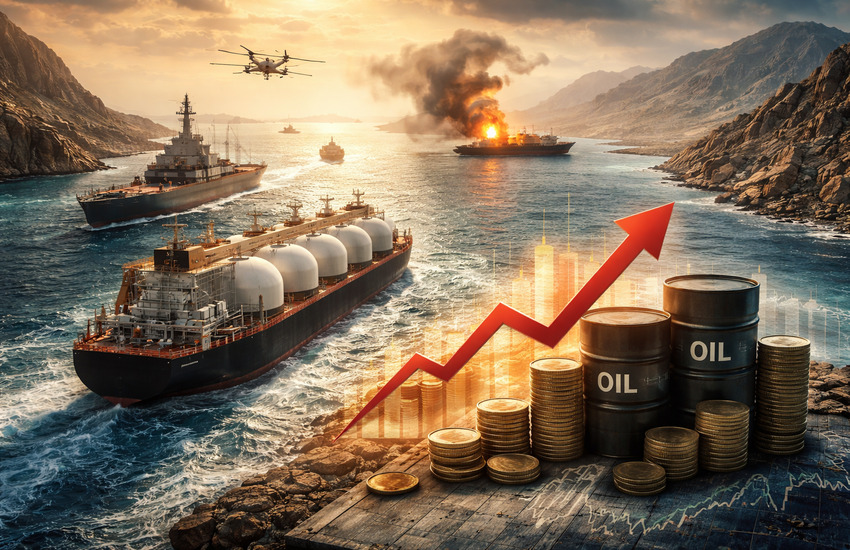
The Iran war has turned a narrow shipping corridor into one of the most important forces shaping global markets.
Roughly 20% of the world’s oil supply moves through the Strait of Hormuz, and the escalating conflict has pushed crude prices sharply higher. Brent crude recently climbed above $100 per barrel, with oil rising roughly 40% since the war began, even as governments attempted emergency supply measures and released strategic reserves.
At the same time, the White House has begun pressing allies to form a coalition to escort ships through the strait after multiple vessels were struck and energy markets destabilized. The administration has reportedly contacted several nations about deploying warships to secure the route as gasoline prices in the United States surged 26% in just one month to about $3.70 per gallon, according to AAA.
Markets reacted quickly to the immediate shock. Oil producers rallied, volatility rose, and investors rushed into defensive assets. But the real story may be developing more slowly beneath the surface.
Over The Next 6–24 Months, the companies most exposed to shipping risk, LNG logistics, and maritime insurance could experience structural shifts in pricing power and demand.
The Strait of Hormuz is not just a geopolitical flashpoint. It is a mechanism through which energy flows, shipping insurance costs, and global trade economics converge—meaning specific U.S.-listed companies could see very different outcomes depending on how long disruption in the region persists.
What The Market Priced First
The market’s first reaction to the war was predictable.
Energy prices surged as traders assessed potential disruptions to global oil flows. Brent crude jumped above $100 per barrel, and global equities sold off as investors began pricing a potential energy-driven inflation shock. The S&P 500 Index slid to its lowest level since November, while volatility increased and investors reduced risk exposure.
Investors initially focused on the most obvious beneficiaries of higher oil prices: upstream producers and defense-related companies tied to military spending.
What the market did not fully price in the early days of the conflict were the second-order consequences tied to maritime logistics. Roughly a fifth of global oil exports pass through the Strait of Hormuz, meaning disruptions there affect not just oil prices but tanker insurance, LNG routing, and the economics of alternative energy supply chains.
Those effects are beginning to show up in the underlying mechanics of companies whose revenues depend on global energy logistics—including LNG exporters, marine insurers, and energy producers whose pricing power rises sharply when global supply routes become uncertain.
And that dynamic could have lasting implications for companies like – Cheniere Energy if disruptions to Middle Eastern shipping continue because the world’s largest LNG importers increasingly look to U.S. export capacity as a substitute for unstable energy supply routes.
Cheniere Energy (LNG): LNG Becomes The Reliability Premium
Cheniere Energy (LNG) sits directly in the middle of the energy-security conversation that the Strait of Hormuz crisis has triggered.
The company operates the largest liquefied natural gas export platform in the United States, and its economics depend heavily on global demand for stable supply chains rather than purely on spot oil prices. Cheniere expects 2026 consolidated adjusted EBITDA of roughly $6.75 billion to $7.25 billion, reflecting the scale of its contracted LNG export model.
When geopolitical instability threatens shipping routes in the Middle East, LNG buyers often prioritize reliability over price. That can widen regional price spreads and increase the strategic value of export terminals located far from geopolitical choke points.
The mechanism is not necessarily higher volumes but higher strategic demand for dependable supply. LNG cargoes shipped from the U.S. Gulf Coast face far lower geopolitical risk than Middle Eastern energy shipments moving through Hormuz.
If shipping risk remains elevated, utilities and governments may prioritize longer-term LNG contracts from exporters like Cheniere, which could reinforce the company’s long-term cash flow durability.
White Mountains Insurance Group (WTM): The Hidden Winner In Shipping Risk
White Mountains Insurance Group (WTM) operates in a corner of the financial system that rarely receives attention until maritime disruption occurs: shipping insurance.
When vessels face the risk of mines, drone strikes, or naval conflict, insurers reprice the cost of coverage almost immediately. That dynamic becomes particularly powerful when large volumes of energy shipments move through a single chokepoint.
White Mountains has historically maintained a conservative balance sheet with debt-to-equity of roughly 0.14, giving the company flexibility to deploy capital when insurance pricing rises.
The Strait of Hormuz crisis has already increased shipping risk premiums. If tanker insurance costs continue rising, insurers exposed to maritime risk could see improved underwriting conditions and higher pricing across policies tied to energy transportation.
Unlike energy producers, whose earnings depend directly on commodity prices, insurers monetize the risk premium embedded in global shipping routes, which makes their exposure structurally different from companies whose fortunes rise and fall with oil.
APA Corporation (APA) And Northern Oil And Gas (NOG): Oil Producers With Different Leverage To The Shock
The most visible beneficiaries of rising oil prices remain upstream producers.
APA Corporation (APA), which operates across the Permian Basin, the United Kingdom, and Egypt, produced more than 450,000 barrels of oil equivalent per day in late 2025, giving it significant exposure to higher commodity prices.
The company trades at roughly 7.7 times earnings and pays a dividend yield near 3%, meaning sustained oil prices above $100 could translate into stronger free cash flow generation.
Northern Oil and Gas (NOG), however, operates under a different model. Instead of drilling directly, it acquires mineral interests and partners with operators to extract hydrocarbons. That structure keeps operating costs relatively low while allowing the company to benefit when commodity prices rise.
Northern Oil and Gas currently yields roughly 6% annually, reflecting its ability to pass through higher oil prices into cash distributions. In a prolonged energy shock, companies with lower operating overhead may see a larger share of incremental price gains flow directly to cash flow.
Edison International (EIX): The Electricity Demand Side Of The Oil Shock
Edison International (EIX) represents a different pathway through which energy shocks affect corporate earnings.
Utilities historically benefit from stable demand, but sustained increases in gasoline prices can accelerate long-term electrification trends. Edison has already committed roughly $41 billion toward grid modernization and electrification, positioning the company to benefit if high fuel prices encourage greater adoption of electric vehicles and electric heating systems.
The company pays a dividend yield of about 4.9% and has raised payouts for 23 consecutive years, reinforcing its reputation as a defensive utility investment.
Unlike oil producers, utilities do not benefit directly from higher commodity prices. Instead, their exposure lies in long-term demand growth for electricity infrastructure if transportation and heating systems shift away from petroleum.
The Names The Market May Be Underestimating
The immediate market reaction to the Iran conflict focused on oil producers and defense companies.
But the economic consequences of the Strait of Hormuz disruption extend well beyond the energy sector. LNG exporters, shipping insurers, and electricity infrastructure companies each capture different aspects of the same macro shock.
Companies like Cheniere Energy, White Mountains Insurance Group, Edison International, APA Corporation, and Northern Oil and Gas illustrate how a single geopolitical chokepoint can influence multiple layers of the global economy—from energy pricing to maritime risk premiums to long-term electrification trends.
The market often prices the first order effect quickly. The second-order impacts tied to logistics, insurance, and energy infrastructure tend to take longer to emerge.
Long-Term Structural Implications
The Strait of Hormuz crisis highlights how concentrated global energy supply chains remain.
If instability in the region persists, governments and energy companies may accelerate efforts to diversify supply routes and reduce dependence on Middle Eastern shipping lanes. LNG infrastructure, insurance pricing models, and electricity grids could all see capital allocation shift as companies adapt to a higher-risk geopolitical environment.
At the same time, policy responses remain uncertain. Military escorts for commercial shipping could stabilize tanker flows, while a negotiated ceasefire might reduce the geopolitical risk premium embedded in energy prices.
Valuations for companies exposed to energy logistics and insurance may therefore fluctuate as markets attempt to determine whether current disruptions represent a temporary shock or a longer-term restructuring of global energy flows.
Final Thoughts
The Strait of Hormuz has always been a strategic chokepoint for global energy markets. The current conflict has simply reminded investors how powerful that geography can be.
Oil prices rising above $100, shipping disruptions, and rising insurance costs are all immediate consequences of instability in the region. But the longer-term effects may appear in less obvious places—from LNG export economics to marine insurance pricing and the economics of electrification.
For investors, the key question is not just how long the conflict lasts, but which companies are structurally positioned to capture the economic consequences of uncertainty in global energy transportation.
Disclaimer: We do not hold any positions in the above stock(s). Read our full disclaimer here.