

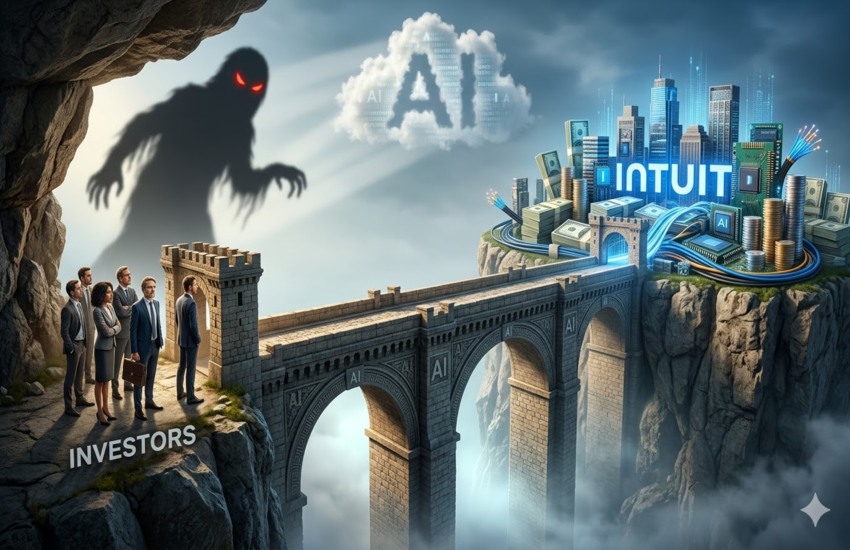
Markets love a good villain. Right now, artificial intelligence has become the monster hiding under every software company’s bed. Investors seem convinced that generative AI will dismantle legacy platforms and flatten the economics of software. Few companies illustrate that fear better than Intuit (NASDAQ:INTU), whose shares have dropped sharply even as its business continues to grow.
Management sees the situation very differently. In fact, the company recently accelerated share buybacks and halted executive stock sales to signal confidence in the business. The leadership team argues the market is chasing a narrative rather than looking at the numbers. Revenue is still growing at double-digit rates. AI tools are already embedded in the product suite. And millions of customers are using them daily.
That disconnect makes Intuit an interesting case study in how markets process technological disruption. AI will undoubtedly reshape software. But disruption rarely unfolds the way investors expect. Sometimes the companies assumed to be the most vulnerable end up benefiting the most.
The debate around Intuit raises a bigger question. Is AI about to dismantle financial software platforms, or is it quietly making them stronger?
Below are four forces that help explain why the market might be misreading the situation.
Regulation, Liability & Trust Still Matter
Financial software is not the same as a chatbot writing poems or summarizing emails. The stakes are much higher. When a business files taxes incorrectly or misreports financial data, the consequences can be severe. That simple fact shapes the entire industry.
Intuit’s management emphasizes this point repeatedly. The company operates in a regulated environment where accuracy, compliance, and security matter deeply. For customers making financial decisions, mistakes carry real liability. That changes how technology is adopted.
Many AI tools today provide suggestions. But financial workflows require something closer to certainty. Businesses need confidence that calculations are correct and compliant with regulations. Consumers filing taxes want reassurance that their returns will stand up to scrutiny. In those moments, trust becomes a powerful moat.
This is where incumbents like Intuit have an advantage. The company has spent decades building software that handles high-stakes financial tasks. It also integrates human experts into its services. That combination of technology and professional expertise creates an experience that pure AI tools struggle to replicate.
In practice, this means AI may complement trusted platforms rather than replace them. Chatbots can answer questions about taxes. But filing a return with confidence still requires systems built for accuracy and compliance. In finance, reliability matters more than novelty.
Data Moats May Matter More In The AI Era
Artificial intelligence thrives on data. The better the training data, the more accurate the results. That dynamic tends to favor companies that already sit on large and unique datasets.
Intuit is one of those companies. Its platform serves nearly 100 million consumers and businesses across products such as TurboTax, QuickBooks, and Credit Karma. Over decades, those platforms have accumulated enormous amounts of financial information.
This data fuels the company’s AI models. Management describes its system as a combination of proprietary data, domain-specific AI models, and human expertise. Each new customer interaction improves the system. More data leads to better insights, which in turn improves recommendations.
The result is a network effect. As more customers use the platform, the intelligence of the platform improves. That can deepen the company’s competitive advantage over time. AI does not erase the value of data. In many cases, it amplifies it.
The same dynamic has played out in other industries. Companies like Bloomberg and Visa built durable advantages around proprietary financial data. AI did not weaken those advantages. Instead, it made their datasets even more valuable.
Intuit appears to be following a similar path. Its financial data ecosystem may prove harder to replicate than investors currently assume.
AI & Human Expertise Are Becoming A Hybrid Model
One of the more interesting insights from Intuit’s recent discussions is how customers are responding to automation. Many analysts assume AI will replace human professionals. The early evidence inside Intuit’s ecosystem suggests something different.
The company has been testing AI agents across its platform. These agents handle tasks such as transaction categorization, financial analysis, and tax preparation steps. Millions of customers are already using them.
The impact is measurable. Intuit’s accounting agent categorized more than 237 million transactions in a single month. Finance tools can reduce the time required for financial analysis dramatically. Automation is clearly improving efficiency.
Yet the company also discovered something unexpected. Customers prefer combining AI tools with human expertise. When users can access both automated insights and expert guidance, they appear willing to pay more for the service.
This hybrid model—AI plus human intelligence—is becoming central to Intuit’s strategy. Automated systems handle repetitive tasks. Human experts provide judgment and reassurance for complex decisions.
Rather than eliminating professionals, AI may increase demand for their expertise. Experts can now serve more customers because routine work is automated. At the same time, customers gain confidence knowing a real person can validate critical financial decisions.
In that sense, AI may expand the service layer around financial software rather than replace it.
AI May Expand The Market Instead Of Shrinking It
A common fear among investors is that AI will commoditize software. If tools become easier to build, the argument goes, profit margins should fall. Yet the opposite outcome is possible in certain industries.
Intuit believes AI could expand its total addressable market. The company estimates its opportunity across small businesses and consumers at roughly $300 billion. Its current penetration remains relatively low.
Automation makes complex financial tools easier to use. Small businesses that previously relied on manual accounting may now adopt software platforms. AI assistants can guide users through tasks that once required specialized knowledge.
This effect is already visible in some areas of the business. AI tools inside TurboTax help users navigate tax preparation faster. Automated data entry has been used by more than 80% of customers during the current filing season. AI agents can also identify additional deductions, improving outcomes for taxpayers.
Similar trends appear in small-business software. AI-driven features can categorize transactions, generate financial statements, and analyze cash flow. Tasks that once required hours of manual work can now be completed quickly.
The result is a platform that becomes more useful as automation improves. Instead of shrinking demand, AI may encourage more businesses and individuals to adopt financial software.
That possibility challenges the assumption that AI automatically erodes software companies’ economics.
Final Thoughts: Narrative Versus Valuation
The debate around Intuit ultimately comes down to how investors interpret technological change. The market currently appears to be pricing in significant disruption risk. The company’s share price has declined even as revenue growth and product adoption remain strong.
From a valuation perspective, the stock’s multiples have compressed meaningfully. Intuit currently trades around 6.4× LTM revenue, 21.1× LTM EBITDA, and roughly 29× LTM earnings. Those figures are well below levels seen less than a year ago, when revenue multiples exceeded 10× and earnings multiples approached 60×.
Forward estimates show similar compression. Consensus projections imply roughly 5.8× forward revenue, 13.9× forward EBITDA, and about 18.6× forward earnings. Free-cash-flow yield has also risen toward the mid-single digits.
Those shifts reflect investor uncertainty about how AI will reshape financial software. If the technology erodes traditional moats, lower multiples may prove justified. If instead AI strengthens platforms built on data, regulation, and trust, the current valuation could reflect excessive pessimism.
For now, the market is treating AI as a potential existential threat. Intuit’s leadership argues the opposite: that artificial intelligence may reinforce the very advantages that made the company successful in the first place. Time will determine which interpretation proves closer to reality.
Disclaimer: We do not hold any positions in the above stock(s). Read our full disclaimer here.