


Continue Reading With Our 7-Day Free Trial
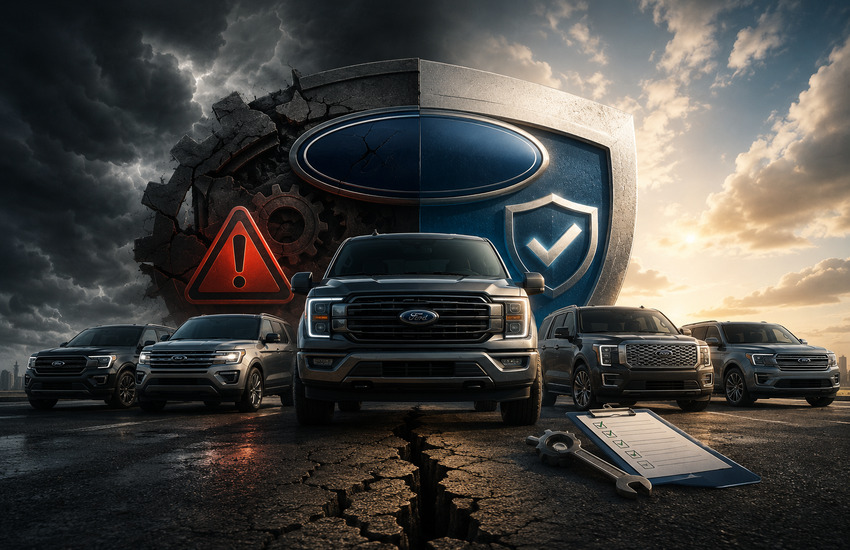
Ford Motor (NYSE:F) is back in the spotlight for a reason no car owner likes: a major safety recall. The company is recalling more than 740,000 vehicles because of a transmission and parking system issue. The affected list includes certain Expedition, Navigator, Explorer, Aviator, and F-150 models from 2018 to 2021.
The concern is simple but serious. Some vehicles may unexpectedly engage the park function while moving. That could damage the parking system and later create a rollaway risk when the vehicle is parked.
This is not Ford’s only recall headache. The company has also dealt with a large F-150 recall tied to unexpected downshifting, plus software-related recalls involving screens, brake lights, and trailer turn signals.
So, is this a Ford crisis or a painful clean-up phase? Let’s break it down.
A Safety Recall That Feels Personal
This recall hits differently because it involves vehicles many Americans actually drive every day.
The F-150 is not just another truck. It is a family hauler, work tool, and weekend vehicle. Add the Explorer, Expedition, Navigator, and Aviator, and this becomes a recall that touches parents, contractors, road-trippers, and commuters.
The issue is also easy to understand. Nobody wants a vehicle that may have parking or transmission problems. The idea that a parked car could roll away is enough to get attention beyond Wall Street.
Ford dealers will update the software and inspect or replace damaged transmission parts at no cost. That matters. It shows the company has a defined fix.
Still, recalls are not just about repairs. They are about trust. A customer may forgive one issue. A pattern is harder to ignore, especially when safety is involved.
Ford Says This Is Part Of The Clean-Up
Ford’s latest earnings call gives the recall story more balance.
CEO Jim Farley said the company recalled many older vehicles to “take care of customers.” That is an important point. Ford is not hiding from the issue. It is trying to frame these recalls as part of a broader quality reset.
The company also said it made progress on quality and lowered warranty costs in 2025. That helps the bull case. If warranty costs are falling, the internal repair bill may be moving in the right direction.
Ford is also tying management compensation to cost, quality, and software milestones. That makes quality more than a talking point. It becomes part of how executives are judged.
But the market will want proof. A lower warranty bill is useful. Fewer future recalls would be better. Until then, every new recall risks keeping the old quality narrative alive.
The Recall Wave Could Still Dent The Brand
Ford’s problem is not just this one recall. It is the growing memory of repeated recall headlines.
In 2025, Ford issued more recalls than any other automaker, affecting nearly 13 million vehicles. That is a large number. It makes each new recall feel less isolated.
The company has also dealt with an F-150 recall involving unexpected downshifting. That issue could lead to loss of control. Separately, Ford has faced software-related recalls involving center screens, brake lights, and trailer turn signals.
This creates a tricky message. Ford is building more software-heavy vehicles. Yet some of its recent recall issues also involve software fixes.
That does not mean Ford cannot solve the problem. It does mean quality execution is now central to the story. Buyers may love Ford trucks, SUVs, and off-road trims. But loyalty can weaken if safety worries keep showing up.
The Business Is Still Bigger Than The Recall
The recall story matters, but it does not define the whole company.
Ford ended 2025 with $187 billion in revenue and adjusted EBIT of $6.8 billion. Management guided for $8 billion to $10 billion in adjusted EBIT for 2026. That suggests the business still has strong earning power.
Ford Pro remains a major profit engine. The commercial business delivered $66 billion in revenue and $6.8 billion in EBIT last year. Paid software subscriptions also grew 30%, which gives Ford another growth lever beyond vehicle sales.
Ford Blue is still powered by trucks and SUVs. The company highlighted strength in F-Series, Super Duty, Bronco, Explorer, Maverick hybrids, and Raptor trims.
This is why the article is not simply “Ford is broken.” It is more nuanced. Ford has a real quality problem to manage, but it also has cash, scale, loyal buyers, and profitable franchises.
Final Thoughts
Ford’s latest recall is serious because it touches popular vehicles and raises a basic safety question: can owners fully trust the car in their driveway?
At the same time, Ford is not financially fragile. The company had nearly $29 billion in cash and almost $50 billion in liquidity at year-end 2025. Management is also targeting lower warranty costs and better quality.
Valuation is mixed. Ford trades at about 1.01x LTM EV/revenue and 0.29x LTM price/sales, which looks low on sales. But profitability-based multiples are less comfortable, with 25.28x LTM EV/EBITDA and 122.91x LTM EV/EBIT. The trailing P/E is negative at -8.89x, reflecting earnings pressure.
So the stock does not look expensive on revenue. But the market may want cleaner earnings and fewer recall headlines before giving Ford more credit.
Disclaimer: We do not hold any positions in the above stock(s). Read our full disclaimer here.