


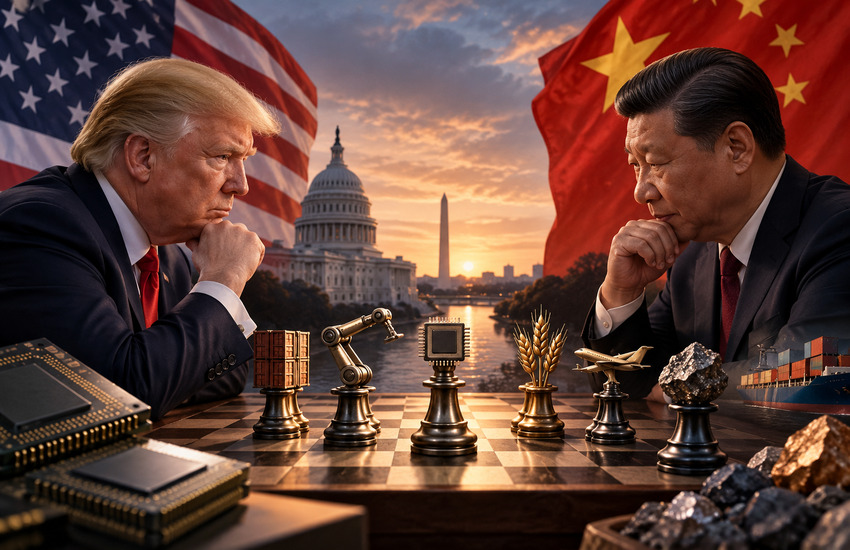
Chinese President Xi Jinping is scheduled to visit the United States from September 23 through September 25. At the center of that visit is a September 24 meeting that Wall Street will be watching closely. Xi and President Donald Trump are set to meet in Washington for their second summit this year. The meeting comes just weeks before the current U.S.–China trade truce is due to expire in November. The economic agenda could be wide. Trade, artificial intelligence, technology restrictions, rare earths, agricultural purchases, and U.S. aircraft are among the issues surrounding the talks. Senior U.S. and Chinese officials have already been discussing AI, trade, tariffs, and rare earths ahead of the meeting. For Wall Street, this creates several possible market-moving decisions inside one summit. Reuters has placed the meeting among the major events facing global markets this week.
Here is where it gets much closer to home for investors. You may already own exposure to September 24 without realizing it. One company has removed China Data Center compute revenue from its outlook. Another has already taken an $800 million hit connected to export controls. One faces tariffs and China-linked manufacturing. Another could find aircraft purchases back in the spotlight. And the final company sits almost directly inside the fight over rare-earth supply. Five stocks in particular deserve attention before Trump and Xi sit down. The important question is not whether the summit is described as a success or failure. It is whether anything changes in the policies that affect these businesses. If one of these stocks is already in your portfolio, the details coming out of Washington could matter considerably more than the diplomatic photographs.
The AI King Has Something Missing From Its Forecast
The first company may seem like the obvious China-sensitive stock, but there is a twist. NVIDIA Corporation (NASDAQ:NVDA) is currently planning its Data Center business without China compute revenue.
That is striking considering the scale of NVIDIA today. Second-quarter revenue reached $96 billion, while Data Center alone generated $89 billion. Hyperscale revenue reached $49 billion. The company expects fiscal 2028 revenue growth of roughly 70%, and management says demand remains constrained by supply.
China currently contributes very little to those numbers. H200 products shipped into China under U.S. licenses represented less than 1% of second-quarter Data Center revenue. More importantly, NVIDIA said it includes no China Data Center compute revenue in its forward outlook because of geopolitical uncertainty.
That makes September 24 particularly interesting.
AI is part of the broader U.S.–China discussion. However, investors should distinguish conversations about AI cooperation from actual changes in semiconductor export rules. Advanced-chip access remains contentious, even as the two countries discuss broader AI issues.
For NVIDIA, therefore, the summit is not simply about defending an existing China forecast. The more interesting question is whether future market access changes from a baseline where China Data Center compute contributes nothing to guidance.
That distinction matters while NVIDIA is entering another major product cycle. Vera Rubin production shipments have begun, with orders spanning major hyperscalers, AI clouds, and system manufacturers.
Watch the export-control language, not simply the AI headlines. That is where September 24 could intersect with NVIDIA’s investment story.
This Chipmaker Already Knows What Restrictions Cost
The second company does not need investors to imagine the financial impact of export controls. Advanced Micro Devices, Inc. (NASDAQ:AMD) has already put a number on it.
AMD’s second-quarter 2025 results included approximately $800 million of inventory and related charges associated with U.S. export restrictions on MI308 shipments to China. That provides a concrete example of how government policy can move from Washington into a semiconductor company’s financial statements.
The timing is important because AMD is becoming much more dependent on Data Center.
Second-quarter 2026 revenue reached a record $11.5 billion, up 50% year over year. Data Center revenue surged 107% to $6.7 billion, representing 58% of AMD’s total revenue. One year earlier, that contribution was 42%.
The company is also moving deeper into AI infrastructure. Instinct accelerator sales more than doubled year over year. AMD is preparing to ramp Helios, its rack-scale AI platform combining MI450 GPUs, Venice CPUs, Pensando networking, and ROCm software.
Management now expects the Data Center segment to more than double again in 2027.
That makes the policy backdrop harder to ignore.
Beijing has sought relief from U.S. technology restrictions, while advanced computing remains a sensitive area in the relationship. There is no basis for assuming September 24 will change AMD’s access to China.
But AMD investors have already seen what restrictions can cost. With Data Center becoming the center of the company’s growth story, any concrete change in export licensing deserves attention.
The Trump Xi Summit reaches across five companies through semiconductor restrictions, tariffs, aircraft demand and critical minerals. The investment question is not whether the meeting produces positive diplomatic headlines, but whether concrete policy changes alter revenue opportunities, costs, supply chains or market access.
Concrete policy changes could reopen semiconductor revenue opportunities, reduce tariff pressure, support aircraft demand, or improve critical-material availability across these companies.
Summit headlines may produce little policy change, while export controls, tariffs, supply constraints, and company-specific execution challenges continue to shape fundamentals.
Watch September 24 for concrete export-license changes, tariff measures, aircraft purchase details, and evidence of improved rare-earth material flows.
September 24 is a catalyst to monitor rather than an investment thesis by itself. The material question is whether specific policy outcomes alter the economics facing these five companies rather than simply changing the diplomatic narrative.
This Consumer Giant Is Exposed From Both Directions
The third stock presents a completely different problem. Apple Inc. (NASDAQ:AAPL) sits between China as a consumer market and China as part of its manufacturing network.
Apple has made substantial progress moving U.S.-bound production elsewhere.
Management said the majority of iPhones sold in the United States were originating from India. The vast majority of Macs, iPads, and Apple Watches sold in the U.S. were coming from Vietnam.
Yet there is an important second half to that story. For other international markets, the vast majority of Apple products were still coming from China.
Then there are tariffs.
Apple incurred approximately $800 million of tariff-related costs during its June quarter. Management expected around $1.1 billion in the September quarter, assuming the policies and tariff rates then in place remained unchanged.
China also remains commercially important.
Greater China revenue increased 4% during that quarter. Apple reported a record Greater China installed base and a June-quarter record for mainland Chinese iPhone upgraders. Those numbers show why China cannot be viewed purely as a manufacturing issue.
There is even another connection hiding deeper in Apple’s supply chain. The company announced a $500 million commitment with MP Materials to support recycled rare-earth materials in the United States.
So what should Apple shareholders watch?
Tariffs matter. Manufacturing conditions matter. Chinese consumer demand matters. Critical-material availability matters. September 24 potentially touches several of those variables at once.
That makes Apple one of the clearest examples of how U.S.–China relations can reach both sides of a company’s income statement.
One Headline Could Put Hundreds Of Aircraft In Focus
The fourth stock could generate one of the summit’s easiest headlines to understand. The Boeing Company (NYSE:BA) has aircraft sitting inside the broader commercial conversation between Washington and Beijing.
Reuters reports that possible Chinese purchases of U.S. goods, including Boeing aircraft, are among the economic issues surrounding the September 24 meeting.
That immediately puts Boeing on the investor watchlist.
But the company is already dealing with an enormous amount of demand. Boeing ended its second quarter with a record Commercial Airplanes backlog of $597 billion covering more than 6,200 aircraft. Its total company backlog stood around $715 billion.
The bigger challenge is turning that backlog into deliveries and cash.
Boeing delivered 171 airplanes during the second quarter, its highest quarterly total since 2018. It is working to stabilize 737 production at 47 aircraft per month before moving toward higher rates. Boeing has also stabilized 787 production at eight aircraft per month.
That execution issue has become even more relevant. On September 16, CEO Kelly Ortberg said stabilizing 737 MAX production at the targeted rate was taking longer than expected. He also played down expectations surrounding a major Chinese order at the summit.
That is an important reality check.
If an aircraft announcement emerges on September 24, the headline number alone will not determine its financial importance. Aircraft mix, contractual terms, delivery dates, and Boeing’s ability to raise production all matter.
For investors, China could add another layer to Boeing’s demand story. But execution will determine how much of that demand ultimately becomes cash.
The Rare-Earth Stock That Is Already Watching September 24
The fifth company has perhaps the most direct connection to the summit. MP Materials Corp. (NYSE:MP) has already been discussing September 24 with investors.
At the September 9 Jefferies Global Industrials Conference, management was specifically asked about the Trump–Xi summit and Chinese rare-earth restrictions. Its response revealed something important.
MP believes customers have already changed how they think about dependence on China.
Management described flows of several critical rare-earth materials and heavy rare-earth-containing magnets into the U.S. and Japan as extremely constrained. The concern is straightforward: manufacturers cannot comfortably depend on an export approval determining whether their factories receive critical components.
That makes this summit unusual for MP.
A relaxation of restrictions could improve near-term material availability. Continued restrictions could keep attention on developing alternative Western supply chains. Neither outcome by itself determines MP’s future economics.
The company is already building for that alternative supply chain.
Mountain Pass is producing roughly 1,000 tons of NdPr per quarter as MP moves toward targeted throughput. The company is also expanding downstream into permanent magnets. General Motors is a foundational customer, while Apple has become another major partner.
MP is also developing its 10X magnet facility. Its government partnership provides offtake support and a minimum earnings structure while the company works toward commercial customers.
Meanwhile, rare earths remain part of the discussions surrounding the summit. U.S. officials have been pushing for improved mineral flows, and the issue featured in preparatory talks ahead of September 24.
For MP investors, watch actual material flows and export licenses rather than diplomatic language alone. Those details say far more about the supply chain than a broad statement about cooperation.
Final Thoughts
September 24 is unusual because one diplomatic meeting reaches into several corners of the U.S. stock market. AI infrastructure, semiconductors, smartphones, commercial aircraft, and critical minerals all have something at stake in the broader U.S.–China relationship. That does not mean every summit headline will change the investment case for these companies. It means investors should know exactly where their portfolios intersect with the negotiations.
NVIDIA, AMD, Apple, Boeing, and MP Materials also represent very different businesses. Some are benefiting from rapid AI infrastructure spending. Others are navigating tariffs, manufacturing shifts, production recoveries, or the creation of new domestic supply chains. Their valuations and financial profiles differ substantially, so owning them simply because they are connected to September 24 would miss the bigger picture. The summit is a catalyst to monitor, not an investment thesis by itself.
Still, these are companies investors may reasonably keep on a broader watchlist when building exposure to AI, technology, aerospace, consumer hardware, and critical materials. The question after September 24 will be whether anything coming out of Washington changes their revenue opportunities, costs, supply chains, or long-term competitive positions.
That is the suspense heading into this week. Trump and Xi will command the headlines. But if you own any of these five stocks, what happens underneath those headlines could matter much more to your portfolio.
Disclaimer: We do not hold any positions in the above stock(s). Read our full disclaimer here.