


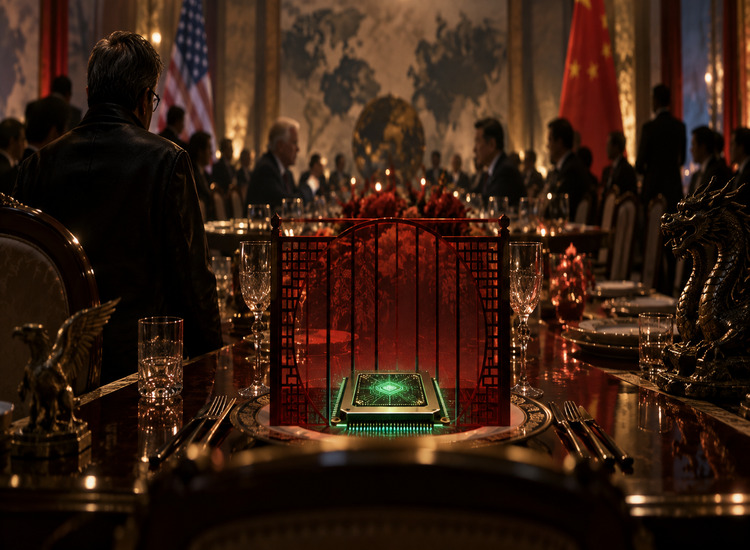
Jensen Huang’s presence at Thursday’s Trump–Xi state dinner puts Nvidia’s China problem back at the center of the AI debate.
The Nvidia (NASDAQ:NVDA) CEO is expected to attend President Donald Trump’s September 24 state dinner for Chinese President Xi Jinping, just as AI and advanced chips sit near the center of U.S.-China economic tensions. For Nvidia, the timing is hard to ignore.
The company is still largely shut out of China’s Data Center compute market. At the same time, Chinese rivals are getting stronger, and Nvidia is building its outlook with almost no China revenue contribution. The Nvidia China Access question now sits directly inside that broader technology debate.
So the real question is not whether Huang gets a seat at the table. It is whether Nvidia China Access can improve before the market it wants to re-enter changes around it.
H200 Nvidia China Access Remains The Immediate Bottleneck
Nvidia’s China problem is no longer a simple U.S. export-ban story. The company now needs approvals on both sides.
Beginning in February 2026, the U.S. government granted licenses allowing Nvidia to ship limited quantities of H200 processors to specified Chinese customers. However, Nvidia says Chinese restrictions prevented it from selling all the products covered by those licenses. Only a fraction of authorized shipments ultimately moved. Those H200 sales represented less than 1% of Nvidia’s latest quarterly Data Center revenue.
That is why Thursday deserves attention without being treated as a guaranteed catalyst. Nvidia China Access remains the immediate issue investors need to watch.
Nvidia already has a pathway for some H200 exports. The issue is whether that pathway can become commercially meaningful. Its latest filing says the company remains effectively excluded from competing broadly in China’s Data Center compute market.
There is another complication. Licensed H200s must undergo a U.S. inspection process and face a 25% tariff when imported into the United States. Nvidia says it has not been able to pass that cost to customers.
So reopening China would matter, but the economics of those sales matter too.
Nvidia’s China opportunity is unusual because its current growth case does not rely on China Data Center compute revenue. Reopening could create incremental revenue opportunities, but access alone would not settle the thesis. Investors still need to weigh restrictions, tariffs, margin dilution, and the speed at which Chinese competitors are strengthening while Nvidia remains constrained.
China is not required for Nvidia’s current growth case, but improved access could expand it. The deciding variable is whether reopening arrives soon enough, and economically enough, to protect Nvidia’s competitive position.
China’s Potential Revenue Pool Is Too Large To Ignore
Here is where the numbers become much more interesting.
Nvidia has estimated China’s potential AI-chip market at roughly $50 billion. That figure refers to the broader market opportunity.
The H200-specific estimate is different. Barron’s has cited potential demand for roughly 1.5 million H200 processors, which could represent about $30 billion of product value.
Those numbers should not be treated as guaranteed Nvidia sales. The $50 billion figure describes the broader China AI-chip market, while the roughly $30 billion figure reflects one estimate of H200 demand within that market. Nvidia China Access is what determines how much of either opportunity can actually become revenue.
Still, the size explains why China remains strategically important even while Nvidia grows rapidly elsewhere.
During its August earnings call, Nvidia reported quarterly revenue of roughly $96 billion and Data Center revenue of about $89 billion. Management also said it expects fiscal 2028 revenue to grow about 70%, despite remaining supply constrained.
Yet management included no China Data Center compute revenue in its forward outlook because of geopolitical uncertainty.
That creates an unusual setup. Nvidia is not depending on China to support its current growth expectations. A meaningful reopening could therefore create incremental revenue opportunities beyond those assumptions.
The real question is how much of that theoretical $50 billion market Nvidia can still capture if access eventually improves.
Huawei & Alibaba Are Making The Clock Matter
China is not waiting for Nvidia to return.
Huawei said in September that demand for its AI computing equipment within China was already greater than supply. The company is accelerating development of new Ascend processors and plans additional products in 2027. Huawei is also building enormous systems that connect large numbers of processors together.
Alibaba added another warning sign this week. The company unveiled its Zhenwu V900 AI processor, which it says offers roughly three times the performance of its predecessor. Mass production is expected in early 2027. Alibaba is also expanding its data-center infrastructure and developing increasingly large AI models.
None of this means Nvidia has suddenly lost its technological advantage.
Nvidia still benefits from CUDA, its broad software ecosystem, networking products and full-stack computing architecture. Its latest earnings call repeatedly emphasized that customers buy more than individual GPUs. They buy a platform that can support training, inference and increasingly complex agentic workloads.
But Nvidia itself acknowledges the competitive risk. Its latest filing warns that exclusion from China has helped competitors build larger developer and customer ecosystems.
That is why Nvidia China Access is also a competitive issue, not simply a sales issue.
That makes time almost as important as access. Every restricted quarter gives Chinese alternatives another opportunity to improve.
China Could Change Long-Term AI Revenue Assumptions
The most important investment question may not be how many H200s Nvidia can sell next quarter.
It is whether China eventually changes the long-term revenue assumptions around Nvidia’s AI platform.
For now, Nvidia does not need China to demonstrate powerful demand. Management expects roughly 70% fiscal 2028 revenue growth while saying customer demand could support even faster expansion if supply were available.
That means any China reopening would arrive against an already supply-constrained backdrop.
There are several possible effects. Additional H200 orders could lift revenue. Broader access could restore Nvidia’s developer ecosystem inside China. It could also slow the migration toward Huawei, Alibaba and other domestic accelerators. Nvidia China Access would therefore influence both near-term sales and the longer-term competitive position.
But investors should separate revenue potential from earnings potential. Nvidia said current Chinese H200 shipments are dilutive to corporate gross margins. Tariffs and regulatory requirements also make those sales economically different from unrestricted Data Center revenue.
There is another risk. If domestic Chinese hardware becomes deeply embedded before Nvidia regains access, reopening may not restore Nvidia’s former market position.
September 24 therefore matters most as one possible signal about the direction of that long-term competitive equation.
Final Thoughts
Nvidia enters Thursday with a very different valuation profile from the one investors saw a little more than a year ago.
As of September 21, its LTM EV/Revenue multiple stood at 18.04x, while LTM Price/Sales was 18.12x. LTM EV/EBITDA was 27.16x, and LTM EV/EBIT was 27.67x. The stock traded at 28.75x trailing diluted earnings.
Those are still substantial multiples in absolute terms. However, they have compressed sharply from July 2025. At that point, Nvidia traded around 47.48x LTM EV/EBITDA and 55.95x trailing earnings. Earnings and revenue growth have therefore absorbed a meaningful portion of the earlier valuation premium.
That brings investors back to China. Nvidia China Access could influence how much additional growth can be layered onto an already large global business.
A policy change could make part of a potentially enormous market commercially accessible again. Yet restrictions, tariffs, margins and domestic Chinese competition would determine how much value Nvidia actually captures.
Thursday does not need to produce an H200 breakthrough to matter. What investors may learn instead is whether Nvidia’s China opportunity is becoming easier to recover, or whether the clock continues to run in favor of domestic alternatives.
For now, Nvidia’s valuation still assumes substantial future growth. China could expand that growth opportunity, but the current multiples also leave investors weighing that potential against execution, policy and competitive risks.
Disclaimer: We do not hold any positions in the above stock(s). Read our full disclaimer here.