


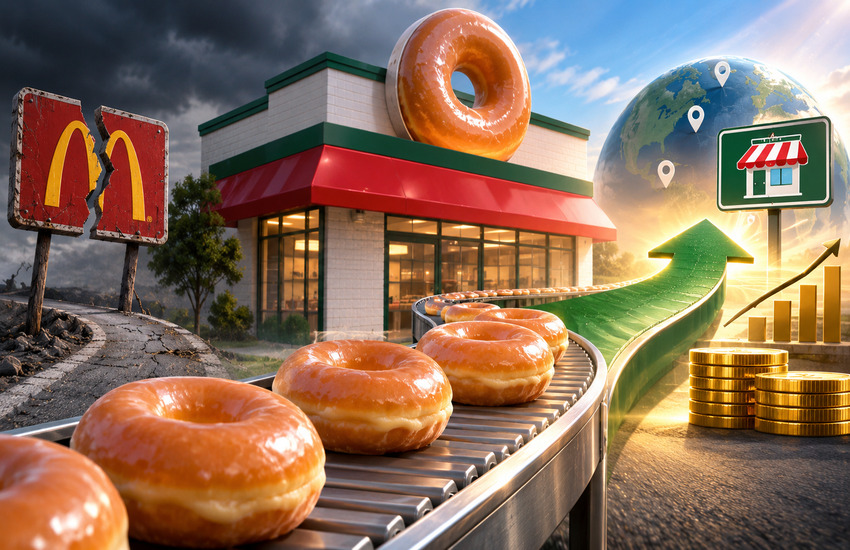
Krispy Kreme, Inc. (NASDAQ: DNUT) is attempting to rebuild its business following the collapse of its ambitious nationwide partnership with McDonald’s. The Krispy Kreme Turnaround is gaining momentum. On November 5, 2026, the doughnut maker’s shares surged 30.7% to $4.60 after management reported improving underlying profitability, reduced capital spending, and higher revenue guidance.
The results present an interesting contradiction. Third-quarter revenue declined 12.4% to $328.8 million, while Krispy Kreme reported a $13.3 million net loss. Nevertheless, management raised its 2026 revenue outlook to $1.35 billion–$1.40 billion, reduced its net leverage ratio from 6.7 times to 5.5 times, and improved year-to-date free cash flow by approximately $82 million.
The company is shifting away from aggressive distribution expansion toward a leaner model built around profitable retail relationships, international franchising, and operational efficiency. The question is whether these changes can deliver a sustainable recovery—or whether the recent stock rally has already priced in much of the expected improvement.
The McDonald’s Breakup Could Become Krispy Kreme’s Biggest Turnaround Catalyst
Krispy Kreme’s partnership with McDonald’s was originally designed to bring its doughnuts to thousands of U.S. restaurants. By early 2025, distribution had reached approximately 2,400 McDonald’s locations, but demand failed to justify the associated production, delivery, and replenishment costs.
The companies terminated the agreement in July 2025. Krispy Kreme subsequently recognized substantial impairment charges, including approximately $356 million in goodwill impairments, reflecting deteriorating expectations for its operating assets.
Management has since prioritized distribution profitability over geographical reach. The company completed outsourcing its U.S. logistics operations in April 2026 and is focusing on retailers capable of generating sufficient sales volumes to justify fresh delivery.
Early results are encouraging. U.S. organic revenue increased 0.9% in the third quarter, while adjusted EBITDA margin improved approximately 320 basis points after excluding a $9.3 million cybersecurity insurance recovery recorded in the prior-year period.
Revenue per U.S. production hub reached approximately $5.3 million on a trailing four-quarter basis, up 10.4%.
However, average weekly revenue per fresh-delivery door declined 1.5% to $606. This suggests that distribution productivity remains uneven despite improvements in production efficiency.
The central opportunity is to build a smaller, more profitable delivery network rather than recreate the scale of the abandoned McDonald’s rollout.
Refranchising Could Create A More Profitable Global Business
Krispy Kreme is increasingly transferring company-operated businesses to franchise partners, reducing its direct exposure to store development, labor, and infrastructure costs. This shift is becoming a central component of the Krispy Kreme Turnaround.
During 2026, the company refranchised its Japan business and western U.S. joint venture. Franchise-operated locations now represent approximately 42% of systemwide sales, compared with around 25% in 2025. Management expects the proportion to reach approximately 50% beginning in 2027.
International expansion remains an important opportunity. Krispy Kreme signed a development agreement covering 120 shops in Pakistan over five years, alongside a separate 33-shop expansion agreement in the New York metropolitan area. Additional agreements cover Estonia, Mauritius, and the Netherlands.
The financial impact is becoming visible. Market Development segment revenue increased 135% to $44.4 million in the third quarter, while adjusted EBITDA rose 54% to $18.5 million.
However, refranchising changes how revenue is recognized. Company-operated sales may disappear from consolidated revenue and be replaced by royalties or other franchise-related income. Consequently, declining reported revenue does not necessarily indicate weaker consumer demand.
The long-term opportunity is a business that generates more cash from royalties and product supply arrangements while requiring less capital to expand.
The Turnaround Is Improving. The Debt Burden Still Matters.
Krispy Kreme is restructuring its distribution network and shifting toward franchising after the McDonald’s breakup. Lower capital expenditure and improving underlying margins are encouraging, but weak organic demand and elevated leverage complicate the recovery. The central investment question is whether operational improvements can translate into sustainable free cash flow and debt reduction.
A higher franchise mix, improved distribution productivity, and lower capital spending could strengthen free cash flow and support further debt reduction.
Net debt of approximately $839.5 million limits financial flexibility, particularly if weak organic demand prevents the anticipated profitability recovery.
Track whether full-year free cash flow exceeds management’s $15 million outlook and whether organic sales and distribution productivity improve.
Baptista Research’s Neutral rating and $5.54 price target reflect a credible but incomplete turnaround. Sustainable cash generation, stronger organic demand, and reduced leverage must support the recovery before a lasting valuation re-rating becomes more defensible.
Margin Improvements And Lower Capital Spending Could Strengthen Cash Flow
Krispy Kreme’s profitability recovery is becoming more visible beneath declining reported revenue.
Third-quarter adjusted EBITDA reached $35.3 million, down 13.1% year over year. However, excluding the prior-year insurance recovery, underlying adjusted EBITDA increased approximately 12.7%, with comparable adjusted EBITDA margin improving from 8.3% to 10.7%.
Adjusted net income increased to $9.9 million from $1.4 million, while adjusted earnings per share rose to $0.06 from $0.01.
Cost discipline is contributing to these improvements. During the first nine months of 2026, capital expenditure declined approximately 65% to $28.6 million, compared with $80.8 million a year earlier.
Free cash flow improved from negative $91.9 million to approximately negative $10 million, representing an improvement of roughly $82 million. This substantial reduction in cash burn represents an important milestone in the Krispy Kreme Turnaround.
Management now expects full-year capital expenditure of $40 million–$45 million and free cash flow exceeding $15 million.
However, reducing investment cannot remain the principal source of cash flow improvement indefinitely. Krispy Kreme must maintain its production infrastructure, delivery reliability, and product quality while rebuilding underlying demand.
Higher Revenue Guidance Could Support The Turnaround—But Organic Growth Remains Weak
Krispy Kreme raised its 2026 revenue guidance to $1.35 billion–$1.40 billion from $1.25 billion–$1.35 billion, increasing the midpoint by $75 million.
Management also maintained adjusted EBITDA guidance of $140 million–$150 million, suggesting that higher expected revenue has not yet translated into a corresponding improvement in projected earnings.
Underlying demand remains mixed. Third-quarter consolidated organic revenue declined 0.1%, reflecting U.S. growth of 0.9% and international weakness of 5.4%, primarily in the United Kingdom.
Global points of access increased 7% to approximately 15,889, while digital transactions accounted for 19.4% of retail sales, up from 17.4%.
The company expects to open at least 100 new shops during 2026, almost entirely through franchise partners.
The next important test is whether management can translate broader distribution and international franchising into higher organic sales, improved route productivity, and sustainable earnings growth. These improvements will be critical to determining whether the Krispy Kreme Turnaround can deliver sustained financial benefits.
What If Krispy Kreme Becomes A Cash-Generating Franchise Business?
The most compelling possibility is that abandoning the McDonald’s partnership ultimately enables Krispy Kreme to establish a more financially sustainable operating model.
A greater franchise mix, lower capital requirements, and more productive U.S. distribution could improve cash generation without requiring rapid growth in company-operated restaurants.
However, these benefits depend on successful franchise development, reliable third-party logistics, and improved consumer demand.
If Krispy Kreme can consistently generate positive free cash flow while reducing debt, investors may begin valuing it more like an international franchise business than a capital-intensive doughnut manufacturer.
Conversely, if organic sales remain weak and cost reductions lose momentum, the restructuring could produce only a temporary improvement in financial performance.
Valuation And Scenario Analysis
At approximately $4.60 per share, Krispy Kreme’s implied enterprise value was around $1.65 billion, representing approximately 11.4 times the midpoint of its 2026 adjusted EBITDA guidance.
The valuation is complicated by approximately $839.5 million in net debt, which magnifies changes in common equity value.
Our 2027 valuation scenarios use estimated adjusted EBITDA, enterprise-value multiples, and constant net debt and diluted share assumptions.
Constrained Recovery: With $145 million in adjusted EBITDA and a nine-times multiple, the implied valuation is $2.64 per share, representing approximately 43% downside.
Base Case: Assuming $165 million in adjusted EBITDA and an eleven-times multiple, the implied valuation reaches $5.54 per share, representing approximately 20% upside.
Accelerated Recovery: With $190 million in adjusted EBITDA and a thirteen-times multiple, the implied valuation reaches $9.25 per share, representing approximately 101% upside.
These are Baptista Research scenarios, not management forecasts. Actual outcomes will depend on profitability, cash generation, financing obligations, and execution.
What Could Go Wrong?
Krispy Kreme’s elevated leverage remains its greatest financial risk. Net debt of approximately $839.5 million and a 5.5-times leverage ratio limit flexibility if earnings weaken.
Organic revenue growth is also fragile, particularly internationally. Franchise expansion may disappoint, while reduced capital spending could eventually affect production reliability.
Outsourced logistics introduces third-party operational dependencies, and ingredient inflation, labor costs, and consumer price sensitivity could pressure margins.
Following the 31% rally, valuation risk has also increased. Any slowdown in the turnaround could lead to significant share-price volatility.
Conclusion & Baptista Research View
Krispy Kreme’s post-McDonald’s transformation is producing measurable improvements in operating efficiency, capital expenditure, and cash flow. Its expanding franchise network could gradually create a more attractive business model. The Krispy Kreme Turnaround is increasingly dependent on converting these operational gains into sustainable profitability.
Nevertheless, organic revenue remains weak, GAAP losses persist, and elevated debt continues to constrain financial flexibility.
Baptista Research maintains a Neutral rating with a $5.54 price target, representing approximately 20% upside from the November 5 closing price of $4.60. The more favorable valuation scenario reaches $9.25, while the adverse scenario indicates a potential decline to $2.64.
The turnaround is credible but incomplete. Sustainable positive free cash flow, stronger organic sales, and further debt reduction will ultimately determine whether Krispy Kreme can justify a lasting valuation recovery.
Disclaimer: We do not hold any positions in the above stock(s). Read our full disclaimer here.