

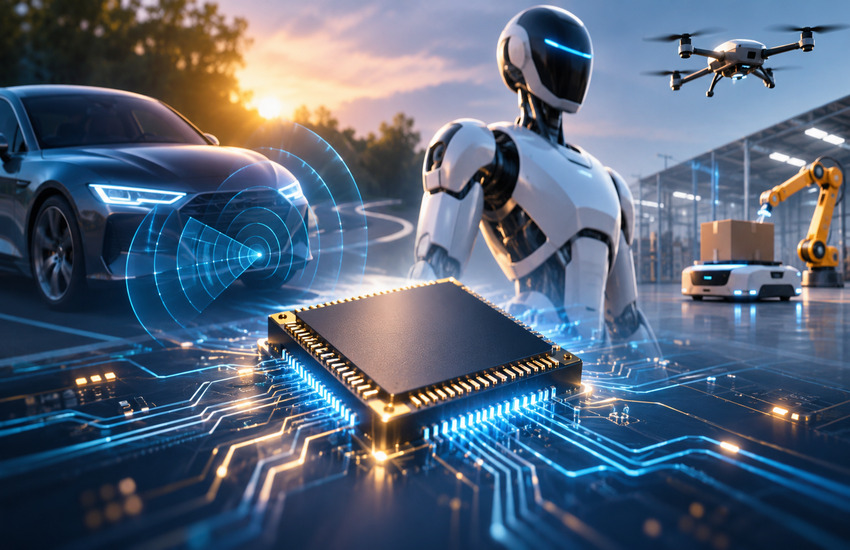
indie Semiconductor, Inc. (NASDAQ: INDI) is expanding beyond automotive chips into the emerging Physical AI market, where its sensing technologies could power humanoid robots, drones, and autonomous industrial equipment. The company’s shares surged 33.58% to $1.81 on November 6, 2026, following third-quarter results highlighting stronger revenue growth, automotive radar production milestones, and new robotics design wins. The rally has brought renewed investor attention to indie Semiconductor Stock.
Revenue increased 31% year over year to $70.2 million, while core business revenue grew 14% sequentially to $40.7 million. Management also reaffirmed a $6.2 billion strategic backlog, excluding opportunities associated with Physical AI.
However, indie remains unprofitable, carries significant convertible debt, and is pursuing a major portfolio restructuring. The investment question is whether its expanding semiconductor opportunities can generate sustainable profits before cash consumption and potential dilution become more significant concerns.
A $6.2 Billion Backlog Could Drive Long-Term Automotive Growth
indie’s $6.2 billion strategic backlog provides visibility into potential revenue from automotive design wins over a rolling ten-year period. Importantly, this figure represents estimated future program revenue, not guaranteed purchase orders. The conversion of this backlog into actual revenue will be an important consideration for investors evaluating indie Semiconductor Stock.
The company recently entered high-volume production of an automotive radar chipset following completion of the Production Part Approval Process. It also secured a major radar selection from one of North America’s three largest automotive manufacturers.
Management has outlined a long-term opportunity to ship 50 million–70 million radar units annually, with average selling prices of approximately $5–$6. This translates into an illustrative annual revenue opportunity of $250 million–$420 million, although these volumes are neither contracted nor guaranteed.
Demand for radar, cameras, LiDAR, and sensor-fusion systems continues to benefit from increasingly sophisticated advanced driver assistance systems. Higher semiconductor content per vehicle could allow indie to grow even when overall automotive production remains subdued.
The company’s challenge is converting design wins into profitable manufacturing volumes. Automotive programs can take years to reach maturity, and actual revenue depends on production schedules, vehicle demand, and customer adoption.
The Backlog Is Substantial. The Cash Flow Test Remains.
indie Semiconductor’s $6.2 billion strategic backlog and expanding robotics design wins provide long-term revenue opportunities beyond its established automotive business. The proposed $135 million Wuxi divestiture could improve the margin profile of the remaining operations. However, persistent operating losses and substantial debt make the transition to sustainable cash generation the central investment question.
Automotive radar production, vision design wins and emerging robotics applications could support revenue growth while the Wuxi divestiture improves retained-business margins.
Continued operating losses and cash consumption, combined with substantial convertible debt, could increase financing pressure and potential dilution before commercialization delivers profitability.
Track completion of the $135 million Wuxi divestiture and whether the retained business progresses toward management’s second-quarter 2027 non-GAAP profitability target.
indie’s technology portfolio provides several potential growth avenues, but its investment case remains dependent on translating design wins into profitable production volumes. The divestiture could strengthen financial flexibility, although debt, cash consumption and commercialization uncertainty support a measured assessment.
Humanoid Robots Could Create A New Physical AI Revenue Opportunity
indie’s expansion into humanoid robotics represents a potential second growth market.
The company has reported design wins involving robotics developers Agibot, Unitree, and Figure AI, alongside applications involving drones and warehouse automation.
Its automotive perception technologies are relevant to robots that must navigate complex environments, identify obstacles, and make real-time decisions.
Management indicated that certain humanoid robotics platforms could contain more than $100 of indie semiconductor content. At hypothetical production volumes of 100,000 robots, this would represent a $10 million annual opportunity; one million robots would imply $100 million.
These are illustrative calculations, not revenue forecasts.
The company’s iND880 DRAM-less vision processor could provide an important competitive advantage by reducing external memory requirements, power consumption, and system complexity.
Higher memory prices have reportedly accelerated customer interest in this architecture.
indie secured more than 40 vision design wins during 2026, although fewer than 20% had begun generating revenue. This highlights both the scale of the emerging opportunity and the uncertainty surrounding commercialization. The pace of commercialization could also influence how investors assess the longer-term growth potential of indie Semiconductor Stock.
Management has excluded Physical AI opportunities from its strategic backlog because future production volumes remain difficult to estimate.
The opportunity could become significant if robotics manufacturers reach commercial scale. However, design wins do not guarantee substantial shipments, and competition from larger semiconductor companies remains considerable.
Radar, Vision & Software Could Improve Profitability
indie’s third-quarter revenue growth reflects increasing commercialization of its radar and vision technologies.
Core business revenue reached $40.7 million, supported by automotive production ramps and new customer programs.
The company also secured electronic mirror and side-view mirror design wins with major automotive manufacturers in India and South Korea.
Its acquisition of emotion3D expanded its capabilities in driver-monitoring and occupant-monitoring software.
Management expects software royalties of approximately $4–$8 per vehicle, depending on functionality, potentially creating an additional revenue stream alongside semiconductor hardware.
Photonics provides further diversification through quantum computing, satellite communications, and laser-based technologies.
Nevertheless, profitability remains challenging.
The third-quarter non-GAAP operating loss narrowed to $7.2 million from $11.3 million a year earlier, indicating improving adjusted operating leverage.
However, the GAAP operating loss remained substantial at approximately $39 million.
Management expects fourth-quarter revenue of $73 million–$81 million, implying approximately 33% year-over-year growth at the midpoint.
Core revenue is expected to reach approximately $47 million.
The key question is whether higher production volumes can generate sufficient gross profit to offset continued engineering, commercialization, and administrative expenses. This operating leverage will be a significant factor in determining the financial outlook for indie Semiconductor Stock.
The $135 Million Wuxi Sale Could Transform The Financial Profile
indie plans to divest its Wuxi subsidiary to United Faith Auto-Engineering for approximately $135 million in gross cash proceeds, subject to regulatory approvals and closing conditions.
Wuxi contributed approximately $29.5 million in third-quarter revenue, representing roughly 42% of consolidated sales.
However, its lower-margin operations have weighed on consolidated profitability.
Management expects gross margins for the retained business to approach the low-50% range following the sale, compared with the third quarter’s approximately 41.6% non-GAAP gross margin.
The proceeds could also support debt reduction and strengthen liquidity.
At September 30, indie held approximately $134.2 million in unrestricted cash against $441.1 million in debt principal.
Operating cash outflows reached approximately $73.4 million during the first nine months of 2026, highlighting continued funding requirements.
Management targets non-GAAP profitability in the second quarter of 2027 and positive cash flow in the following quarter.
The company is also pursuing the acquisition of ams-OSRAM’s CMOS image-sensor business for approximately €40 million, expanding its sensing portfolio but introducing additional capital commitments.
The Wuxi divestiture could improve margins, but it will also remove substantial reported revenue. Investors must evaluate the profitability and growth of the remaining operations rather than relying on consolidated historical comparisons.
indie Semiconductor Stock Valuation & Scenario Analysis
At approximately $1.81 per share, indie had a common equity capitalization of roughly $416 million, based on Class A shares outstanding.
Including economically exchangeable Class V interests increases the illustrative equity value to approximately $436 million.
With $441.1 million in debt principal and $134.2 million in unrestricted cash, simplified enterprise value was approximately $743 million.
The company trades at roughly 2.8 times implied 2026 consolidated revenue, using the midpoint of its fourth-quarter guidance.
This multiple includes Wuxi revenue and therefore does not represent the future post-divestiture business.
Our illustrative valuation sensitivities suggest:
Constrained Commercialization — $0.39 per share: Weak demand, continued losses, and valuation compression create substantial downside.
Gradual Recovery — $2.05 per share: Improving radar and vision revenue supports approximately 13% upside.
Accelerated Commercialization — $3.71 per share: Stronger semiconductor adoption and improved investor confidence support approximately 105% upside.
These are analytical sensitivities rather than formal 12-month price targets. They use the current consolidated revenue perimeter and do not fully incorporate the Wuxi transaction, future dilution, or acquisition adjustments.
What Could Go Wrong?
indie’s principal risks include continued operating losses, negative cash flow, and significant convertible debt obligations.
The $6.2 billion strategic backlog is not guaranteed revenue, while humanoid robotics commercialization remains uncertain.
Delays in the Wuxi divestiture could postpone expected proceeds and margin improvements. Even after completion, the company must demonstrate that its smaller retained business can generate stronger absolute profitability.
Automotive demand weakness, semiconductor competition, export restrictions, and continued research expenditure also present risks.
Potential equity dilution could reduce the value attributable to existing shareholders. These financial and execution risks remain important considerations when assessing indie Semiconductor Stock.
The Backlog Is Visible; Profitable Conversion Remains Unproven.
Conclusion & Baptista Research View
indie Semiconductor has several identifiable growth opportunities across automotive radar, vision processing, perception software, and Physical AI.
Its $6.2 billion strategic backlog provides long-term commercial visibility, while new robotics design wins could extend the company’s technologies into emerging markets.
The proposed Wuxi divestiture may improve gross margins and financial flexibility, but execution risks remain significant.
Baptista Research maintains a Neutral rating, reflecting substantial technological opportunities alongside ongoing losses, debt obligations, and commercialization uncertainty.
Our central valuation sensitivity is $2.05 per share, compared with the November 6 closing price of $1.81. The accelerated scenario reaches $3.71, while the constrained scenario falls to $0.39.
The decisive indicators will be radar production growth, robotics revenue conversion, completion of the Wuxi transaction, improved margins, and positive operating cash flow.
indie’s long-term opportunity is substantial, but shareholder returns will ultimately depend on translating its expanding technology portfolio into sustainable financial performance.
Disclaimer: We do not hold any positions in the above stock(s). Read our full disclaimer here.