


Continue Reading With Our 7-Day Free Trial
Abits Group Inc. (NASDAQ:ABTS) is a very small Bitcoin miner with a surprisingly tangible infrastructure footprint. Through Abit USA, the company operates in Tennessee and has built a business around self-mining, hosted mining, power access, cooling, and data-center operations. Revenue reached $9.13 million in 2025, up 37% from 2024. The company also ended the year with 15.99 Bitcoin, while its combined Tennessee fleet reached about 760 PH/s by April 2026. This gives the Abits AI Mining thesis an operating foundation rather than a development-only starting point.
That alone would make Abits worth watching. Yet another feature caught Baptista Research’s attention. The company already controls infrastructure that consumes large amounts of power and supports dense computing equipment. Duff is a self-owned Tennessee site. Memphis adds hosted capacity. Abits also owns roughly 55 acres in Wisconsin that its 2025 filing says is intended for a data center. This report is independent. Abits has not commissioned or paid for it.
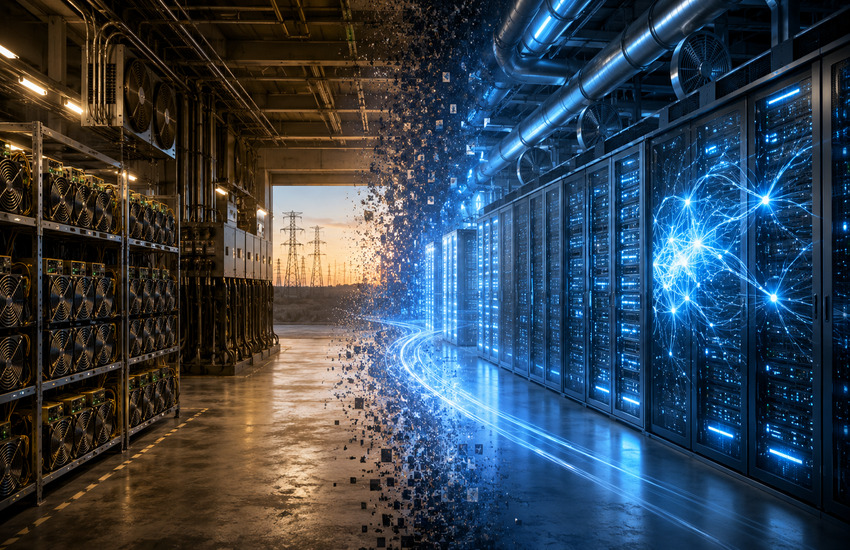
Here is the question that makes the story more interesting. What if part of this infrastructure could eventually support AI inference or other high-performance computing workloads? The Antminers themselves cannot run AI models. They are specialized Bitcoin ASICs. The optionality sits elsewhere. It sits in the power, land, cooling, electrical equipment, operating experience, and potential data-center shell. That distinction matters because other Bitcoin miners have already converted powered sites for AI and HPC customers.
Memphis Scale-Up & 760 PH/s Hash Rate Expansion
Abits entered 2025 with a much smaller operating base. By year-end, the picture had changed. The company’s Tennessee fleet reached 4,575 miners and roughly 720 PH/s. By April 6, 2026, that increased to 4,775 units and about 760 PH/s. Memphis was the main step-change. The new site began operating in late March 2025 and contributed $2.90 million of revenue during the year. That gives investors an operating asset that is already producing revenue rather than a development-only story.
The revenue growth followed the capacity expansion. Abits generated $9.13 million in 2025 versus $6.71 million in 2024. Gross profit increased to $3.68 million. Mining output reached 89.09 Bitcoin across Duff and Memphis. The economics were not perfect, since gross margin fell to about 40%. Yet the business grew despite the April 2024 Bitcoin halving. That is important because the halving reduced block rewards while forcing miners to become more efficient. Abits still expanded its revenue base during that tougher industry backdrop.
The company kept adding equipment in 2026. In March, Abit USA bought another 200 new Antminer T21 units. Those machines were delivered to Duff and placed into operation after testing. That move is modest beside larger listed miners. It is material beside Abits’ current size. It also shows management is still investing in the core business. For shareholders, this matters because the AI scenario does not need Bitcoin mining to disappear. The stronger thesis is a dual-use infrastructure story, with Bitcoin providing the existing operating base.
There is also a useful asymmetry here. The market value supplied for this report is only about $3.91 million at $1.32 per share. That is less than half of 2025 revenue. It is also well below reported shareholders’ equity of $7.78 million at year-end. The company remains loss-making at the EBIT and net-income levels. Still, the operating footprint is already much larger than the equity value suggests. If utilization, Bitcoin economics, or hosting revenue improve, even modest financial progress can have an outsized effect on a microcap valuation.
Low-Cost Power & Existing Data-Center Infrastructure — Abits AI Mining
For a Bitcoin miner, electricity is not a side issue. It is the business model. Abits reported average power costs around or below $0.04 per kWh at Duff. The company also reduced water expenses after installing wells and improving cooling-related infrastructure. Water costs fell 48% during 2025, from $571,053 to $295,135. These figures matter for mining margins. They matter even more when thinking about a future compute-hosting strategy, because access to reliable power is becoming a scarce strategic asset.
Duff deserves particular attention. It is the company’s self-owned property in Tennessee, where Abit USA operates its mining infrastructure. The filing describes substantial investment in plant and equipment at that site. That ownership is valuable. A hosted mining site gives a company access to power, but ownership gives more control over physical upgrades. Any AI or HPC conversion would still need new equipment, networking, cooling, redundancy, and potentially major electrical work. Yet starting with a powered operating site is fundamentally different from starting with undeveloped land.
The Memphis operation expands the energy footprint further. The company disclosed an initial 12 MW arrangement there, with expansion potential to 22 MW. Memphis uses a hosting structure rather than the same ownership model as Duff. That limits how freely Abits could repurpose the site. Still, it demonstrates something useful. Management has already negotiated power, deployed thousands of machines, and operated a second large computing location. Those capabilities are relevant if Abits ever seeks a partner for a different form of compute hosting.
Then there is Wisconsin. Abits acquired about 55 acres in New Auburn in April 2024. Its latest annual filing states that the property is intended for a data center. There is no disclosed AI project there today. Investors should not assume one. Still, the land broadens the optionality. Abits is not merely a corporate shell holding Bitcoin miners. It has physical sites, electrical relationships, data-center ambitions, and operating history. At a sub-$4 million equity value, that combination creates a much more interesting asset-backed setup than the stock price alone suggests.
Revenue Growth, Hosting Diversification & Bitcoin Treasury Optionality
The core mining business is becoming less one-dimensional. Abits started third-party hosting in 2024 and generated $309,091 of hosting fees in 2025. That is still small beside total revenue. Yet the strategic relevance is larger than the dollar amount. Hosting changes the model from using infrastructure only for Abits’ own miners to earning money from infrastructure used by outside customers. That concept sits much closer to the economics of AI colocation than pure self-mining does. This operating bridge is relevant to the Abits AI Mining thesis because it demonstrates that the infrastructure can already support third-party equipment commercially.
Hosting also introduces a different revenue profile. Bitcoin self-mining depends heavily on Bitcoin prices, network difficulty, uptime, and block rewards. Hosting can shift part of the economics toward contracted service revenue. Abits is not there at scale today. Still, it has already crossed the first operational bridge. The company has shown it can support third-party equipment and collect hosting fees. For a future AI partner, that operating history could be more relevant than the current size of the hosting line. It proves the company understands at least the basic commercial structure.
The Bitcoin treasury adds another layer. Abits increased holdings from 2.58 Bitcoin at the start of 2025 to 15.99 Bitcoin at year-end. This is not large enough to define the valuation. It does show a deliberate choice to retain some mined Bitcoin rather than immediately monetize every coin. In a strong Bitcoin market, that creates additional balance-sheet participation. In a weaker market, the treasury can add volatility. The bullish interpretation is that Abits retains exposure to Bitcoin upside while building infrastructure that may support other revenue streams.
That combination is important. Investors do not need to choose between a Bitcoin thesis and an infrastructure thesis. Abits can continue mining while exploring hosting. Other miners have already followed a similar path at far larger scale. Core Scientific kept its Bitcoin franchise while converting selected sites for CoreWeave’s HPC workloads. TeraWulf has also extended Bitcoin infrastructure into long-term AI data-center leasing. Abits is nowhere near those companies in scale, but the strategic pattern is relevant. The optionality comes from adding a second use for scarce powered infrastructure.
Microcap Valuation, Institutional Financing & Re-Rating Potential
The valuation is where this setup becomes unusual. Based on the TIKR data supplied for this report, Abits trades around 0.43x LTM sales, 0.62x enterprise value to revenue, 4.99x EV/EBITDA, and 0.40x book value at $1.32. The company is not profitable on an EBIT basis, so P/E and EV/EBIT are not useful valuation anchors. Still, the market is assigning a very low value to revenue, tangible infrastructure, and positive EBITDA. The Abits AI Mining thesis therefore sits on top of a valuation that currently reflects primarily the existing mining and infrastructure business.
The financing history adds another reference point. In February 2026, Abits completed a registered direct offering involving 792,452 ordinary shares and pre-funded warrants. The transaction price was $2.65 per share, with gross proceeds of roughly $2.1 million. That price is about twice the $1.32 reference price used here. It is not a valuation floor. Markets can move well below financing prices. Yet it shows that institutional capital was raised recently at a materially higher share price.
Share count also matters. The company reported 2,961,447 ordinary shares outstanding as of April 29, 2026, plus 252,999 remaining pre-funded warrants. That is an extremely small equity base. It helps explain why Abits can move violently when volume arrives. The company itself warns that its shares may be thinly traded. Thin float cuts both ways. It can magnify downside, but it can also make any fundamental re-rating unusually powerful if investor attention improves.
There is a final valuation point. Abits produced positive EBITDA of roughly $1.14 million in 2025, despite a $2.87 million net loss. Depreciation alone was about $3.52 million. That means accounting losses partly reflect the heavy depreciation burden of mining assets. Cash generation is not strong enough to ignore liquidity risk. Yet the gap between EBITDA and EBIT matters when valuing infrastructure businesses. If the company can stabilize capex, improve hosting mix, or monetize power more efficiently, the current 4.99x EV/EBITDA multiple leaves room for meaningful re-rating.
What If Abits Used Its Power Infrastructure For AI Inference?
Box
Here is the speculative part. AI inference means using trained models to answer queries, generate content, analyze data, or run applications. It requires GPUs, networking, storage, cooling, and reliable power. Abits’ Antminers cannot perform that work. They are ASICs designed for Bitcoin hashing. The bull case is not about converting miners into GPUs. It is about converting some powered infrastructure into a home for GPUs. NVIDIA’s designs show that inference still needs specialized GPU compute and data-center networking. For Abits AI Mining to become more than infrastructure optionality, that conversion would need to be commercially and technically validated.
There is real precedent. Core Scientific agreed to modify Bitcoin-mining sites for CoreWeave’s NVIDIA GPU workloads. Its original 200 MW contracts implied about $290 million of average annual revenue. CoreWeave funded the required infrastructure modifications, with roughly $300 million credited against hosting payments. TeraWulf later signed more than 200 MW of AI hosting agreements worth about $3.7 billion over ten years. Those sites are far more advanced than anything Abits has disclosed. Still, powered Bitcoin infrastructure can become AI infrastructure.
Now apply a severe haircut. Suppose only 3 MW to 5 MW of Abits’ controlled infrastructure eventually became suitable for AI inference. Suppose annual revenue reached only $0.6 million to $1.0 million per MW. That sits well below the revenue intensity in those peer contracts. The result would be roughly $1.8 million to $5.0 million of incremental annual revenue. This is not company guidance. Yet against Abits’ current $9.13 million revenue base, even a limited conversion would materially change the mix.
Without AI, 1.0x to 1.25x sales values the equity at roughly $9.1 million to $11.4 million. Using 2.96 million ordinary shares, that equals about $3.08 to $3.85 per share. Including remaining pre-funded warrants lowers the diluted range to about $2.84 to $3.55. An 8x to 10x EV/EBITDA cross-check also supports a multi-dollar valuation, depending on post-offering net debt.
Under the AI scenario, revenue could rise toward roughly $10.9 million to $14.1 million. A hybrid infrastructure multiple of 1.5x to 2.0x sales implies about $16 million to $28 million of equity value. On roughly 3.21 million diluted shares, that translates to approximately $5.10 to $8.80 per share. A feasibility study, fiber upgrade, named partner, lease, or signed HPC contract would justify giving this scenario greater valuation weight.
What Could Go Wrong?
The biggest risk is simple. There is no disclosed Abits AI project today. No GPU customer has been announced. No AI-capable data hall has been disclosed. No fiber specification has been provided. No conversion budget exists publicly. A Bitcoin mine is not automatically an AI data center. Large AI facilities require costly electrical upgrades, networking, liquid cooling, redundancy, security, and service-level commitments. TeraWulf has disclosed project costs of roughly $8 million to $10 million per critical IT MW for a major AI build. A partner-funded structure would therefore be the most credible route for Abits.
Liquidity is the second issue. Abits ended 2025 with only $83,837 of cash and $2.76 million of current liabilities. It also carried $1.875 million of debt. The February 2026 offering improved the funding position, but it also showed that the company uses external capital. More growth may require more equity or debt. The mitigant is the company’s tiny market capitalization. A relatively modest strategic investment or customer-funded infrastructure program could be meaningful without requiring hyperscale spending from Abits itself.
Bitcoin remains the near-term earnings engine. The company says results vary with Bitcoin prices and mining economics. It also highlights power availability, technology changes, cybersecurity, and operating-cost risk. The 2024 halving already reduced mining rewards. The mitigant is diversification. Memphis increased capacity. Hosting revenue has started. The Bitcoin treasury provides some upside exposure. Most importantly, a future HPC business could reduce reliance on Bitcoin if it ever becomes commercially real.
Finally, this is an extremely thinly traded microcap. The company itself warns that liquidity in the shares can be limited. It also has a history of Nasdaq minimum-bid-price pressure. That makes target prices less reliable than they would be for a large-cap stock. It also increases financing and dilution risk. Still, the same small equity base creates the upside asymmetry. A single credible infrastructure contract could change the market’s valuation framework much faster than it could for a larger miner.
Conclusion & Baptista Research Rating
Abits is not an AI company today. That should remain clear. It is a Bitcoin miner with a small hosting business, a self-owned Tennessee site, additional hosted power in Memphis, and a Wisconsin parcel designated for a future data center. Revenue grew 37% in 2025. Hash rate reached about 760 PH/s by April 2026. Power costs remain around $0.04 per kWh, and management continues to expand the fleet. The Abits AI Mining thesis remains an optionality case layered onto those existing assets rather than a currently disclosed AI business.
The valuation is the central reason the risk-reward looks unusual. At $1.32, Abits is valued at about 0.43x sales and 0.40x book value using the TIKR figures supplied here. The February financing occurred at $2.65. The company has positive EBITDA, tangible infrastructure, and a growing operating base. Those facts alone support a bullish re-rating case even if AI never enters the story.
Baptista Research therefore assigns Abits Group a Buy rating. Our stand-alone Bitcoin-mining and hosting valuation range is $2.85 to $3.85 per share. That implies about 116% to 192% upside from the $1.32 reference price. This range assumes no AI contract. It also recognizes the remaining pre-funded warrants. The valuation reflects a move toward roughly 1.0x to 1.25x sales as the expanded operating base receives greater credit.
The AI scenario creates the larger option. If Abits validates even a few megawatts for inference or HPC hosting, the valuation framework could change quickly. A customer-funded or partner-funded conversion would be especially important. In that case, our bull-case valuation range rises to roughly $5.00 to $8.50 per share, or about 279% to 544% upside.
That range is not a forecast before a contract exists. It is a scenario value for infrastructure optionality. At today’s microcap valuation, the market is assigning little value to that option.
Disclaimer: We do not hold any positions in the above stock(s). Read our full disclaimer here.