


Continue Reading With Our 7-Day Free Trial
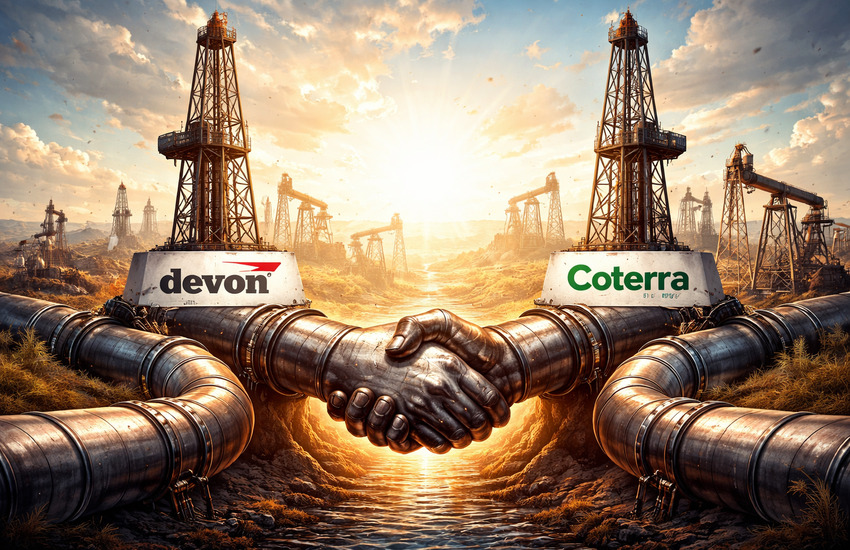
Devon Energy just announced a $21.4 billion all-stock acquisition of Coterra, positioning itself as one of the largest U.S. shale producers. While the headline deal size grabbed attention, the real story lies beneath the surface—in operational overlaps that could alter Devon’s cost structure and long-term margins.
The market sees a bloated transaction funded by undervalued equity. But Devon isn’t chasing scale for its own sake. This is a targeted bet on one basin that already accounts for most of its capital allocation. And in that basin, the math shifts quickly when you double down on contiguity.
Scale & Synergies In The Delaware Basin
Devon’s Delaware footprint already spans 400,000 net acres. Coterra adds 346,000 more—most of it adjacent. That proximity unlocks longer laterals, lower unit costs, and improved returns on every dollar drilled. Shared infrastructure and supply chains further compress development costs.
This isn’t theoretical. Devon has already realized over 60% of a $1 billion business optimization plan by tightening its Delaware execution. Folding Coterra’s assets into that machine could accelerate savings and extend drilling inventory. But there’s a less visible angle here too: with fewer prime locations left in U.S. shale, Devon is locking down quality rock before it becomes scarce.
And the part Wall Street isn’t fully pricing is what happens if Devon turns that contiguous Delaware acreage into structurally lower costs and longer-lived inventory—well beyond the initial synergy target.
Operational overlap also reduces fixed costs. Shared facilities, rigs, and service agreements can be streamlined. And while some of these savings might take time to materialize, Devon’s recent performance in driving efficiency across its base assets lends credibility. Management has already executed more than 60% of its $1 billion business optimization plan ahead of schedule. Folding in Coterra’s Delaware assets under that same system could supercharge the results.
Marcellus Exposure Adds Optionality—But Also Complexity
Coterra brings something Devon doesn’t currently have: a sizable position in the Marcellus Shale, the crown jewel of U.S. natural gas. That gives Devon geographic and commodity diversification at a time when natural gas demand is expected to rise, driven by LNG exports and power sector electrification. From an asset standpoint, the Marcellus is known for its low breakeven costs and proximity to high-demand East Coast markets.
However, diversification cuts both ways. Adding natural gas exposure could weigh on Devon’s simplicity narrative—the one that investors liked when it streamlined its portfolio through divestitures in Canada and the Barnett. The Marcellus assets aren’t adjacent to Devon’s core operations, which could dilute management focus and stretch integration resources.
Still, the deal provides gas marketing optionality. Devon already has relationships and infrastructure in place, especially after securing premium natural gas marketing contracts in recent quarters. If it can bring Coterra’s gas to higher-value markets through its expanded network, the upside could justify the added complexity. But it will require careful capital allocation to avoid overextending into non-core regions.
Capital Discipline Meets Free Cash Flow Leverage
One of Devon’s most lauded strengths over the last few years has been its capital discipline. The company made headlines in 2020 when it became the first U.S. E&P to implement a fixed-plus-variable dividend framework. That ethos hasn’t changed. Devon is expected to return 60% of free cash flow to shareholders in 2025 through dividends and buybacks, while keeping production growth to under 5%.
The Coterra deal doesn’t necessarily break that discipline. If anything, it could extend it. Coterra brings lower-cost gas and liquids assets, and if synergies materialize—even at 70% of the projected $1 billion—Devon’s already-strong free cash flow profile could get a meaningful bump. For context, Devon generated $820 million in free cash flow last quarter alone. Management believes the deal makes Devon a “free cash flow machine.” The key will be proving it.
More scale also means more negotiating leverage—with service providers, pipeline partners, and regulators. Devon’s previous deals, including its WPX merger, were well-integrated and led to better margins. CEO Clay Gaspar has a track record of managing cost structures tightly. If Devon can replicate that approach here, the larger asset base might not just be manageable—it could become a competitive advantage.
A Shared Operational Culture… Mostly
Corporate culture and integration risks don’t get enough attention in shale M&A, but they matter. Devon and Coterra have reportedly flirted with the idea of a merger before. Now that it’s official, the long-standing familiarity between leadership teams might ease the transition. Coterra’s CEO, Tom Jorden, will step into a non-executive chairman role at Devon. That gives him a voice in strategy without complicating chain of command.
Still, the two companies aren’t clones. Coterra is the product of a 2021 merger between Cimarex and Cabot—a combination that puzzled analysts at the time due to its mix of oil and gas assets. Bringing that patchwork under the Devon umbrella won’t be trivial. It’s worth noting that Devon plans to keep its name and headquarters, indicating it will likely drive the integration.
What’s encouraging is Devon’s track record. Since 2018, it’s executed several value-creating moves: selling its midstream interest in EnLink, exiting higher-cost plays like the Barnett, and merging with WPX to strengthen its Permian focus. That playbook—prune the portfolio, focus on cash returns, optimize operations—could guide how it handles Coterra. But execution risk is real, especially with less overlapping regions like the Marcellus and Anadarko.
Final Thoughts: Synergies Are Real, But So Are The Risks
The proposed Devon and Coterra shale deal is a strategic bet on scale, synergy, and cash flow. The combined portfolio would be one of the largest in the U.S. shale patch, with enviable positions in the Delaware Basin and beyond. Potential gains include longer drilling laterals, lower unit costs, and increased marketing leverage. Yet, not all assets are a clean fit. The addition of the Marcellus and legacy Cimarex regions complicates Devon’s otherwise tight operational focus.
Valuation adds another layer to the equation. Devon currently trades at 4.26x LTM EV/EBITDA and 8.28x EV/EBIT—elevated relative to its 2024 levels, but still modest compared to many large-cap peers. Its forward P/E sits at 12.13x, suggesting investors have already priced in some synergy upside. But with integration risk and regional diversification concerns still in play, the market may demand proof before awarding a higher multiple.
Ultimately, whether this is a smart use of undervalued stock or a stretch too far will depend on Devon’s ability to execute. The bones of the deal are solid. But the margin for error? Not insignificant.
Disclaimer: We do not hold any positions in the above stock(s). Read our full disclaimer here.