


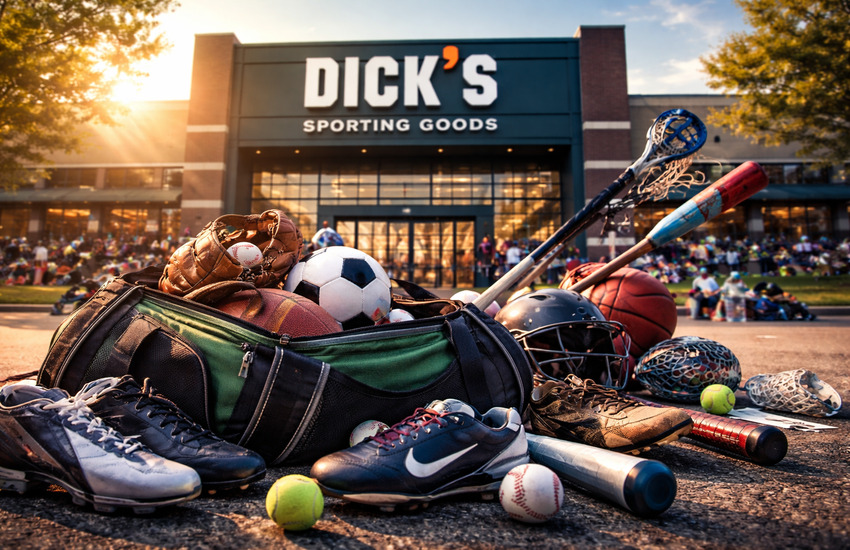
Walk into a youth baseball tournament today and something feels different. The kids still play the same game. But the gear looks like it belongs in a professional clubhouse. Composite bats cost $450. Cleats come in neon colors. Gloves arrive in custom patterns. And every dugout seems to have its own unofficial equipment sponsor—usually a proud parent.
That cultural shift sits quietly at the center of the business model for Dick’s Sporting Goods (NYSE:DKS). Youth sports spending has exploded into a roughly $40 billion industry in the United States. Parents now spend thousands each year on gear, tournaments, and travel teams. Dick’s has positioned itself as the place where that spending happens.
The company recently posted record revenue of $14.1 billion and continues to expand its massive “House of Sport” stores across the country. It also owns GameChanger, a popular youth sports streaming platform that keeps parents connected to games and stats.
None of this happened by accident. Youth sports have evolved into a subtle form of suburban competition. Kids compete on the field. Parents compete through gear, travel teams, and training. And Dick’s has quietly become the retailer supplying that entire ecosystem.
Below are four forces that help explain why the youth sports economy—and Dick’s role within it—keeps growing.
Youth Sports Spending Has Become A Suburban Status Game
Youth sports once centered on participation and teamwork. Today they often reflect something else: a quiet competition among families.
Parents rarely say this out loud. But the signals appear everywhere. One child arrives with a $450 composite bat. Another has custom gloves and limited-edition cleats. Sunglasses, training bats, arm sleeves, and branded backpacks fill dugouts across the country.
The result looks less like recreational sports and more like a consumer category. The Aspen Institute estimates families now spend more than $40 billion annually on youth sports. In baseball alone, average spending has risen sharply in recent years.
Dick’s sits directly at the center of this spending. Parents visit one store to buy nearly everything a young athlete needs. The company’s leadership often refers to customers as “athletes,” reinforcing the identity many families adopt around youth sports.
The economics resemble a familiar cycle. One parent upgrades equipment. Others notice. Soon the new gear becomes the standard. Dick’s doesn’t create the competition, but it benefits when the bar rises. And as long as youth sports remain culturally important, the spending cycle continues.
House Of Sport Stores Turn Retail Into An Experience
Retail stores used to focus on shelves and checkout lines. Dick’s is trying something very different.
Its newest format, called “House of Sport,” spans roughly 150,000 square feet. These locations include batting cages, turf fields, golf simulators, and climbing walls. Customers can test equipment inside the store before buying it.
The concept reflects a broader change in retail strategy. Stores now compete with online shopping by offering experiences rather than just products.
Dick’s opened 16 new House of Sport locations last year and plans more expansion ahead. The company believes these stores strengthen relationships with both customers and major athletic brands.
For parents and kids, the format creates a destination. A visit might involve trying out a new bat, practicing swings in a cage, and browsing shelves filled with performance gear.
That environment naturally encourages comparison. Young athletes see what others use. Parents see what competitors buy. And the cycle of equipment upgrades quietly continues.
House of Sport stores don’t just sell gear. They turn sports retail into a physical stage where the youth sports economy plays out.
GameChanger Is Turning Youth Sports Into A Media Ecosystem
Technology has also transformed youth sports culture. One of the clearest examples is GameChanger, the livestreaming and stat-tracking platform owned by Dick’s.
The app allows parents and relatives to watch games remotely, follow player statistics, and view highlight clips. Coaches can manage lineups and track performance in real time.
In short, GameChanger turns local youth games into something resembling professional sports broadcasts.
The platform continues to grow rapidly. Company executives describe it as a leader in the youth sports technology market. It also provides a new kind of data connection between Dick’s and millions of families.
That connection matters. When parents track stats and watch games through the app, they become more engaged in the sport itself. Engagement often leads to more spending on equipment, training tools, and apparel.
GameChanger also feeds Dick’s emerging media network. Advertisers can reach parents and young athletes during the moments when sports matter most—before games, during livestreams, and while reviewing stats.
The result is a full ecosystem. Dick’s sells the gear. GameChanger captures the attention around the game.
The Intersection Of Sport & Culture Is Getting Stronger
Executives at Dick’s often describe the business as sitting at the “intersection of sport and culture.” That phrase captures a broader shift in the sports economy.
Athletics today influence fashion, entertainment, and identity. Signature sneakers launch like cultural events. Women’s sports have seen surging interest. Global competitions such as the World Cup and Olympics draw massive audiences.
These cultural moments ripple down to youth leagues.
When young athletes watch their heroes wear certain gear, they want the same equipment. Brands respond with new designs, colors, and limited releases. Retailers like Dick’s then distribute those products to families across the country.
The company has also expanded its brand relationships and product partnerships in recent years. Running shoes, signature basketball footwear, and emerging athletic brands all contribute to sales growth.
At the same time, Dick’s acquired Foot Locker, expanding its reach deeper into sneaker culture. That move adds scale and strengthens connections with major athletic brands.
Taken together, the message is simple. Sports culture keeps expanding. Youth participation follows close behind. And retailers positioned in the middle of that ecosystem often benefit.
Final Thoughts
Youth sports in America now resemble a complex economic ecosystem. Participation remains the core activity, but culture and spending increasingly surround it. Families invest heavily in gear, tournaments, and training experiences. Retailers like Dick’s Sporting Goods have adapted their strategies to capture that demand.
The company’s recent financial performance reflects this positioning. Dick’s generated record revenue and continues expanding experiential store formats while building digital platforms such as GameChanger. These initiatives help embed the brand deeper into youth sports culture.
From a valuation perspective, the market appears to recognize this steady business model. The stock currently trades around 1.38× LTM EV/Revenue, 11.96× EV/EBITDA, and roughly 19.3× trailing earnings. Those multiples place Dick’s in the mid-range of large specialty retailers, suggesting investors see stable growth but not excessive optimism.
The long-term outlook for youth sports spending will depend on participation trends, household budgets, and broader cultural shifts. For now, however, the competitive spirit that fuels youth athletics continues to extend beyond the field—and into the aisles of sporting goods stores across the country.
Disclaimer: We do not hold any positions in the above stock(s). Read our full disclaimer here.