
Continue Reading With Our 7-Day Free Trial
It has been a bruising few weeks for Novo Nordisk (NYSE:NVO). First came the clinical disappointment: CagriSema, the company’s highly anticipated next-generation obesity drug, failed to beat Eli Lilly’s tirzepatide in a head-to-head trial. Then came the pricing reset: Novo announced it would slash U.S. list prices for Ozempic by 34% and Wegovy by 50%, bringing both to $675 per month starting in 2027. The stock, a lready down sharply over the past year, slid further.
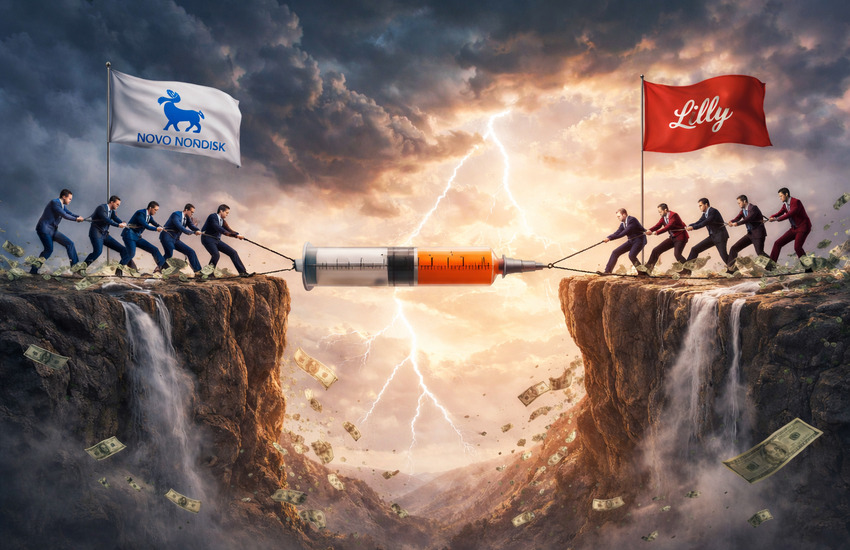
Taken together, these moves signal mounting competitive and margin pressure. They also deepen the market’s growing divergence between Novo and Eli Lilly. Lilly’s drugs are outperforming in trials and commanding pricing strength. Novo, by contrast, is leaning into price and volume to defend share. That shift forces investors to reassess three things at once: the credibility of Novo’s pipeline, the durability of its pricing power, and the strategic options left in the obesity arms race.
Pipeline Credibility Under Pressure & The Cost Of Falling Short
CagriSema was supposed to be the sequel that kept the franchise fresh. It combines semaglutide with cagrilintide, aiming to deliver greater weight loss than GLP-1 alone. In the obesity trial, patients on CagriSema achieved 23% weight loss after 84 weeks. That is impressive in isolation. The problem is that Eli Lilly’s tirzepatide delivered 25.5% in the same comparison.
In biotech, “close” is not always good enough. The primary endpoint was superiority. Novo did not get there. The market reacted swiftly, sending shares down sharply. Investors understood what the numbers implied: Lilly remains the efficacy leader. In a category where magnitude of weight loss drives demand, that matters.
Novo management struck an optimistic tone, highlighting that CagriSema still achieved robust results. They also pointed to future trials like REDEFINE 11, which may better showcase the drug’s potential under optimized dosing. Still, credibility has taken a hit. Investors now must discount not just one trial outcome, but the possibility that the pipeline will struggle to decisively leapfrog Lilly. That uncertainty weighs on long-term valuation assumptions.
Pricing Power Erodes & Margins Come Into Focus
Novo’s decision to cut U.S. list prices is historic. The company has never before reduced list prices for Ozempic or Wegovy in the U.S. Ozempic will see a 34% reduction. Wegovy’s cut is steeper at 50%. Management framed it as an investment in volume growth and broader access.
The timing, however, speaks volumes. The company’s 2026 guidance calls for adjusted sales to decline between 5% and 13% at constant exchange rates. U.S. sales are expected to fall in the teens, driven largely by price. That is a stark shift for a franchise once defined by pricing strength.
Margins are already feeling the strain. Gross margin declined to 81% in 2025 from 84.7% the year prior. Operating profit growth slowed, and restructuring costs added further drag. While the Wegovy pill launch has been strong, management acknowledged that its gross margin is lower than the injectable version.
Lower prices can expand access. They can also compress profitability. In a high-fixed-cost business that depends on manufacturing scale and R&D investment, sustained price pressure can reshape earnings power. Investors are no longer modeling just volume growth. They are modeling price elasticity and margin trade-offs.
The Divergence With Eli Lilly Widens
The competitive contrast has become sharper. Lilly’s tirzepatide outperformed CagriSema in the obesity trial. Lilly’s Mounjaro and Zepbound have posted strong sales growth. The market has rewarded that performance, pushing Lilly’s valuation toward the trillion-dollar mark at times.
Novo, meanwhile, has seen its stock fall roughly 50% over the past year. The divergence is not just about one trial. It is about perception. Lilly is viewed as the efficacy leader with a strong pipeline that includes an oral GLP-1 candidate, orforglipron. Novo is seen as defending share with price cuts and awaiting clearer pipeline wins.
Novo’s Wegovy pill has launched well, with rapid uptake and broad pharmacy availability. That is a positive. But even here, management emphasizes the need to expand access through self-pay channels and partnerships. This reflects a more competitive market than the one that existed two years ago.
When markets crown a leader, they tend to pay up. When leadership is questioned, multiples compress. The divergence between the two companies now reflects both operational results and investor psychology.
Strategic Crossroads & Capital Allocation Questions
With price pressure rising and competitive dynamics intensifying, strategic options come into focus. Novo signaled that it could spend up to $35 billion on acquisitions. That suggests management is considering ways to bolster the pipeline externally.
At the same time, capital expenditures remain high as the company expands manufacturing capacity. In 2025 alone, significant capital was deployed toward production and R&D expansion. Shareholders have continued to receive dividends, marking 30 consecutive years of increases. Yet free cash flow guidance for 2026 implies tighter conditions ahead.
Investors must now weigh the risks of cannibalization between injectable and oral products, the pace of Medicare coverage expansion, and the impact of generic competition in international markets. The obesity market is dynamic, and management acknowledges the uncertainty around volume response to price cuts.
In this environment, every capital allocation decision carries more weight. Should the company double down on internal innovation? Accelerate acquisitions? Prioritize margins over share? The answers will shape the next phase of competition in weight loss therapies.
Final Thoughts: Cheaper For A Reason Or Opportunity In Disguise?
Novo Nordisk’s setback in the CagriSema trial and its aggressive U.S. price cuts are not isolated events. Together, they mark a shift. Competitive pressure is real. Pricing power is no longer unquestioned. The divergence with Eli Lilly has become more visible.
At the same time, Novo retains meaningful strengths. It remains a global GLP-1 leader with strong brand recognition. The Wegovy pill launch has been robust. The pipeline includes next-generation assets such as zenagamtide and triple agonists. Manufacturing scale is expanding. Dividend growth continues.
Valuation now reflects the reset. As of late February 2026, Novo trades at roughly 10.6x LTM earnings and about 7.8x LTM EBITDA, well below prior peaks. LTM price-to-sales has compressed to 3.5x. Dividend yield has risen to around 4.5%. These are far more modest multiples than a year ago.
Whether the stock is inexpensive or fairly priced depends on one key question: can Novo restore confidence in its pipeline and defend margins in a more competitive market? The obesity race is far from over. But it is no longer a one-horse show.
Disclaimer: We do not hold any positions in the above stock(s). Read our full disclaimer here.