


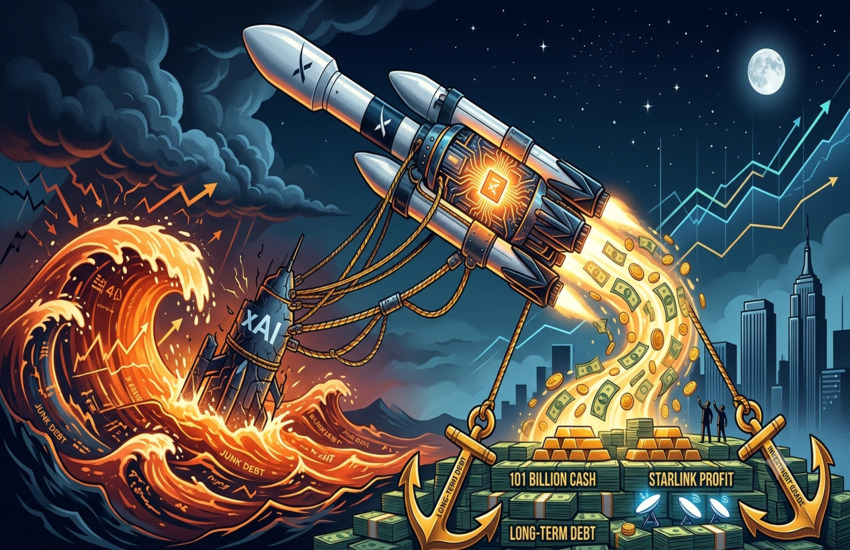
Twelve days after SpaceX raised $86 billion in the largest IPO in American history, Elon Musk went back to Wall Street and asked for $25 billion more.
The company had $101 billion in cash. And it borrowed $25 billion anyway.
This is not a story about SpaceX needing money. It is a story about what happens when the AI boom shifts from an equity story to a debt story. And yesterday’s crash, the worst single day for AI stocks in months, is directly connected to it.
One company in our screener fell 4% yesterday. It had never appeared in our model before. We added it to the LENS Watch List after the close. The SpaceX bond deal is the reason it belongs there.
We will get to that name. But you need to understand the bond deal first.
What Spacex Actually Did
On Tuesday, SpaceX priced $25 billion in senior unsecured bonds across five tranches. Maturities run from 2031 to 2056. Interest rates range from 5.35% to 6.65%. The offering attracted $89 billion in demand at its peak. The deal was originally targeted at $20 billion and had to be upsized.
Goldman Sachs, Morgan Stanley, JPMorgan, Bank of America, and Citigroup all took a seat at this table.
The proceeds have one destination: repaying a $20 billion bridge loan that SpaceX raised to pay off the junk bonds sitting on xAI’s balance sheet when SpaceX acquired it in February.
This Is The Part That Matters
Before February 2026, xAI had $17.5 billion in junk-rated bonds at 9.5% to 12.5% interest, costing around $1.8 billion a year in debt service. And xAI was losing money at scale. The company generated $3.2 billion in revenue last year but posted a $6.4 billion operating loss. Those losses doubled from 2024.
When SpaceX absorbed xAI, xAI’s junk debt became SpaceX’s investment-grade debt. Not because xAI’s business improved. Because Starlink generated $4 billion in operating profit in 2025, and government rocket contracts are the most reliable cash-flow machines in tech. That changed the credit rating. And that changed everything.
The new $25 billion bonds will cost SpaceX about $1.5 billion a year in interest. That is $300 million less than the old xAI debt. By stapling xAI’s balance sheet to Starlink’s, Musk refinanced his AI bet at investment-grade rates. He used one company’s creditworthiness to bail out another company’s debt problems. And Wall Street handed him $89 billion to do it.
SpaceX’s free cash flow was negative $14 billion in 2025, more than double the year before. The AI division is consuming Starlink’s profits faster than Starlink can generate them. The bonds maturing in 2056 are asking investors to believe this empire will still generate cash flows in 30 years.
That is a 30-year bet on a company whose AI division lost $6.4 billion in operating income last year.
The Two Markets Telling Opposite Stories
The equity market has been selling AI stocks hard. Yesterday, the KOSPI crashed 10%. Nvidia, Broadcom, AMD, and Micron all fell sharply. The narrative is that AI capex is out of control, returns are uncertain, and the bubble may be entering its debt-funded final phase.
The bond market saw $89 billion show up for $25 billion of SpaceX paper. Four times oversubscribed. On a first-time issuer. With a 30-year tranche. Bond investors lose everything if the company defaults. And they could not get enough.
One market is panicking. The other is placing long-duration bets at scale. Both cannot be right. Which one is correct will determine what happens to AI stocks for the next 12 months.
The Stock That Just Entered Our LENS Watch List
Here is what nobody has connected yet.
The bond market is telling you AI infrastructure spending is not stopping. It is accelerating, just financed differently. Every dollar of that SpaceX bond deal funds compute infrastructure that runs on chips. Specific chips. From a company with an ecosystem so entrenched that switching costs alone protect its market position.
Yesterday’s crash sent that company’s stock down 4%. Its valuation fell into territory that triggered our model for the first time in its history. It appeared in the Hidden AI Beneficiary screener on Tuesday evening. It was not in the screener last week. The price had to fall this far before the fundamentals looked compelling enough relative to the share price.
The SpaceX bond deal is the reason the thesis holds. If debt markets are funding 30-year AI infrastructure paper, the compute buildout is a multi-decade capital cycle. And the company that dominates the core of that cycle at an 80%+ market share just got cheaper.
We added it to the LENS Watch List after Tuesday’s close.
Where The LENS Index Stands
On Tuesday, the S&P 500 fell 1.44%. LENS fell 0.88%. The portfolio outperformed the market on the worst AI selloff day of the month. That is what low-beta, thesis-driven positioning is supposed to do in a correction.
| Metric | Value | Notes | Last Updated |
|---|---|---|---|
| Active Positions | 11 / 30 | No stop losses hit — all positions held | 06-Oct-26 |
| Cash Deployed | 48% | 52% reserve maintained | 06-Oct-26 |
| Cash Reserve | 52% | Minimum 15% policy maintained | 06-Oct-26 |
| Performance Since Launch | +7.55% | S&P: +5.23% | Alpha: +2.32% | 06-Oct-26 |
| Alpha Generated | +2.32% | Widened as the portfolio outpaced a rising market | 06-Oct-26 |
| LENS All-Time High | 107.55 (06-Oct-26) | New record today — 0.13 above the prior high of 107.42 (22-Sep-26) | 06-Oct-26 |
| Portfolio Beta | 0.75 | vs S&P 500 | 77 observations | 06-Oct-26 |
| Max Drawdown | -3.7% | Jun18 peak → Jul16 trough 101.47. Current level remains well above trough. | 06-Oct-26 |
| Sharpe Ratio | 1.41 | Annualized, rf=3.5% | 06-Oct-26 |
| Stop Loss Check | Zero positions hit | One position's stop buffer widened to 6.0% after touching 3.2% on Oct 2, still the tightest in the book | 06-Oct-26 |
| Inception | May 22, 2026 | LENS Index launched | Fixed |
| Benchmark | S&P 500 Total Return | Outperform on risk-adjusted basis | Fixed |
| Strategy | Narrative Disruption | Long-only, large-cap, max 30 positions | Fixed |
| Direction | Long Only | Subscribe to access all positions | Fixed |
The SpaceX bond deal is not a red flag. It is a signal about where we are in the AI infrastructure cycle. The name we added to the Watch List yesterday answers which market is right. And so does its entry trigger.
The name we added to the LENS Watch List on June 23, 2026 is …
Continue Reading With Our 7-Day Free Trial
… NVIDIA Corporation.
NVDA closed at $200.04 on Tuesday, down 4.13% on the day. For the first time in the history of the LENS screener, Nvidia passed our Hidden AI Beneficiary filter at a forward P/E of 30.63. Nvidia at a P/E below 31 is a level this stock has not seen since before the AI boom began.
Why This Is A LENS Idea & Not Just A Dip Buy
The market narrative is that custom AI chips are eating Nvidia’s market share. Amazon’s Trainium, Google’s TPUs, Broadcom’s custom ASICs are taking compute workloads off Nvidia GPUs. The equity market is pricing this as a structural shift that will meaningfully erode Nvidia’s dominance.
That narrative is wrong in a specific way.
ASIC chips do one set of tasks extremely well. They are custom-built for a single customer’s specific workload. They cannot be reprogrammed for the next model architecture. They do not run the researcher’s experimental code. The reason large language models were invented on Nvidia GPUs is not marketing. It is that CUDA, Nvidia’s software ecosystem, is the only environment where that level of research flexibility exists.
Custom ASICs are not replacing GPUs. They are supplementing them. The hyperscalers are running both. And as AI workloads grow at the pace implied by SpaceX borrowing $25 billion at 30-year maturities, demand for both types of chip grows.
The narrative gap: the market is pricing ASIC adoption as zero-sum against Nvidia. It never has been. Every hyperscaler’s actual capex disclosures confirm it.
The LENS Watch List Entry For NVDA
We are watching for an additional 10–12% pullback to the $175–$180 range. At that price, the forward P/E drops to approximately 27, the thesis break risk becomes better compensated, and the position enters at SPEC tier with a 1–2% allocation. Hard stop sits 35% below entry. The thesis breaks only on a sustained reversal of GPU market share in AI training, not on short-term price action or earnings noise.
The next major catalyst is Q2 FY2027 earnings in August. Between now and then, any further selloff in AI stocks that pushes NVDA toward $175 is where we become interested.
The Spacex Connection One Final Time
If the AI buildout were slowing, institutional debt investors would not have put $89 billion in orders for 30-year SpaceX paper. They would have said the compute cycle is peaking and walked away.
Instead, they lined up four times oversubscribed. That is the bond market telling you the AI compute demand cycle is decades long.
Nvidia is the primary beneficiary of decades-long compute demand. At $175, we will be watching closely.
Disclaimer: We do not hold any positions in the above stock(s). Read our full disclaimer here.