

Continue Reading With Our 7-Day Free Trial
Tesla (NASDAQ:TSLA) heads into Tesla Q2 Earnings on July 22 with a strange problem. The company just delivered 480,126 vehicles, far above the company-compiled analyst median of 408,609. Yet its shares initially fell after the release. That reaction says a lot about what Wall Street now expects from Tesla.
Investors are no longer judging the company only by how many cars it sells. They increasingly want proof that robotaxis, artificial intelligence, and Optimus can become meaningful businesses.
The Miami robotaxi launch adds momentum, but one analyst estimates the active fleet at only 40 to 60 vehicles. Optimus also carries substantial strategic value. However, commercial production remains early and difficult to forecast.
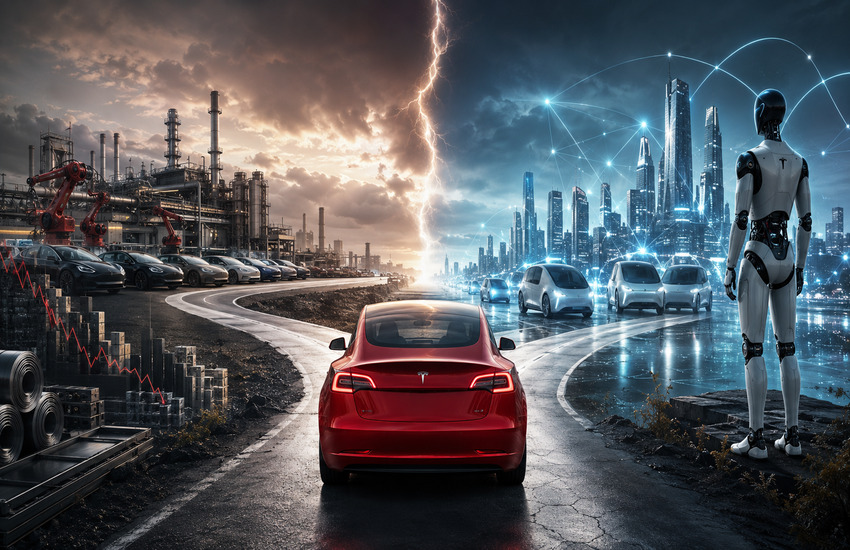
So, this report is not simply about revenue, margins, or deliveries. It is a test of Tesla’s identity. Can the company show that its AI businesses are moving toward commercial scale? Or will investors have to focus again on the economics of the automobile operation?
That tension makes July 22 far more important than a normal quarterly update.
Tesla Q2 Earnings Put The AI Narrative On Trial
Tesla’s delivery result was strong by almost any measure. The company shipped 480,126 vehicles during the second quarter. That was about 18% above its company-compiled consensus. Deliveries also increased 25% from the prior-year period.
Still, the stock fell 7.5% after the announcement. Part of that move may have reflected profit-taking after a strong run. Investors also questioned whether higher gasoline prices helped demand. Improving European sales provided another important source of support.
There are also questions about how repeatable the result may be. Model S and Model X production has ended, and some sales may have reflected final purchases. That source of demand will not continue.
This is where the July 22 report becomes important. Tesla Q2 Earnings should reveal whether the delivery surprise translated into stronger underlying financial performance. A delivery beat does not automatically equal an earnings beat.
Revenue depends on vehicle pricing, product mix, and leasing activity. Margins depend on incentives, tariffs, production costs, and warranty expenses. Cash flow will also matter because Tesla has entered a major investment cycle.
The results should reveal whether record vehicle deliveries created stronger economics or simply higher volume.
Robotaxi Expansion Needs More Than New Cities
The robotaxi story is moving forward, but it is not yet a large business. Tesla has expanded the service into Miami after launches in Texas. One analyst estimate placed the active fleet at only 40 to 60 vehicles.
Management hopes to reach roughly a dozen states by year-end. It also said robotaxi and unsupervised FSD revenue would probably not be material in 2026. The contribution could become more meaningful in 2027. Tesla says its cautious approach has avoided injuries and fatalities so far.
The obstacles are not limited to headline safety events. Tesla has described vehicles becoming too cautious, getting stuck, blocking intersections, or repeating routes around roadwork. These problems sound mundane, but they matter in a paid transportation service.
Cybercab production has started, although Tesla expects a slow initial ramp. Older Hardware 3 cars also cannot support unsupervised FSD without computer and camera upgrades. That complicates the idea of quickly converting Tesla’s installed fleet into robotaxis.
At Tesla Q2 Earnings, investors now need operating evidence, not only new city announcements. Fleet size, paid rides, interventions, utilization, and revenue per vehicle would make progress easier to judge.
Optimus Production Faces A Slow Reality Check
Optimus may be Tesla’s boldest long-term idea. It may also be the hardest one to value today. Tesla has been converting part of its Fremont footprint from Model S and Model X production toward robots.
Management previously pointed to a late July or August start for Optimus production. Yet it also said the initial ramp would be slow. Elon Musk said the 2026 production rate was impossible to predict. Early robots are expected to begin with relatively simple factory tasks.
Tesla is also preparing a second Optimus factory at Giga Texas. That facility could begin production around summer 2027. The company has said the updated V3 design is close to demonstration, although the timing remains flexible.
Tesla Q2 Earnings therefore needs more than another polished demonstration. Investors need a clear bridge from prototype to useful product.
That means more detail on production timing, manufacturing costs, task capabilities, factory deployment, and potential external customers. Investors may also want to know when Optimus could begin generating revenue outside Tesla.
Until those pieces emerge, Optimus remains strategically important but financially uncertain.
The AI Transformation Comes With A $25 Billion Bill
Tesla is spending like a technology platform, not a traditional automaker. Management expects more than $25 billion of capital expenditure in 2026.
The money will support robotaxi infrastructure, Optimus, AI chips, manufacturing plants, and a semiconductor research facility. Tesla also warned that free cash flow could remain negative for the rest of the year.
That investment may create future capacity, but it raises the standard for execution. The AI narrative now requires measurable returns on very large investments. Investors will want to know when these projects can begin producing revenue and cash.
This spending backdrop makes Tesla Q2 Earnings an important test of capital allocation as well as technology execution.
The automobile operation still matters because it helps finance that transition. Tesla previously reported that automotive gross margin excluding regulatory credits improved to 19.2%. However, one-time warranty benefits also supported that result.
FSD provides another potential bridge between cars and software. Tesla reported nearly 1.3 million paid FSD customers worldwide. Management now describes the software as the product and the vehicle as its delivery mechanism.
Energy storage adds another source of scale. Second-quarter deployments reached 13.5 GWh, up from 9.6 GWh one year earlier. That business may receive less attention, but it could provide diversification while robotaxis and Optimus remain early.
Final Thoughts
Tesla enters July 22 with more evidence of demand than it had one quarter ago. Record deliveries, stronger international trends, growing FSD adoption, and higher energy-storage deployments all provide support.
The robotaxi network is expanding, and Optimus manufacturing preparations are becoming more concrete. Yet both businesses remain early. Their near-term revenue contribution is limited, while the required investment is substantial.
The difficult issue is valuation. As of July 9, Tesla traded at approximately 15.31 times LTM revenue, 135.09 times LTM EBITDA, 312.04 times LTM EBIT, and 373.22 times diluted LTM earnings.
Those multiples leave limited room for vague timelines or incomplete disclosure. They indicate that investors are already assigning substantial value to businesses beyond Tesla’s current automobile profits.
That does not make the AI thesis incorrect. It does mean the burden of proof is high. Tesla Q2 Earnings must connect ambition with measurable execution.
The market will be listening for robotaxi scale, Optimus production milestones, spending discipline, automotive margins, and cash flow. Tesla Q2 Earnings may not settle whether Tesla is a car company or an AI company. It should show whether the gap between those two identities is narrowing or becoming harder to defend.
Disclaimer: We do not hold any positions in the above stock(s). Read our full disclaimer here.