


Continue Reading With Our 7-Day Free Trial
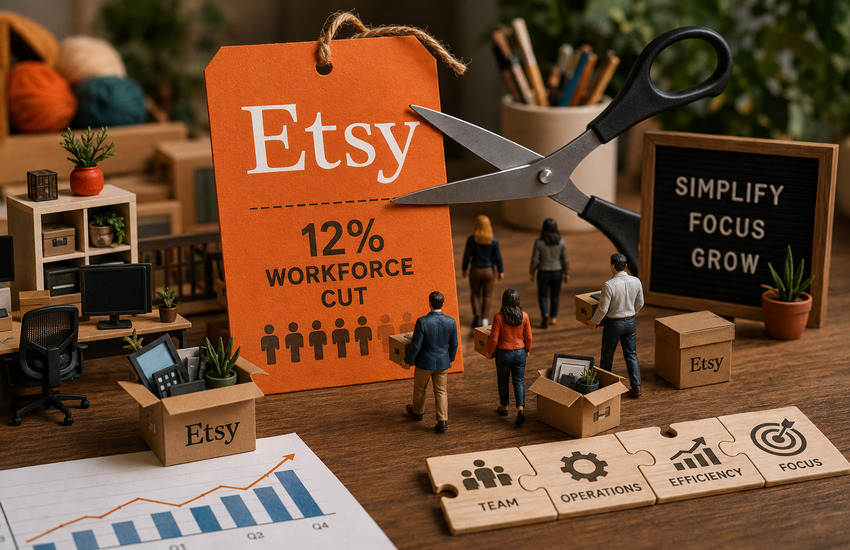
Etsy (NASDAQ:ETSY) is cutting about 220 jobs, or roughly 12% of its workforce, under the Etsy Workforce Cuts plan, even as its marketplace improves. That contrast makes this restructuring notable. Management expects head count to fall to about 1,600. Etsy will also record roughly $35 million in related charges. Most of the restructuring should be finished by the end of the third quarter.
The company says the plan will create a simpler organization. It should also improve coordination and speed up decisions. Meanwhile, Etsy authorized another $2 billion in share repurchases with no expiration date.
The timing is important. Etsy marketplace sales, revenue, and comparable profit all increased during the second quarter. Its shares had also gained about 50% during 2026 before the announcement. Etsy is not cutting jobs during an obvious financial crisis. Instead, management appears to be reshaping the company while its turnaround is still gaining traction.
Improving Results Hide A Still-Fragile Recovery Behind Etsy Workforce Cuts
Etsy’s latest financial results were stronger than the layoff headline might suggest. Second-quarter marketplace gross merchandise sales rose 7.5% to $2.6 billion. Marketplace revenue increased 9.3% to $668 million. Comparable net income reached $114 million, rising more than 50% from the previous year.
Those numbers point to improvement. However, Etsy’s earlier earnings call showed that the recovery was still uneven. First-quarter active buyers increased sequentially for the first time in two years. GMS per active buyer also grew year over year for the first time since 2022.
Still, purchase frequency remained modestly below the prior year. Habitual and repeat buyers had stabilized, but they were still declining annually. Management also warned that progress would not move in a straight line.
That difference matters. Higher order values can support sales before customers begin shopping more often. Some of Etsy’s order-value growth also came from currency movements, tariffs, and seller price increases. Those benefits may fade.
The Etsy Workforce Cuts may therefore reflect caution rather than panic. Etsy’s marketplace is healthier, but it has not yet produced a clear frequency-led recovery. A smaller cost base gives management more protection if buyer activity improves slowly.
Portfolio Cleanup Creates A Smaller Core Business
Etsy has spent more than a year narrowing its focus. The company sold music-equipment marketplace Reverb in June 2025. It then completed the $1.4 billion sale of Depop to eBay on July 30.
Those transactions leave Etsy centered on its original marketplace. That business connects shoppers with handmade, customized, vintage, and creative products. The company is becoming simpler at the portfolio level and now wants the organization to match.
Owning several marketplaces created extra management layers and competing priorities. Each platform required separate technology, marketing, operations, and investment decisions. Following the divestitures, some roles may no longer fit Etsy’s smaller structure.
Management has also made coordination a central part of its strategy. Its current priorities include discovery, product matching, customer loyalty, and human connection. These areas overlap across engineering, marketing, product, and operations. Slow decisions can weaken execution when several teams must work together.
The Etsy Workforce Cuts could remove duplication and shorten approval processes. They may also concentrate spending on the core marketplace rather than maintaining infrastructure for a broader portfolio.
Still, simplification carries risk. Fewer employees can create pressure on remaining teams. Etsy must reduce complexity without slowing product releases, customer support, seller protection, or marketplace enforcement.
A Leaner Structure Could Speed Product & AI Execution
Artificial intelligence is becoming central to Etsy’s product strategy. The company is using machine learning to improve search results, personalize recommendations, and understand buyer preferences. It is also developing tools that help sellers manage listings and operate their shops.
The mobile app is especially important. During the first quarter, app-based GMS rose 11.2% and reached about 47% of total marketplace GMS. Etsy has said app users generate 40% higher lifetime value than non-app users. They visit more often, engage more deeply, and convert at higher rates.
Etsy is also testing conversational shopping tools. These include a gift-finding agent for buyers and an operational assistant for sellers. Management said some new agents were built within weeks rather than months.
That faster development cycle helps explain the restructuring. The Etsy Workforce Cuts may reflect a belief that smaller teams can produce more when AI handles parts of coding, analysis, content creation, and shop management. Management previously described these tools as force multipliers across the organization.
This does not mean AI directly replaced every eliminated position. Etsy has not provided that level of detail. However, the company is clearly redesigning how work gets done.
The key test is output. Investors will watch whether Etsy releases products faster while maintaining trust, support quality, and marketplace safety.
Buybacks Raise The Stakes For Margin Discipline
Etsy’s additional $2 billion repurchase authorization is larger than the expected restructuring charge. The company will spend about $35 million on severance, benefits, and related costs. Management expects future savings from operating with roughly 1,600 employees.
The buyback sends a separate but related message. Etsy believes direct capital returns remain an important use of cash. The Depop sale also gives the company more financial flexibility to repurchase shares.
Etsy was already focused on efficiency before announcing the Etsy Workforce Cuts. During the first quarter, product development, marketing, and administrative expenses all gained operating leverage. Free-cash-flow conversion also improved. Management repeatedly discussed tighter expense control and return-based investment decisions.
The restructuring may help protect Etsy’s adjusted EBITDA margin while it invests in search, personalization, AI, and seller tools. Earlier guidance called for a full-year adjusted EBITDA margin between 28% and 30%.
There is still a difficult balance. Share repurchases can increase per-share value when a stock is reasonably priced. They are less effective when they come at an elevated valuation or weaken operating investment.
Employees, sellers, and investors may also view large buybacks differently during a workforce reduction. Etsy will need to show that the cuts improve execution rather than simply increasing short-term earnings per share.
Final Thoughts
Etsy’s workforce reduction arrives during an unusual stage of its turnaround. Marketplace sales and profit are improving. Active buyers have stabilized, and app engagement is growing. Yet customer frequency remains weak, competition is intense, and discretionary spending is still uncertain.
The restructuring could produce a more focused company with faster decisions and lower costs. It could also place more pressure on teams responsible for product development, seller support, and marketplace trust.
Valuation leaves limited room for execution problems. As of August 5, Etsy traded at 3.48 times LTM enterprise value to revenue and 2.81 times LTM sales. It also traded at 23.01 times LTM EBITDA, 25.91 times LTM EBIT, and 34.62 times diluted earnings.
Those multiples reflect a meaningful recovery in investor expectations. The LTM EBITDA multiple stood near 15 times at the end of March. It had risen above 23 times by August 5.
Etsy is no longer valued like a deeply troubled marketplace. The current price assumes that growth, efficiency, and capital returns can continue together. The layoffs may support that case, but the outcome will depend on buyer frequency, product execution, and the durability of marketplace growth.