
Continue Reading With Our 7-Day Free Trial
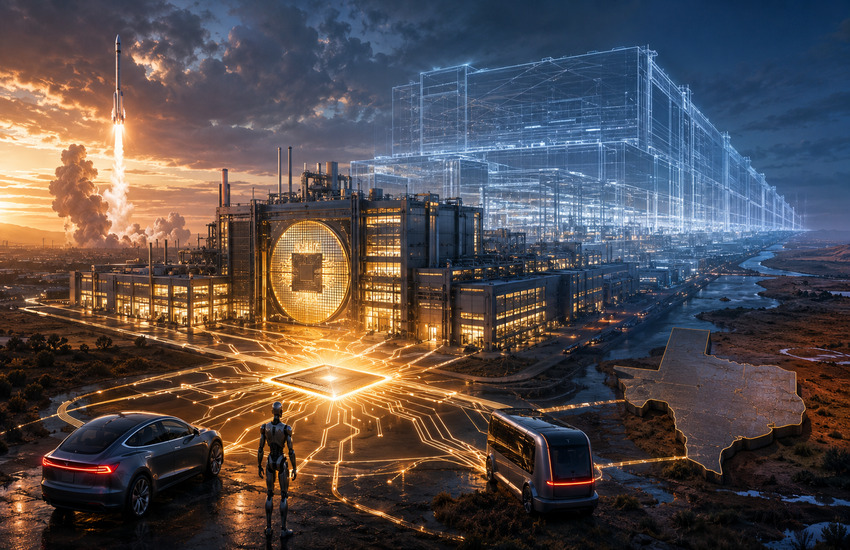
Tesla (NASDAQ:TSLA) and SpaceX are taking another major step toward Elon Musk’s vertically integrated AI vision. The companies have committed an initial $16.8 billion to Terafab, a massive semiconductor complex planned for Grimes County, Texas. The Tesla Terafab Investment is expected to become a central part of that strategy. The site is expected to span more than 100 million square feet and manufacture advanced logic and memory chips.
That headline number, however, tells only part of the story. An earlier SpaceX filing outlined an initial $55 billion investment and said later phases could lift total spending to as much as $119 billion. The new $16.8 billion commitment should be viewed separately from that earlier proposal.
For Tesla investors, that distinction matters. Tesla is already entering one of the largest capital spending cycles in its history. Terafab now adds another possible layer. The real question is not whether Musk can build a semiconductor factory. It is how much capital Tesla may eventually commit before Optimus, Cybercab and AI infrastructure generate enough returns to justify the spending.
Tesla Terafab Investment Could Remove A Critical AI Chip Bottleneck
The strategic argument for Terafab starts with something simple: Tesla expects to need an enormous number of AI chips. Musk has already said chip availability could limit how quickly Optimus production can grow.
Terafab is designed to attack that constraint directly. The facility would combine logic manufacturing, memory, packaging and chip testing under one roof. Tesla is also developing a smaller Austin research fab where new chip designs can move rapidly from masks to fabrication and testing. Musk described semiconductor availability as essential to scaling Optimus.
That matters because Tesla’s robotics ambitions are becoming increasingly vertically integrated. Tesla designs specialized electronics for Optimus and is developing its AI5 and AI6 processors. At the same time, suppliers including TSMC, Samsung and Micron remain important partners. Tesla has therefore not abandoned external semiconductor capacity. Instead, Terafab appears intended to create another layer of control over a supply chain management considers strategically important. The Tesla Terafab Investment therefore extends Tesla’s existing semiconductor strategy rather than replacing outside suppliers.
This is the bullish case for the project: Tesla could reduce dependence on outside capacity while shortening chip-development cycles.
But semiconductor manufacturing is very different from chip design. Leading-edge fabs require huge capital investments, specialized equipment and constant process improvements. That makes the potential benefit significant, but it also makes execution costly.
Tesla Is Already Entering A Massive Capex Cycle
Terafab is arriving when Tesla’s capital requirements are already moving sharply higher.
Management expects 2026 capital expenditures to exceed $25 billion, with spending increasing further during the second half. Tesla also expects capex to keep growing over the next two or three years. The spending list is unusually broad: robotaxis, Optimus factories, semiconductor manufacturing, solar production, AI compute and additional automotive capacity.
Tesla is preparing its balance sheet accordingly. Management said it is pursuing debt facilities that could provide up to $30 billion of borrowing capacity. That gives the company more flexibility, but it also shows the scale of the investment cycle now underway. The Tesla Terafab Investment adds another potential demand on capital during this already aggressive expansion phase.
Musk has also been clear about the trade-off. Tesla is willing to accept somewhat lower capital efficiency if spending faster allows projects to come online sooner. His argument is that earlier deployment can produce a higher net present value even when construction costs are less optimized.
That philosophy becomes particularly important with Terafab.
The current $16.8 billion commitment is shared with SpaceX. Yet the earlier SpaceX proposal shows how much larger the project could theoretically become.
Investors therefore need to separate today’s committed spending from the project’s possible long-term capital requirements. Tesla’s eventual contribution to later phases has not been established.
SpaceX Shows Both The Opportunity & The Spending Risk
SpaceX provides an interesting comparison because it is already spending enormous amounts on AI infrastructure.
During the second quarter, SpaceX reported approximately $18.4 billion of capital expenditures, including about $15.8 billion directed toward AI compute infrastructure. That was a dramatic increase from the prior year and helped explain investor concern around the company’s spending trajectory.
There is an important counterpoint. SpaceX says its recent compute investments are producing payback periods of less than one year. The company generated $2.6 billion of AI segment revenue during the quarter. New cloud agreements contributed $1.6 billion of incremental AI infrastructure revenue. SpaceX also reported $100 billion of cash, cash equivalents and marketable securities after its IPO and debt financing.
That makes SpaceX’s spending easier to evaluate. Investors can already compare infrastructure costs with cloud revenue and contracted capacity. The Tesla Terafab Investment will eventually face a similar test as investors compare capital deployed with measurable economic output.
Tesla’s Terafab economics are less direct.
The chips are expected to support Optimus, Cybercab and other edge-computing applications. Those businesses could eventually create significant semiconductor demand. However, their financial returns depend on production scale, utilization and commercialization.
SpaceX is already monetizing portions of its AI infrastructure. Tesla still has to prove how quickly its own AI hardware investments translate into earnings and cash flow.
That difference could become increasingly important if Terafab moves beyond its initial phase.
Tesla & SpaceX Are Becoming More Closely Connected
Terafab also highlights another development investors should watch: the growing operational overlap between Tesla and SpaceX.
The relationship is expanding well beyond sharing Elon Musk as CEO. Tesla and SpaceX are collaborating on Terafab and Digital Optimus. Grok is being used within Tesla products, while Starlink connectivity is being incorporated into Cybercab and potentially other Tesla vehicles. Tesla also holds an investment in SpaceX and recorded a $1 billion mark-to-market gain on that position during the second quarter.
There are clear strategic benefits. Tesla can access SpaceX’s AI models, connectivity infrastructure and engineering capabilities. SpaceX can potentially benefit from Tesla’s manufacturing expertise, energy storage products and robotics technologies. The Tesla Terafab Investment could deepen this relationship further by giving both companies access to shared semiconductor infrastructure.
Terafab could deepen those ties because both companies require increasingly large quantities of compute.
Yet shared infrastructure can also make capital allocation harder to analyze. Investors will want clarity around funding contributions, asset ownership, capacity allocation and economic returns.
The important issue is not whether collaboration creates synergies. It is whether Tesla shareholders receive returns that justify Tesla’s share of the capital committed.
That question becomes more relevant as projects become larger and more interconnected.
Final Thoughts
Terafab fits logically into Musk’s broader strategy. Tesla wants more control over the hardware supporting autonomous vehicles and Optimus. SpaceX wants enormous amounts of compute for AI and space-based infrastructure. A vertically integrated semiconductor platform could reduce a major supply constraint for both companies.
The financial question is much harder.
Tesla already expects more than $25 billion of capex this year, followed by further increases. Terafab begins with a $16.8 billion joint commitment, while SpaceX’s earlier filing illustrates a potential project scale reaching $119 billion. There is currently no basis to assume Tesla will fund a fixed percentage of that larger figure, but the possibility makes future capital allocation worth watching closely. The Tesla Terafab Investment therefore needs to be judged alongside Tesla’s broader capital spending commitments rather than in isolation.
Valuation leaves limited room for investors to ignore execution. As of August 6, Tesla traded at roughly 12.00x LTM enterprise value to revenue, 115.59x LTM EV/EBITDA and 295.96x LTM diluted P/E. Its LTM price-to-sales multiple stood at about 12.26x.
Those multiples indicate that the market continues to value Tesla far beyond the economics of a conventional automaker.
That does not make Terafab inherently attractive or unattractive. It simply raises the standard for returns. At Tesla’s current valuation, large infrastructure projects eventually need to translate into meaningful revenue, margins and cash flow. Terafab may solve a critical semiconductor bottleneck, but investors will ultimately judge it by how much capital goes in and how much economic value comes out.
Disclaimer: We do not hold any positions in the above stock(s). Read our full disclaimer here.