

Continue Reading With Our 7-Day Free Trial
Your next MacBook is $200 more expensive. Your next iPad Pro is $200 more. Apple announced the price increases on Thursday and its stock fell 6%.
That is the headline. And the headline is the least interesting part of this story.
What matters is what comes next. And what comes next is the thing the market is not pricing in yet.
Why Apple Raised Prices & It Has Nothing To Do With Tariffs
Apple CFO Kevan Parekh said it on April 30. “Products gross margin decreased, driven by higher memory costs.” Tim Cook was even more direct: “Beyond the June quarter, we believe memory costs will drive an increasing impact on our business.”
Nobody paid attention.
On Thursday, June 25, those words became a price tag.
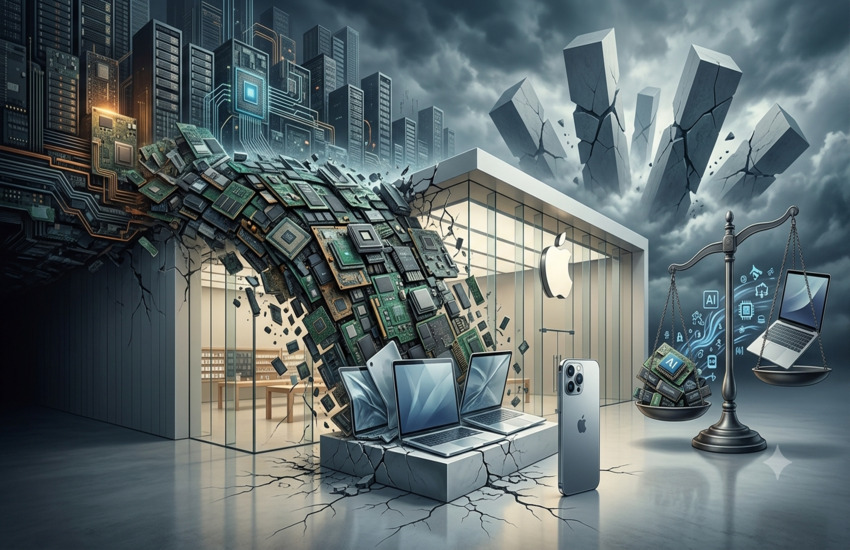
The reason Apple raised prices on Mac and iPad is not tariffs. It is not supply chain disruption. It is the global memory chip shortage caused by AI data center construction. Every hyperscaler building AI infrastructure is competing with Apple for the same DRAM and NAND flash storage. The data centers buy in multi-year, trillion-dollar contracts. Apple buys for laptops and tablets.
The data centers are winning. The MacBook Air is now $1,299.
The $3 Trillion Collapse Nobody Called
This is not just an Apple problem. The Magnificent Seven are coming apart.
In June 2026 alone, the Mag 7 fell by a combined $2.99 trillion in market capitalization. Think about that number for a second. Three trillion dollars of market value. Gone in four weeks.
Microsoft is down 21.6% in the month of June alone and is on pace for its worst month since 2000. The reason: AI capex guidance reportedly rising to $190 billion, turning what was a high-margin software compounder into something that looks increasingly like a capital-intensive infrastructure company. Investors who thought they owned a software business are starting to wonder if they accidentally bought a data center.
Apple’s problem is the mirror image. Microsoft is spending too much on AI infrastructure. Apple is being forced to pay for the consequences of that infrastructure spending. Two different companies. Two different problems. One root cause.
The market has started voting with its feet. On Thursday, the Dow hit an intraday all-time high of 52,655 while the Nasdaq fell. Caterpillar was up 6%. Johnson and Johnson was up. Healthcare, industrials, materials, utilities. Everything that makes money in the real world right now, today, was rising. Everything priced on an AI future was falling.
The Number Tim Cook Did Not Say Out Loud
In the April earnings call, Tim Cook was asked directly about pricing options as memory costs rise. He said Apple would “look at a range of options.”
He looked. The answer was price increases on Mac and iPad.
But iPhone prices did not move.
Analysts at Counterpoint Research estimate the higher memory and storage costs could add roughly $200 per iPhone for Apple. Apple sells approximately 240 million iPhones per year. Do that math. That is between $36 billion and $48 billion in additional annual memory costs that Apple either absorbs into its margins or eventually passes to consumers.
The MacBook Neo launched at $599 specifically to bring Mac to people who could not previously afford it. In the April earnings call, Tim Cook lit up talking about Kansas City Public Schools switching students from Chromebooks to MacBook Neo. That machine now costs $699 because AI data centers Apple will never own needed the same memory chips.
What Nobody Is Writing About For 2027
Every analysis of Thursday’s news focuses on what already happened. Mac up $200. iPad up $150. Stock down 6%.
But the more important question is what happens in 12 months.
If iPhone gets a price increase of $150 to $200, which the component math strongly suggests is coming, the most important consumer device in the world gets meaningfully more expensive. 1.5 billion Apple users face a choice: pay more or upgrade less often. Gene Munster called the selloff an overreaction, arguing Apple’s ecosystem lock-in supports strong pricing power. He might be right. But $150 to $200 added to an iPhone is a different test than $200 added to a laptop most people buy every four years.
The Federal Reserve under Kevin Warsh has signaled at least one rate hike by late 2026. Consumer balance sheets are under pressure. Tariffs are already compressing discretionary spending. And into that environment, Apple is about to find out whether its pricing power survives a world where AI ate all the memory chips.
This is not a story about Apple’s price list.
It is a story about what happens when the AI buildout collides head-on with the consumer economy. We are at the very beginning of that collision.
A New CEO Walks Into The Fire
Tim Cook steps down as Apple CEO on September 1, 2026. John Ternus takes over.
Ternus inherits a company with $147 billion in cash, a fresh $100 billion buyback authorization, and a memory cost crisis that management’s own words say will “drive an increasing impact” beyond this quarter. He also inherits the market’s mounting suspicion that the companies funding the AI buildout cannot sustain that spending without breaking their own business models.
Tim Cook’s final act as CEO included raising prices on the entry-level Mac he launched specifically to bring computing to more people. That is not the legacy anyone planned. And it is not a problem Ternus can solve by cutting costs. The shortage is structural. The demand from data centers is not going away. The only variable is how much of the cost Apple passes to the people who carry iPhones in their pockets.
Where The LENS Index Stands
The LENS Index entered a position in AI memory in early June on the thesis that supply cannot keep up with demand for the foreseeable future. The same shortage that raised your MacBook price by $200 on Thursday is the structural constraint that thesis was built around. The data is now visible in every Apple Store price tag worldwide.
| Metric | Value | Notes | Last Updated |
|---|---|---|---|
| Active Positions | 11 / 30 | No stop losses hit — all positions held | 27-Aug-26 |
| Cash Deployed | 48% | 52% reserve maintained | 27-Aug-26 |
| Cash Reserve | 52% | Minimum 15% policy maintained | 27-Aug-26 |
| Performance Since Launch | +5.25% | S&P: +4.05% | Alpha: +1.20% | 27-Aug-26 |
| Alpha Generated | +1.20% | Third consecutive session of expansion | 27-Aug-26 |
| LENS All-Time High | 106.64 (13-Aug-26) | Current 105.25 — 1.39 below ATH, narrowest gap in two weeks | 27-Aug-26 |
| Portfolio Beta | 0.69 | vs S&P 500 | 60 observations | 27-Aug-26 |
| Max Drawdown | -3.7% | Jun18 peak → Jul16 trough 101.47. Current level remains above trough. | 27-Aug-26 |
| Sharpe Ratio | 1.28 | Annualized, rf=3.5% | 27-Aug-26 |
| Stop Loss Check | Zero positions hit | All positions retain 24%+ buffer to their hard stops | 27-Aug-26 |
| Inception | May 22, 2026 | LENS Index launched | Fixed |
| Benchmark | S&P 500 Total Return | Outperform on risk-adjusted basis | Fixed |
| Strategy | Narrative Disruption | Long-only, large-cap, max 30 positions | Fixed |
| Direction | Long Only | Subscribe to access all positions | Fixed |
The AI boom reached every consumer in America on Thursday. It arrived quietly, in the form of a higher price on the laptop you were planning to buy next quarter.
The question nobody is answering is what the price tag looks like when it reaches the iPhone.
Disclaimer: We do not hold any positions in the above stock(s). Read our full disclaimer here.