


Continue Reading With Our 7-Day Free Trial
Apple reports fiscal third-quarter results Thursday, July 30, after the closing bell, in what will be Tim Cook’s final quarterly earnings call as chief executive before John Ternus takes over on September 1. The official conference call begins at 5:00 p.m. Eastern Time. This Apple earnings preview therefore arrives at a pivotal moment for the company.
Published forecasts point to earnings of roughly $1.87 to $1.89 per share, although revenue estimates vary more widely, from approximately $103 billion to almost $109 billion. The obvious debate is whether strong iPhone demand and record Services momentum can extend Apple’s recent run of estimate beats.
That is only the first layer of the setup. Apple’s own prior guidance implied revenue closer to $107 billion–$110 billion, while management warned that rising memory costs would become increasingly painful after the June quarter.
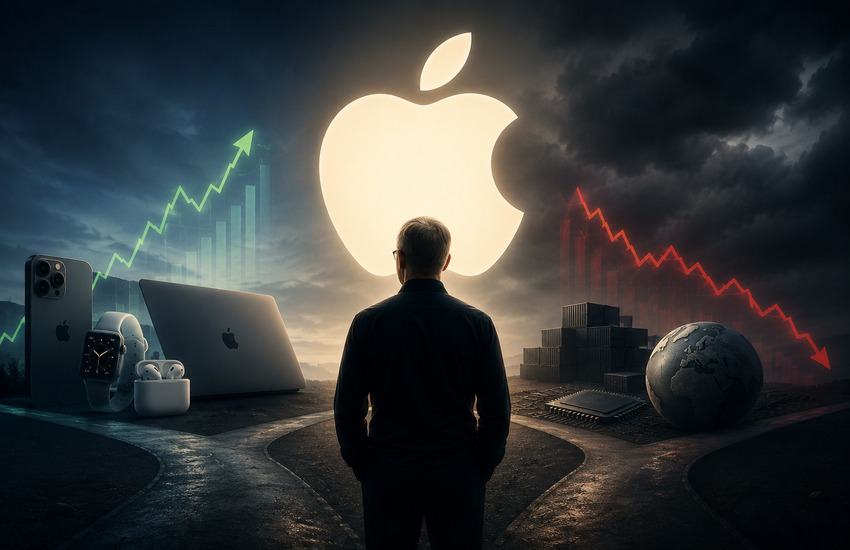
The real earnings test is not whether Apple beats this quarter—it is whether management can protect profitability over the next two quarters without weakening demand.
The Priced-In Scenario: Apple Earnings Preview
Apple enters the report with unusually strong operating momentum. Fiscal second-quarter revenue rose 17% to $111.2 billion, iPhone revenue increased 22% to $57 billion, and Services reached a record $31 billion. Diluted earnings climbed 22% to $2.01 per share, while the company generated a consolidated gross margin of 49.3%.
For the June quarter, management guided to revenue growth of 14%–17% and a gross margin of 47.5%–48.5%. Applied to last year’s fiscal third-quarter revenue of $94 billion, that outlook implies approximately $107 billion–$110 billion of revenue, explaining why the higher end of published consensus estimates appears more consistent with management’s own framework.
The narrative Wall Street appears to be modeling is straightforward. The iPhone 17 family sustains a powerful upgrade cycle, Services continues growing at a mid-teens rate, and supply constraints limit some Mac sales without signaling any deterioration in demand. Apple then enters the September product cycle with a large installed base, improving AI capabilities and a relatively smooth leadership handover.
That narrative also assumes Apple can continue separating itself from the hyperscalers. Microsoft, Alphabet, Amazon and Meta are spending heavily on data centers and AI infrastructure, while Apple has emphasized proprietary silicon, on-device processing, private cloud capacity and selective model partnerships. The market has rewarded that capital efficiency because it protects free cash flow and leaves room for substantial share repurchases.
Yet the stock’s valuation suggests this is no longer a low-expectation setup. Based on the TIKR data supplied for this analysis, Apple trades at approximately 41 times trailing earnings, 30.7 times trailing EBITDA and 10.9 times trailing revenue.
At those multiples, strong growth is not the surprise scenario—it is the minimum requirement.
The Metric That Actually Matters
For this Apple earnings preview, the most important number will be Apple’s outlook for gross margin, particularly for the September and December quarters. Revenue and EPS may determine the initial headline, but margin commentary will determine whether investors continue paying a premium for Apple’s capital-efficient operating model.
Gross margin sits at the intersection of nearly every major debate surrounding the company. Stronger Services mix supports profitability because Services generated a 76.7% gross margin last quarter. Higher-end iPhone demand can also lift product mix, while pricing gives Apple another tool for offsetting component inflation.
The pressure is coming from the other direction. Tim Cook said memory costs had already increased in the March quarter, would rise significantly in the June quarter and were expected to have an even greater impact after that. Apple had some protection from lower-cost inventory purchased earlier, but that buffer naturally becomes less effective as older inventory moves through the income statement.
That makes forward margin guidance more informative than the reported June-quarter result. Apple could deliver a healthy fiscal Q3 gross margin because of Services mix, foreign exchange, pricing and inventory timing, yet still warn that the September quarter will face materially higher component costs. Investors would then have to decide whether recent price increases can offset those pressures without slowing unit demand.
The mechanism matters because Apple’s valuation is supported not only by revenue growth, but by the belief that the company can convert that growth into unusually durable earnings and free cash flow. If margins remain stable while iPhone and Services revenue expand, estimates for future earnings rise and the premium multiple becomes easier to defend. If margins weaken, investors may reduce both earnings forecasts and the valuation multiple applied to those earnings.
Apple’s increasing research-and-development spending adds another layer. Management has said AI investments are being made incrementally on top of the normal product roadmap, and operating expenses rose sharply in the prior quarter.
The decisive question is whether Apple can spend more on AI, absorb higher memory costs and still preserve the economics investors associate with the platform.
What An Upside Surprise Would Look Like
The cleanest upside scenario begins with revenue near or above the top of Apple’s implied guidance range. That would likely require another strong iPhone quarter, continued double-digit Services growth and better availability across constrained Mac models.
The more important ingredient would be reassuring forward commentary. Investors would want management to indicate that memory inflation is manageable through procurement, product mix, operating efficiency and selective pricing rather than through a broad sacrifice in margins. A September-quarter gross-margin outlook that remains within Apple’s recent high-40% range would suggest the company has more cost flexibility than the market feared.
Services could reinforce that interpretation. The installed base has surpassed 2.5 billion active devices, and both paid and transacting accounts reached records in the prior quarter. Advertising expansion, payments, cloud services, subscriptions and enterprise offerings give Apple several monetization levers that do not depend entirely on shipping more hardware.
A constructive AI update would help, but investors may not need a dramatic revenue contribution immediately. In this Apple earnings preview, the more important issue is whether management can show that AI is strengthening the ecosystem without undermining Apple’s financial model. Apple unveiled a more capable generation of Apple Intelligence and Siri in June, placing greater emphasis on personal context, application integration and private processing.
What matters for the earnings reaction is whether management can make the strategy appear commercially relevant without signaling a sudden infrastructure spending surge. Evidence that Apple Intelligence is supporting upgrades, increasing engagement or strengthening ecosystem retention would allow investors to view AI as an extension of the existing model rather than an expensive reinvention.
The leadership transition could then reinforce the message. Ternus has already said that he and CFO Kevan Parekh intend to preserve the financial discipline associated with Cook’s tenure. A confident handover, supported by strong guidance, would reduce uncertainty surrounding Apple’s strategic direction.
The bullish psychological shift would be from “Apple is behind in AI” to “Apple is monetizing AI without inheriting hyperscaler economics.”
Where The Downside Case Forms
The downside scenario does not require an outright earnings miss. Apple could exceed quarterly revenue and EPS estimates yet disappoint investors if the outlook suggests that recent growth has come at the expense of future profitability.
The clearest warning would be a material step down in gross-margin guidance. If higher memory prices, tariffs, product-launch costs or an unfavorable hardware mix overwhelm Services growth, the market may conclude that Apple’s recent earnings trajectory is less durable than the revenue numbers imply.
Pricing is another risk. Apple’s ability to charge premium prices is one of the foundations of its economic moat, but higher prices can create a timing problem. They may protect revenue and margin per device while simultaneously encouraging customers to delay upgrades, choose lower-priced models or keep existing devices longer.
The current valuation leaves little room for that type of trade-off. At 41 times trailing earnings, the market is not merely valuing Apple as a mature hardware company with strong cash flows. It is assigning meaningful value to sustained double-digit growth, expanding Services economics, AI-driven upgrades and continuity under Ternus.
China could add further uncertainty. As this Apple earnings preview highlights, the region remains strategically important for demand, manufacturing and AI distribution. Apple reported strong Greater China performance in the first half of fiscal 2026, but the region remains strategically important for demand, manufacturing and AI distribution. Apple’s June product disclosures said its newest Siri and Apple Intelligence features would not initially be available in China while the company worked through regulatory requirements.
A delay would not necessarily derail the current quarter, but it could weaken the next product cycle by limiting one of the primary selling points for newer devices in a major market. It would also complicate the claim that Apple’s AI strategy can drive a synchronized global upgrade cycle.
Finally, investors could react negatively if management suggests that Apple must materially accelerate infrastructure or acquisition spending. The company has already stopped treating net cash neutrality as a formal capital-structure target, creating more flexibility but also raising questions about future uses of cash.
The downside mechanism is especially powerful because weaker margins would reduce earnings estimates just as strategic uncertainty pressures the multiple.
What Matters After The Print
The first post-earnings move may revolve around whether revenue, EPS and gross margin beat consensus. The more lasting move will depend on what the report reveals about Apple’s positioning for the September launch cycle and the first two quarters under Ternus.
The first signal to monitor is the relationship between pricing and demand. Investors need evidence that Apple’s pricing actions are offsetting higher costs without weakening upgrade rates. Management commentary about geographic demand, channel inventory and customer response will therefore matter more than a single quarter’s iPhone revenue.
The second signal is Services growth quality. Strong revenue growth supported by paid-account expansion, advertising, cloud services and payments would be more durable than growth driven primarily by favorable foreign exchange or one-time licensing effects. Services also needs to remain the stabilizing force behind consolidated gross margin.
The third signal is the AI spending model. The forward-looking focus of this Apple earnings preview is whether Apple’s capital intensity begins changing under its new leadership. Apple is already accelerating research and development, but the market will watch whether capital expenditures also begin rising more aggressively. The distinction is critical: higher R&D can support proprietary models, silicon and software integration, while a hyperscaler-like infrastructure program would alter depreciation, free cash flow and capital-return expectations.
The fourth signal is geographic execution. India remains a substantial installed-base opportunity because Apple still has relatively modest market share, while Greater China remains both commercially important and exposed to regulation and intense competition. Comments on new customers, retail traffic and local AI availability will shape expectations for fiscal 2027.
The final signal is Ternus himself. Investors are not expecting an immediate strategic break, and Cook will remain involved as executive chairman. Still, the next two earnings calls should reveal where Ternus places incremental investment, how he balances engineering ambition with financial discipline and whether Apple’s product roadmap becomes more aggressive.
The next six to twelve months will show whether the transition represents continuity of execution or the beginning of a more capital-intensive Apple.
The Bottom Line
Apple’s fiscal third-quarter numbers matter, but they are unlikely to settle the larger debate. Strong iPhone demand, mid-teens Services growth and another EPS beat would confirm that the current business remains healthy. They would not, by themselves, prove that Apple’s present economics can survive rising component costs and a more demanding phase of AI competition.
The most useful interpretation will come from management’s forward gross-margin framework. Stable profitability would suggest Apple can use pricing, mix, Services and supply-chain leverage to absorb higher costs while maintaining its comparatively light AI infrastructure model. Deteriorating guidance would raise questions about whether the company must choose between protecting demand, preserving margins and accelerating investment.
That distinction is especially important with Apple trading at approximately 41 times trailing earnings, 30.7 times EBITDA and almost 11 times revenue. Those multiples reflect confidence in durable growth, exceptional cash conversion and a controlled leadership transition.
There is therefore no single earnings threshold that defines success. The result must be read through the interaction of growth, margins, AI spending and management’s tone about the next product cycle.
After the headline numbers pass, the metric to keep watching is whether Apple’s gross-margin durability survives the handover from Cook to Ternus.
Disclaimer: We do not hold any positions in the above stock(s). Read our full disclaimer here.