
Continue Reading With Our 7-Day Free Trial
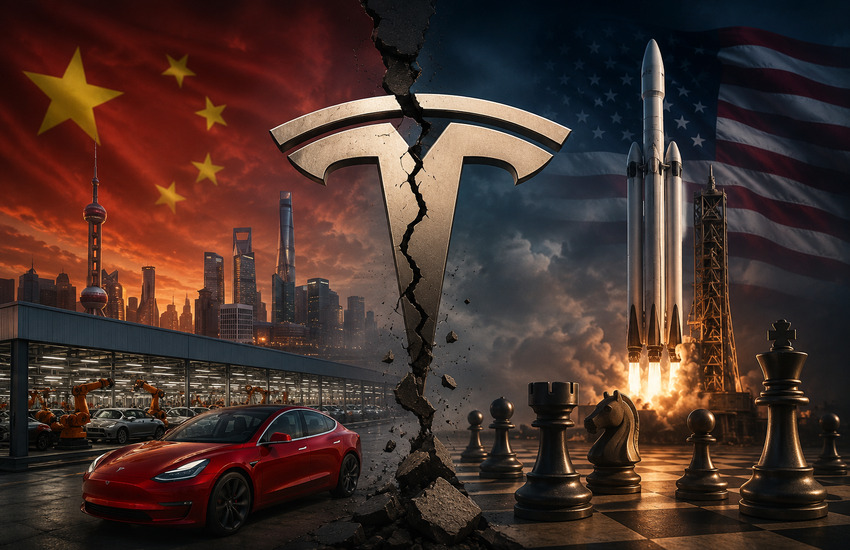
Tesla (NASDAQ:TSLA) may face one of the biggest strategic decisions in its history. The Tesla China business sale is now one of the possible paths under discussion. According to recent reporting, executives have been asked to prepare for a possible separation of Tesla’s China business. Options could include a sale, spin-off, closure, or a more independent operating structure.
The reported goal is not simply to reduce exposure to China. A separation could also clear a major regulatory obstacle to a potential merger with SpaceX. That matters because SpaceX handles classified projects, military launches, and sensitive U.S. government contracts.
Still, Tesla’s China operation is not an ordinary overseas subsidiary. Its Shanghai factories helped turn Tesla into a profitable mass-market automaker. China also represented roughly 18% of company sales during the first half of 2026.
So, the real question is not whether Tesla can separate China. It is whether the company can do so without weakening its manufacturing scale, supply chain, and automotive margins.
SpaceX’s Defense Role Creates A China Problem
Tesla and SpaceX already work together across several major projects. Their ties include Starlink connectivity, Grok, Digital Optimus, energy storage, and the planned Terafab initiative.
During Tesla’s latest earnings call, Elon Musk said there was growing overlap between the companies. Tesla’s general counsel also confirmed an investment and framework agreement with SpaceX. Still, management stopped short of discussing a formal merger.
The regulatory challenge is clear. SpaceX is a major U.S. defense contractor with access to classified activities and export-controlled technology. A combined company would also control Tesla’s factories, technology, and customer data in China.
A Tesla China business sale could therefore become a structural condition for addressing those concerns.
Beijing could view that structure as a national-security risk. Washington could raise similar concerns about Chinese access to sensitive systems. Separating Tesla China could create the firewall needed to address both sides.
Shanghai Remains Central To Tesla’s Manufacturing Engine
Tesla operates major vehicle and battery facilities in Shanghai. Those assets serve Chinese customers and export vehicles to several international markets.
The operation has also played a major role in Tesla’s cost structure. Local suppliers, large production volumes, and efficient factory operations helped improve profitability during Tesla’s mass-market expansion.
A sale or spin-off could reduce Tesla’s direct control over that system. Even a partial separation may create new costs. Tesla could need independent software, office systems, data controls, management teams, and export arrangements.
The deeper the firewall, the harder it may become to preserve current operating efficiencies.
That risk matters because Tesla’s automotive gross margin, excluding regulatory credits, fell to 16.3% in the second quarter. Management said the underlying margin was roughly stable after adjusting for prior benefits. Even so, Tesla has limited room for added manufacturing friction.
Tesla Is Building A More Domestic Supply Chain
Tesla has spent years preparing for possible supply disruptions between the United States and China. Its earlier efforts included moving some Chinese suppliers to Mexico. The company also plans to remove China-based suppliers from its U.S. factories by 2027.
The latest earnings call supports that broader direction. Management highlighted new semiconductor capacity from Samsung in Texas and TSMC in Arizona. Tesla is also investing in domestic batteries, solar manufacturing, robotics, and chip development.
These investments could make Tesla less dependent on China over time. However, the transition will not be simple.
A Tesla China business sale would test whether those domestic investments are advanced enough to replace lost supply chain flexibility.
Management said production growth remains limited by batteries and electronic components. Musk also described the Optimus supply chain as unusually difficult to build.
Tesla is trying to localize supply while scaling several new businesses at once. A China separation could support that strategy, but it could also place more pressure on an already ambitious industrial buildout.
A Merger Could Strengthen Tesla’s AI Story
The case for combining Tesla and SpaceX now extends beyond shared leadership. The two companies increasingly rely on each other’s technology and infrastructure.
Starlink is being added to Cybercab and could expand across Tesla’s vehicle fleet. Reliable satellite coverage could help robotaxis operate in areas with poor cellular service.
SpaceX is also involved with Digital Optimus. Musk said Grok can act as a manager that assigns tasks to Tesla’s computer-use system. SpaceX has purchased Tesla Megapacks to manage power swings at its data centers.
These links could support a broader platform built around mobility, robotics, AI, energy, and communications.
A Tesla China business sale could simplify that platform’s ownership structure before regulators review a deeper combination.
However, many of these benefits are already available through commercial agreements. A merger may improve coordination, but it would also introduce regulatory, governance, and valuation challenges.
That makes the China decision critical. Tesla may need to prove that SpaceX cannot influence Chinese operations or access sensitive local data.
Final Thoughts
A separation of Tesla’s China business could make a SpaceX transaction easier to review. It may also reduce long-term geopolitical exposure. Yet, the move could weaken a manufacturing network that remains important to Tesla’s scale and profitability.
The timing adds another layer of risk. Tesla expects more than $25 billion of capital spending in 2026. CapEx should keep rising for the next two or three years. Free cash flow was negative in the latest quarter, while the company is arranging facilities that could provide up to $30 billion in borrowing capacity.
A Tesla China business sale would therefore need to be judged against both its regulatory benefits and its possible effect on cash generation.
Tesla’s valuation already assumes substantial future growth. As of July 30, 2026, the stock traded at 11.51x LTM enterprise value to revenue, 110.93x LTM EV/EBITDA, and 286.07x LTM diluted earnings. Its LTM price-to-sales multiple was 11.77x.
Those are demanding multiples for an automaker facing major restructuring and capital needs. They may be more understandable if Tesla becomes a broader AI and robotics platform. For now, investors must weigh that potential against the real economic value of Tesla’s China operations.
Disclaimer: We do not hold any positions in the above stock(s). Read our full disclaimer here.