


Continue Reading With Our 7-Day Free Trial
Moderna (NASDAQ:MRNA) just landed a regulatory moment that people will argue about far beyond Wall Street. An FDA advisory committee voted that the benefits of its seasonal flu vaccine, mRNA-1010, outweigh the risks for adults aged 50 to 64 and adults 65 and older. That sounds like a clean win. But this is vaccines we are talking about, so the story is not that simple.
The FDA still has the final call. The advisory vote is important, but it is not binding. Moderna’s own earnings call showed that the U.S. review was already moving toward an August 5, 2026 PDUFA date, while the same flu vaccine was also under review in Europe, Canada, and Australia.
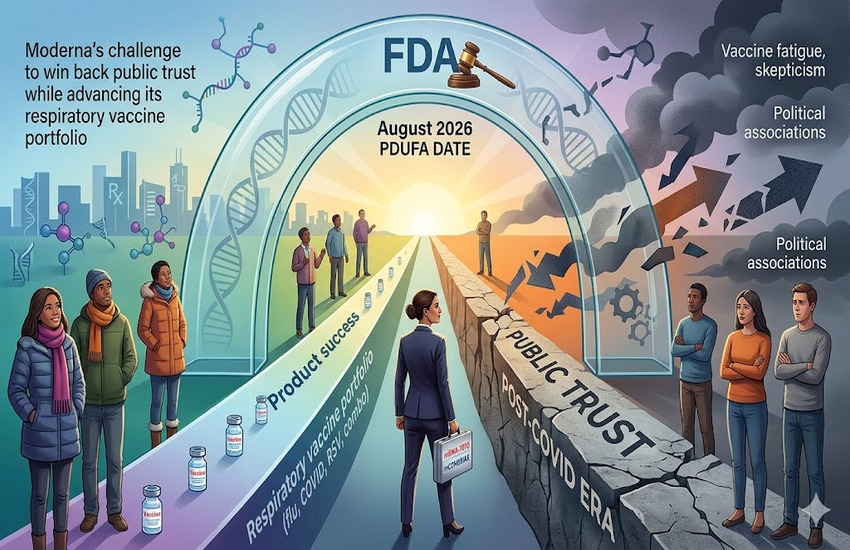
So the real question is bigger than approval. Can Moderna win back public trust in the post-COVID era?
FDA Support Is Strong, But Public Trust Is Harder
The unanimous FDA advisory vote gives Moderna a valuable headline. It tells investors, doctors, and the public that independent advisers saw a favorable benefit-risk profile for mRNA-1010 in older adults. That matters because flu is not a niche illness. It touches families every winter. It also hits older adults harder than younger people. So a new flu shot aimed at adults 50 and above has a clear public health use case.
But regulatory support is only the first hurdle. The FDA still needs to make the final approval decision. That makes the August 5, 2026 deadline the next major checkpoint. Moderna had already told investors that the flu review was progressing through the normal FDA process. Management also said the review was being handled through the usual vaccine office channels, with normal back-and-forth before the PDUFA date.
The harder part may be outside the FDA building. Many Americans still connect mRNA vaccines with COVID, politics, mandates, and fatigue. That creates a strange setup. Moderna may win the scientific argument before it wins the dinner-table argument.
That is why this vaccine could become a public trust test. A flu shot is familiar. mRNA still feels new to many people. If approved, Moderna will need to explain the shot in plain English. It will also need doctors, pharmacies, and payers to feel comfortable recommending it. A regulatory win can open the door. Public confidence decides how wide that door opens.
Moderna Is Rebuilding Its Post-COVID Identity
This flu vaccine is not just another product filing. It sits at the center of Moderna’s attempt to move beyond its COVID identity. The company became famous because of its COVID vaccine. That created huge revenue during the pandemic. It also created a problem. Many people now see the company through one product cycle.
The earnings call made the broader plan clear. Moderna is trying to build a respiratory vaccine portfolio. That includes COVID vaccines, RSV vaccine mRESVIA, flu vaccine mRNA-1010, and flu-plus-COVID combination vaccine mCOMBRIAX. The company said mCOMBRIAX was approved in the European Union for adults 50 and older. It also described it as the first flu-plus-COVID combination vaccine approved in the world.
That combo vaccine matters for the story. People are tired of extra shots. Health systems also dislike complexity. One shot that covers two seasonal risks could be easier to explain, easier to stock, and easier to schedule. That does not mean adoption is automatic. It means the product idea is simple enough for normal people to understand.
Moderna is also expanding beyond respiratory vaccines. Its pipeline includes oncology, rare disease, norovirus, and pandemic flu programs. But the flu shot is easier for the public to grasp. Most Americans know what flu season feels like. That gives Moderna a chance to show that mRNA can be useful in everyday medicine, not just emergency medicine.
Approval Would Not Mean Instant Revenue
Here is the part investors should not skip. Even if the FDA approves mRNA-1010, Moderna is not treating it as an immediate revenue driver for 2026. Management said its 2026 revenue guidance assumes no revenue from the flu vaccine or mCOMBRIAX. That is an important detail. It keeps the story grounded.
The company still expects revenue growth of up to 10% in 2026. That growth is expected to come from long-term strategic partnerships, including the United Kingdom, Canada, and Australia, plus continued growth from mNEXSPIKE. In Q1 2026, revenue reached $400 million, with about 80% coming from international markets. The company also guided for Q2 revenue of $50 million to $100 million.
This makes the flu shot more of a strategic catalyst than a near-term sales fix. Approval would help Moderna’s credibility. It would also add another product to the portfolio. But commercial success would still depend on recommendations, payer coverage, pricing, supply, physician comfort, and patient demand.
There is another piece here. Moderna’s combination vaccine strategy may need time. In Europe, management said mCOMBRIAX and mNEXSPIKE could contribute to growth starting in 2027. The company is working through market access, pricing, and reimbursement. These processes can take time.
So, yes, the flu vote matters. But approval is not the same thing as a blockbuster launch.
The Financial Stakes Are Bigger Than One Shot
Moderna still has a strong balance sheet, but it is not operating like the pandemic boom years. The company ended Q1 2026 with $7.5 billion in cash and investments. That gives it room to fund research, launches, and restructuring. But the quarter also showed pressure. GAAP net loss was $1.3 billion, mainly due to the Arbutus and Genevant litigation settlement. Excluding that settlement, net loss was about $0.5 billion.
Cost control is now a major part of the story. Moderna said adjusted cash costs fell 26% year over year in Q1, excluding the litigation settlement. It is targeting about $4.2 billion in adjusted cash costs for 2026. The company also expects to end 2026 with $4.5 billion to $5 billion in cash and investments.
That creates a clear tension. Moderna has cash. It also has losses, litigation costs, and heavy R&D needs. The company is still funding late-stage programs in cancer, norovirus, rare disease, and respiratory vaccines. That is a lot of science to carry.
This is why mRNA-1010 matters beyond flu season. It could become Moderna’s fifth approved product. Management said that possibility was one of the company’s 2026 value drivers.
The flu vaccine will not solve every issue. But it could help answer a major question. Can Moderna turn its platform into a steady product engine after COVID?
Final Thoughts
Moderna’s flu vaccine story is easy to overhype and easy to dismiss. The middle view is more useful. The FDA advisory vote is clearly positive. It supports the benefit-risk case for mRNA-1010 in older adults. It also gives the company a cleaner path toward the August 2026 FDA decision. Still, the public response remains uncertain. Vaccine fatigue is real. Trust takes longer to rebuild than a regulatory file.
From a valuation standpoint, the stock already reflects a much bigger reset. As of June 18, 2026, Moderna traded at 8.64x LTM EV/Revenue and 11.41x LTM Price/Sales. Those are much higher than the March 2025 levels of 0.68x and 3.39x, respectively. At the same time, LTM EBITDA, EBIT, gross profit, and P/E multiples remain negative. That reflects the current loss profile.
So the valuation is not mainly about today’s earnings. It is more about future approvals, respiratory vaccine adoption, pipeline readouts, and cost discipline. That makes the stock sensitive to execution. The flu shot may be an important step, but the market is already asking Moderna to prove that this is more than a post-COVID bounce.
Disclaimer: We do not hold any positions in the above stock(s). Read our full disclaimer here.