

Continue Reading With Our 7-Day Free Trial
SpaceX (NASDAQ:SPCX) has just put a staggering number behind its Starship ambitions. The company plans to invest at least $100 billion in Starbase Louisiana, a vast new launch complex in Vermilion Parish. SpaceX Starbase Louisiana is expected to support thousands of launches each year. Elon Musk has outlined an even bigger end-state: more than a dozen launch towers and over 30 Starship flights per day.
That vision sounds almost industrial rather than aerospace. Yet there is one important catch. Starship has not yet demonstrated the rapid upper-stage recovery and reuse needed to support those economics. Flight 14 is the next important test, with SpaceX moving toward operational orbital missions and next-generation Starlink deployment. But Musk has now pushed the first Starship upper-stage tower-catch attempt out by a few months.
That creates the real investment debate. Louisiana is being designed for where Starship could eventually go, while Starship is still proving how it gets there.
Flight 14 & The First Operational Starship Mission
Flight 14 is the nearest major catalyst, but investors should be clear about what it represents. This is primarily an orbital and payload-deployment milestone, not the long-awaited Ship tower-catch test.
During SpaceX’s August earnings call, Musk said Flight 14 would carry Version 3 Starlink satellites toward operational orbit. Management described the mission as an important step toward moving Starship beyond development and into revenue-producing work. Starlink V3 matters because those satellites are expected to provide roughly ten times the capacity of the prior broadband generation.
The timing remains fluid. Earlier in August, SpaceX was targeting another Starship flight during the month. Musk later said the Ship tower catch would “probably” happen in a few months instead.
That distinction matters. Reaching operational orbit would prove that Starship can begin doing economically useful work. It could accelerate deployment of larger Starlink spacecraft and support other future missions. For SpaceX Starbase Louisiana, that progress would mark an important step toward the operating model envisioned for the new complex.
But an orbital flight does not prove rapid reuse. Flight 14 therefore advances the technical roadmap without completing the economic one. The next stages are recovery, inspection, refueling, and eventually flying the same upper stage again.
The Missing Upper-Stage Reusability Layer
SpaceX has already shown that the Super Heavy booster can return to the launch site and be caught by its tower. That achievement solved one major part of Starship’s reuse architecture. The upper-stage Ship remains the more important missing piece for the Louisiana economics.
The challenge is different. Starship returns from space at far higher energy and must survive extreme heating during reentry. It then has to reach the tower with enough precision to be captured. After that, SpaceX still needs to prove that the vehicle can be inspected and turned around quickly.
There has been progress. Musk said after Flight 13 that the heat shield performed well and that management viewed the thermal-protection problem as largely solved. SpaceX also said it sees no fundamental technical obstacle to full and rapid reuse.
Still, a successful catch is only one step toward aircraft-like operations. The bigger proof point will be reflight. That milestone would also be central to the economics envisioned for SpaceX Starbase Louisiana.
SpaceX has invested heavily to reach this stage. SEC filings show Starship and related launch infrastructure spending has exceeded $8 billion since 2023. Without full reuse, Starship may still launch large payloads. However, the cost advantage becomes less compelling. That makes the eventual first Ship catch and reflight central to the long-term investment case.
The $100 Billion SpaceX Starbase Louisiana Capacity Bet
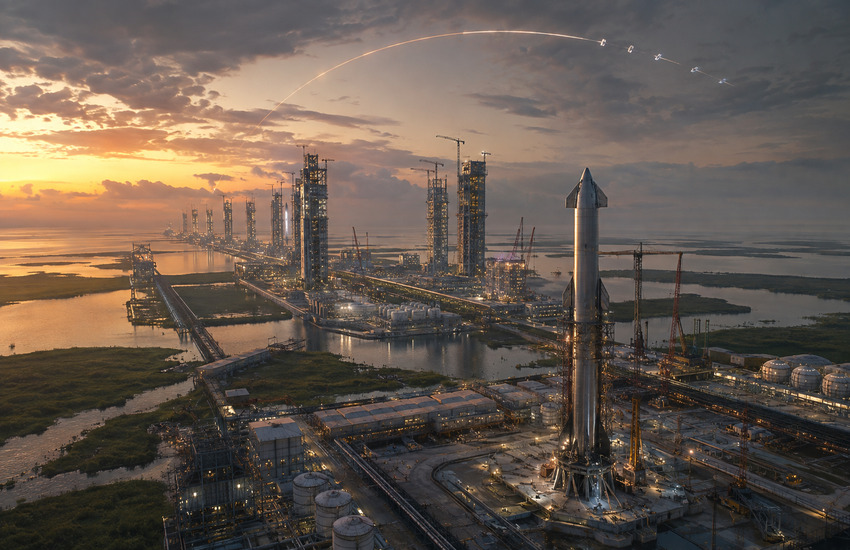
This is where the scale becomes difficult to ignore. Starbase Louisiana is planned across roughly 125,000 acres on Pecan Island, making it far larger than a conventional launch facility. SpaceX intends to build launch pads alongside vehicle processing, power generation, propellant production, deep-water shipping, and other supporting infrastructure.
The formal commitment is already enormous. Louisiana says SpaceX will invest at least $100 billion and create 3,000 direct jobs over ten years. Another 8,100 indirect jobs are estimated. Local reporting has also cited a possible eventual employment footprint approaching 10,000 permanent positions.
The launch ambitions are even larger. Musk has said the completed site could eventually support more than 30 Starship flights per day. That implies over 10,000 launches annually at full cadence.
Construction is expected to begin by late 2027. SpaceX has targeted its first Louisiana launch for 2029, while state officials point toward initial operations in 2030.
That creates the central contradiction. SpaceX is building infrastructure for industrial-scale reuse before industrial-scale reuse has been demonstrated. SpaceX Starbase Louisiana is effectively constructing capacity today for an operating model that still needs several technical milestones.
Starlink & The Orbital-AI Endgame
Why would SpaceX ever need more than 30 Starship flights each day? The answer starts with Starlink, then expands into AI infrastructure and much larger space-based systems.
Management expects Starlink V3 satellites to deliver roughly ten times the broadband capacity of the current generation. SpaceX also expects to launch far more of them. Musk has argued that this combination could create a dramatic increase in total network bandwidth and support continued subscriber growth.
Starship is the machine designed to make that scale possible. Management says the rocket should eventually carry far more payload than Falcon while reducing launch costs substantially. The company is already building infrastructure to support thousands of annual missions.
Then there is AI. SpaceX has discussed launching orbital computing satellites, while SpaceX Starbase Louisiana is intended to support broader satellite and AI ambitions. Reuters reported that the company’s plans include potential support for a constellation of up to one million AI satellites.
This is why launch cadence matters so much. Starbase Louisiana is not being built around today’s satellite market. It is being built around a future where SpaceX moves vastly more mass into orbit.
That future requires Starship to behave less like a conventional rocket and more like reusable transportation infrastructure.
Final Thoughts
SpaceX’s Louisiana announcement makes the long-term vision easier to see. It also makes the remaining execution gap harder to ignore.
Flight 14 could demonstrate that Starship is ready to begin regular orbital work. A later tower catch would test another critical part of the reuse architecture. The more important milestone may ultimately be the first successful reflight of a recovered Ship. That would provide clearer evidence that rapid reuse can move from engineering goal to operating model.
Investors are already paying a substantial premium for that future. SpaceX currently trades at approximately 78.64x LTM enterprise value to revenue, 81.25x LTM price-to-sales, and 151.59x LTM enterprise value to gross profit. Its 307.29x LTM EV/EBITDA multiple is also unusually high, while LTM EV/EBIT remains negative at (526.92x).
Those multiples leave significant expectations embedded in the share price. The Louisiana buildout, Starlink growth, AI expansion, and Starship reuse could support much larger earnings over time. At the same time, today’s valuation gives investors limited room to ignore execution risk. SpaceX Starbase Louisiana therefore sits at the center of both the company’s infrastructure ambition and the valuation debate.
The $100 billion Starbase therefore captures both sides of the story: extraordinary potential capacity and a technology platform that still has important economics left to prove.
Disclaimer: We do not hold any positions in the above stock(s). Read our full disclaimer here.