

On May 21st, somebody walked onto the options market and put $3.3 million on Tesla hitting $480 by June 12th. Not sometime this summer. June 12th specifically, the exact day SpaceX was scheduled to list on Nasdaq.
That same morning, Fortune published a piece arguing the complete opposite. That the SpaceX IPO would drain money out of Tesla, split Elon Musk’s retail fanbase, and leave TSLA holders watching their stock fall apart while everyone else chased a rocket company priced at $1.77 trillion.
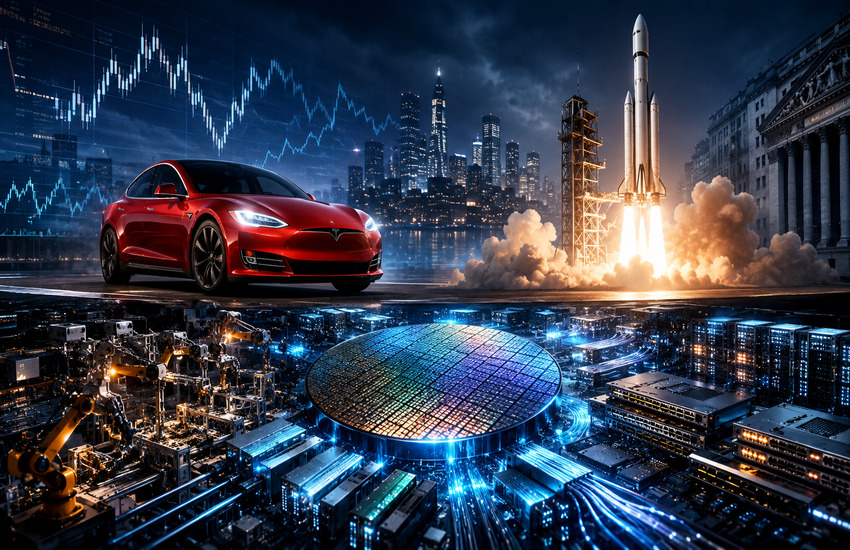
Two people, same morning, completely opposite bets. That is the Tesla trade right now in one image.
Before we get into which side is right, there is one fact buried in the SpaceX S-1 that almost nobody has talked about. You know the 400-page document that approximately eleven people actually read. Buried in it is this: Tesla owns 18,990,195 shares of SpaceX Class A stock. At $135 per share, that stake is worth $2.56 billion.
How did Tesla end up owning part of SpaceX? In January 2026, Tesla put $2 billion into xAI, Musk’s AI company that owns X. In February, xAI got folded into SpaceX. Tesla’s xAI stake automatically converted into SpaceX shares. So Tesla investors who spent the past week selling TSLA to buy SPCX were selling a company that already owns $2.56 billion worth of SpaceX. Wrap your head around that one.
Was The Tesla Selloff Even About Spacex?
BNP Paribas analyst James Picariello published a formal note saying the SpaceX IPO would split Musk’s retail base. Retail investors own roughly 40% of Tesla. SpaceX gave 30% of its IPO to retail. The fear was obvious: Tesla holders would sell to fund their SpaceX allocation.
Barron’s actually did the math though. SpaceX raised $75 billion total. The retail slice works out to about $22 billion. That is roughly 2% of Tesla’s entire market cap. Not nothing, but nowhere near the catastrophic drain the narrative suggested. And the Nasdaq itself fell 6% that same week. Tesla has a beta above 1.5. A 6% market drop should produce around a 9-10% drop in Tesla on its own, no SpaceX required.
Tesla closed Thursday at $399.15, up 4.6%, the exact day the SpaceX order book closed. So either the selling pressure is done or Tesla just had a terrible week for reasons mostly unrelated to rockets. Either way the overhang looks finished.
Now For The Question About Spacex Nobody Wants To Ask Out Loud.
$1.77 trillion. That is what you are paying at $135 per share. Oppenheimer launched coverage this week with a Buy rating and a $190 price target, which implies a $2.6 trillion valuation, about a trillion dollars more than Tesla is worth right now.
Starlink is genuinely excellent. $11.4 billion in 2025 revenue, 63% EBITDA margins, over 10 million subscribers and growing fast. That is a real business.
But when xAI merged into SpaceX, it brought its financials along. xAI lost $6.36 billion in operating losses in 2025. That number is inside the $1.77 trillion now. You are buying that too. The rocket division is essentially a government contractor. Starship is still in development. Mars is still theoretical.
At Starlink’s EBITDA level, even at a very generous 100x multiple you get to around $720 billion in value. The remaining trillion-plus is priced on rockets, a money-losing AI division, and the assumption that humans will eventually live on Mars. That is not an investment thesis. That is a belief system with a ticker symbol.
Meanwhile Tesla Is Actually Building Things & Nobody Noticed.
Everyone spent two weeks watching SpaceX and missed Tesla’s Q1 earnings. Auto margins improved from 17.9% to 19.2%. Highest order backlog in over two years. FSD paid subscribers hit 1.3 million with churn actually declining. Robotaxi is running in Austin, Dallas and Houston with zero incidents, not one. Optimus production starts later this year.
Yes, Tesla is guiding negative free cash flow for the rest of 2026. They are spending $25 billion on six new factories, a chip research facility, and a semiconductor fab they are literally building with SpaceX. That last part did not make any headlines. Tesla and SpaceX are co-developing a chip manufacturing plant. The companies are more intertwined than the market realizes.
Tesla is down 15% this year. It peaked near $499 in December. It is sitting below both its 50-day and 200-day moving averages at $399. The Musk-fanbase crowd that sold it to buy SpaceX may find themselves buying it back at a higher price in a few months.
Did Tesla Or SpaceX Make It To Our LENS Index?
We run something called the LENS Index, which stands for Large-Cap Equity Narrative Strategy. The whole idea is simple: find big companies where the market narrative is provably wrong, build a position before the correction, and wait. Since we launched on May 22nd, the LENS Index is up 4.7%. The S&P 500 over the same period is up 2.4%. We are running about 2.3 percentage points of alpha with a portfolio beta of 0.41, which means we are taking on less than half the market’s risk to generate double its return.
The LENS filter is one question: is the dominant market narrative provably wrong?
Continue Reading With Our 7-Day Free Trial
Tesla does not have a narrative gap. Everyone knows the story. It is transitioning from EVs to physical AI. Everyone knows about Robotaxi, Optimus, FSD, and the painful capex cycle. The market is not wrong about Tesla’s story. It just disagrees on whether the story ends well. That is a valuation dispute, not a narrative gap. LENS does not trade valuation disputes.
SpaceX has no narrative gap for the opposite reason. The market knows exactly what it is and has bid it to $1.77 trillion. Five times oversubscribed. You cannot exploit a narrative that everyone has already priced. There is nothing provably wrong about the SpaceX consensus view. The consensus view is that it is worth everything. That may even be right. But it is not a LENS trade.
SpaceX also does not make the Watch List. A Watch List entry requires a specific entry trigger that makes sense, like a pullback to a level where the narrative gap becomes exploitable. With a 4% float and MSCI inclusion starting tomorrow forcing index funds to buy, a meaningful pullback in the near term is unlikely. If SPCX drops 25-30% six months from now and the Starlink business is still compounding, we will revisit.
Tesla is also not on the Watch List yet. The thesis break condition that would need to hold first is a clear inflection in Robotaxi unit economics, something the Q1 call suggested is coming but has not arrived in the numbers yet.
What Is In LENS That Benefits From All Of This:
Elon Musk said something specific on the Tesla Q1 earnings call that did not make a single headline. He said memory bandwidth is the choke point for the AI models running inside Tesla’s cars and data centers. He disclosed that the hardware upgrade coming to Tesla’s AI4 chip doubles memory per processor from 16GB to 32GB. And then he said the Terafab, the semiconductor plant that Tesla and SpaceX are building together, will produce memory and logic under one roof.
One LENS position entered on June 5th is up 15.3% and sits directly in that supply chain. The thesis break condition has not moved. The Tesla earnings call made the thesis stronger.
A second position from June 5th is up 17.7% and builds the custom networking silicon that every large-scale AI cluster, including the ones Tesla and SpaceX are racing to complete, runs on.
The Watch List has one name that is the clearest single beneficiary of the combined Tesla-SpaceX AI infrastructure buildout. It has been there since launch day. The Terafab disclosure on the Tesla call was the most direct confirmation of its thesis we have seen. Entry trigger is a 10% pullback. It has not triggered yet.
The SpaceX IPO is everywhere today. The companies supplying it are already in the portfolio.
Disclaimer: We do not hold any positions in the above stock(s). Read our full disclaimer here.